

280
responses. The units also were modulated by ventilation and in large fi sh (>25 cm
sl), breathing movements rarely displaced the quiescent toadfi sh more than ±2 mm
and in many cases, there was no discernable body movement demonstrating the
high sensitivity of these fi bers to small displacements (Boyle et al. 2001 ). Therefore,
the ability to integrate of environmental stimuli must also take into account the input
from breathing movements.
The underwater speaker precluded testing frequencies less than 80 Hz, however
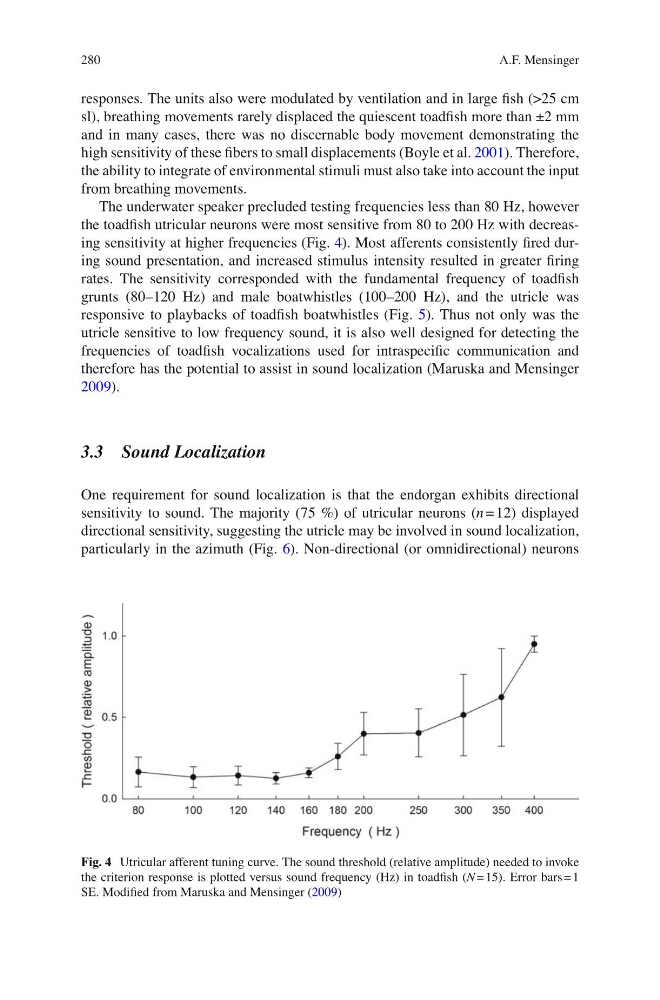
the toadfi sh utricular neurons were most sensitive from 80 to 200 Hz with decreasing sensitivity at higher frequencies (Fig. 4 ). Most afferents consistently fi red during sound presentation, and increased stimulus intensity resulted in greater fi ring
rates. The sensitivity corresponded with the fundamental frequency of toadfi sh
grunts (80–120 Hz) and male boatwhistles (100–200 Hz), and the utricle was
responsive to playbacks of toadfi sh boatwhistles (Fig. 5 ). Thus not only was the
utricle sensitive to low frequency sound, it is also well designed for detecting the
frequencies of toadfi sh vocalizations used for intraspecifi c communication and
therefore has the potential to assist in sound localization (Maruska and Mensinger
2009 ).
3.3 Sound Localization
One requirement for sound localization is that the endorgan exhibits directional
sensitivity to sound. The majority (75 %) of utricular neurons ( n = 12) displayed
directional sensitivity, suggesting the utricle may be involved in sound localization,
particularly in the azimuth (Fig. 6 ). Non-directional (or omnidirectional) neurons
Fig. 4 Utricular afferent tuning curve. The sound threshold (relative amplitude) needed to invoke
the criterion response is plotted versus sound frequency (Hz) in toadfi sh ( N = 15). Error bars = 1
SE. Modifi ed from Maruska and Mensinger ( 2009 )
A.F. Mensinger
responses. The units also were modulated by ventilation and in large fi sh (>25 cm
sl), breathing movements rarely displaced the quiescent toadfi sh more than ±2 mm
and in many cases, there was no discernable body movement demonstrating the
high sensitivity of these fi bers to small displacements (Boyle et al. 2001 ). Therefore,
the ability to integrate of environmental stimuli must also take into account the input
from breathing movements.
The underwater speaker precluded testing frequencies less than 80 Hz, however
the toadfi sh utricular neurons were most sensitive from 80 to 200 Hz with decreasing sensitivity at higher frequencies (Fig. 4 ). Most afferents consistently fi red during sound presentation, and increased stimulus intensity resulted in greater fi ring
rates. The sensitivity corresponded with the fundamental frequency of toadfi sh
grunts (80–120 Hz) and male boatwhistles (100–200 Hz), and the utricle was
responsive to playbacks of toadfi sh boatwhistles (Fig. 5 ). Thus not only was the
utricle sensitive to low frequency sound, it is also well designed for detecting the
frequencies of toadfi sh vocalizations used for intraspecifi c communication and
therefore has the potential to assist in sound localization (Maruska and Mensinger
2009 ).
3.3 Sound Localization
One requirement for sound localization is that the endorgan exhibits directional
sensitivity to sound. The majority (75 %) of utricular neurons ( n = 12) displayed
directional sensitivity, suggesting the utricle may be involved in sound localization,
particularly in the azimuth (Fig. 6 ). Non-directional (or omnidirectional) neurons
Fig. 4 Utricular afferent tuning curve. The sound threshold (relative amplitude) needed to invoke
the criterion response is plotted versus sound frequency (Hz) in toadfi sh ( N = 15). Error bars = 1
SE. Modifi ed from Maruska and Mensinger ( 2009 )
A.F. Mensinger