

279
Utricular neurons were quite sensitive to horizontal but not vertical movements
of the toadfi sh. Sustained body movements of several seconds during either natural
or evoked swimming led to continuous, elevated, and often maximal discharge rates
in utricular afferents. Small (1–3 cm) lateral movements also evoked robust
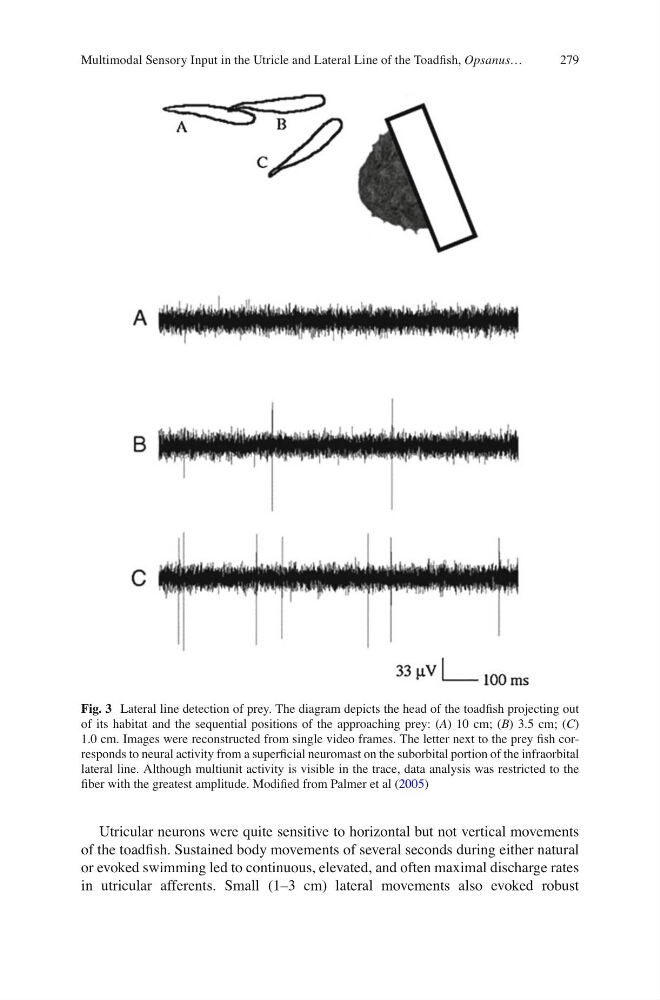
Fig. 3 Lateral line detection of prey. The diagram depicts the head of the toadfi sh projecting out
of its habitat and the sequential positions of the approaching prey: ( A ) 10 cm; ( B ) 3.5 cm; ( C )
1.0 cm. Images were reconstructed from single video frames. The letter next to the prey fi sh corresponds to neural activity from a superfi cial neuromast on the suborbital portion of the infraorbital
lateral line. Although multiunit activity is visible in the trace, data analysis was restricted to the
fi ber with the greatest amplitude. Modifi ed from Palmer et al ( 2005 )
Multimodal Sensory Input in the Utricle and Lateral Line of the Toadfi sh, Opsanus…
Utricular neurons were quite sensitive to horizontal but not vertical movements
of the toadfi sh. Sustained body movements of several seconds during either natural
or evoked swimming led to continuous, elevated, and often maximal discharge rates
in utricular afferents. Small (1–3 cm) lateral movements also evoked robust
Fig. 3 Lateral line detection of prey. The diagram depicts the head of the toadfi sh projecting out
of its habitat and the sequential positions of the approaching prey: ( A ) 10 cm; ( B ) 3.5 cm; ( C )
1.0 cm. Images were reconstructed from single video frames. The letter next to the prey fi sh corresponds to neural activity from a superfi cial neuromast on the suborbital portion of the infraorbital
lateral line. Although multiunit activity is visible in the trace, data analysis was restricted to the
fi ber with the greatest amplitude. Modifi ed from Palmer et al ( 2005 )
Multimodal Sensory Input in the Utricle and Lateral Line of the Toadfi sh, Opsanus…