

258
majority of fi sh species live in shallow and/or highly structured habitats (Lévêque
et al. 2008 ) that disrupt sound propagation in highly unpredictable ways (Lugli and
Fine 2007 ; Wilson et al. 2013 ). In the case of complex sound sources such as a coral
reef, sound propagates much further than would be predicted from simple spreading
models and it is likely that much of this propagation would be in the form of pressure
waves (Fig. 3 ). Radford et al. ( 2011 ) described propagation of ambient reef sound
from a temperate reef and observed a zone around the reef where sound loses little
energy, what they termed the “reef effect” (Fig. 3c ). Beyond the range of the reef
effect (when the receiver is approximately 90° to the reef) sound propagation can be
described by cylindrical spreading with some bottom attenuation. The reef effect
essentially extends the range at which reef sound can propagate away from the reef.
Even when examining the propagation of single species calls, propagation dynamics
do not follow theoretical predictions (Fig. 3a, b ). Courtship calls of oyster toadfi sh
( Opsanus tau ) propagate less than 5 m from the source (Fig. 3b ), with transmission
loss much higher than predicted due to interaction with the substrate on which they
are calling, although low frequency pure tones can propagate further than predicted
due to boundary interactions (Fine and Lehnardt 1983 ). Damselfi sh (Pomacentridae)
that enter the water column to signal (Fig. 3a ) likely cannot detect their own calls
over approximately 10 m away due to rapid propagation loss (Mann and Lobel 1997 )
and freshwater goby ( Padogobius spp.) calls attenuate up to 30 dB 30 cm from the
source (Lugli and Fine 2003 ) due to the shallow nature of their habitat. While simple
spreading models would predict greater sound propagation of many of these low
frequency calls, it is clear that—in the structured world in which many vocalizing
fi sh live—habitat structure and depth put additional constraints on the effective
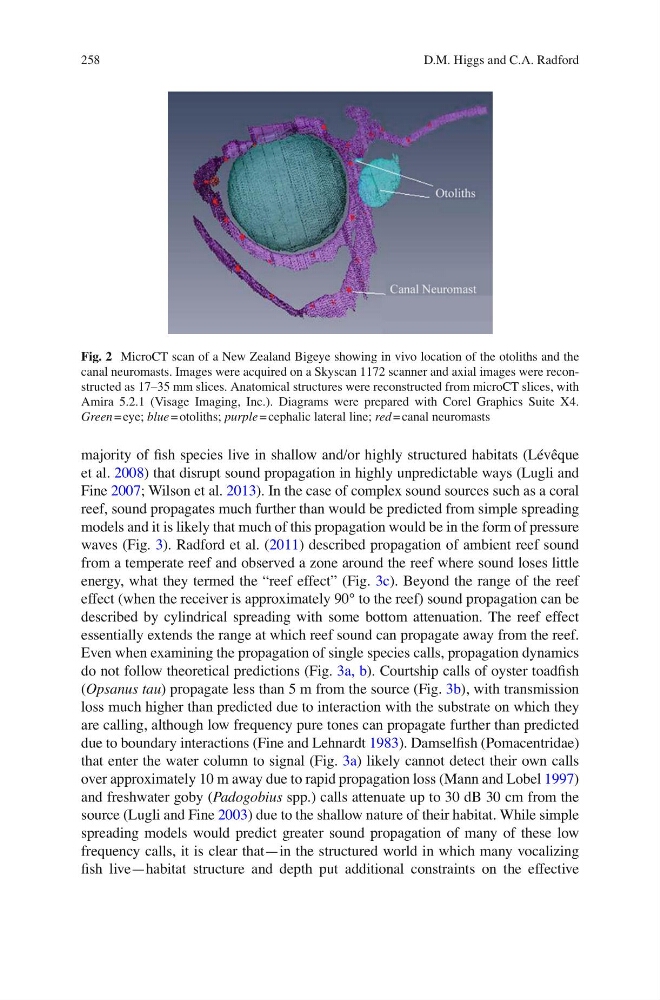
Fig. 2 MicroCT scan of a New Zealand Bigeye showing in vivo location of the otoliths and the
canal neuromasts. Images were acquired on a Skyscan 1172 scanner and axial images were reconstructed as 17–35 mm slices. Anatomical structures were reconstructed from microCT slices, with
Amira 5.2.1 (Visage Imaging, Inc.). Diagrams were prepared with Corel Graphics Suite X4.
Green = eye; blue = otoliths; purple = cephalic lateral line; red = canal neuromasts
D.M. Higgs and C.A. Radford
majority of fi sh species live in shallow and/or highly structured habitats (Lévêque
et al. 2008 ) that disrupt sound propagation in highly unpredictable ways (Lugli and
Fine 2007 ; Wilson et al. 2013 ). In the case of complex sound sources such as a coral
reef, sound propagates much further than would be predicted from simple spreading
models and it is likely that much of this propagation would be in the form of pressure
waves (Fig. 3 ). Radford et al. ( 2011 ) described propagation of ambient reef sound
from a temperate reef and observed a zone around the reef where sound loses little
energy, what they termed the “reef effect” (Fig. 3c ). Beyond the range of the reef
effect (when the receiver is approximately 90° to the reef) sound propagation can be
described by cylindrical spreading with some bottom attenuation. The reef effect
essentially extends the range at which reef sound can propagate away from the reef.
Even when examining the propagation of single species calls, propagation dynamics
do not follow theoretical predictions (Fig. 3a, b ). Courtship calls of oyster toadfi sh
( Opsanus tau ) propagate less than 5 m from the source (Fig. 3b ), with transmission
loss much higher than predicted due to interaction with the substrate on which they
are calling, although low frequency pure tones can propagate further than predicted
due to boundary interactions (Fine and Lehnardt 1983 ). Damselfi sh (Pomacentridae)
that enter the water column to signal (Fig. 3a ) likely cannot detect their own calls
over approximately 10 m away due to rapid propagation loss (Mann and Lobel 1997 )
and freshwater goby ( Padogobius spp.) calls attenuate up to 30 dB 30 cm from the
source (Lugli and Fine 2003 ) due to the shallow nature of their habitat. While simple
spreading models would predict greater sound propagation of many of these low
frequency calls, it is clear that—in the structured world in which many vocalizing
fi sh live—habitat structure and depth put additional constraints on the effective
Fig. 2 MicroCT scan of a New Zealand Bigeye showing in vivo location of the otoliths and the
canal neuromasts. Images were acquired on a Skyscan 1172 scanner and axial images were reconstructed as 17–35 mm slices. Anatomical structures were reconstructed from microCT slices, with
Amira 5.2.1 (Visage Imaging, Inc.). Diagrams were prepared with Corel Graphics Suite X4.
Green = eye; blue = otoliths; purple = cephalic lateral line; red = canal neuromasts
D.M. Higgs and C.A. Radford