

259
distance of these calls and would put the effective range well within the detection
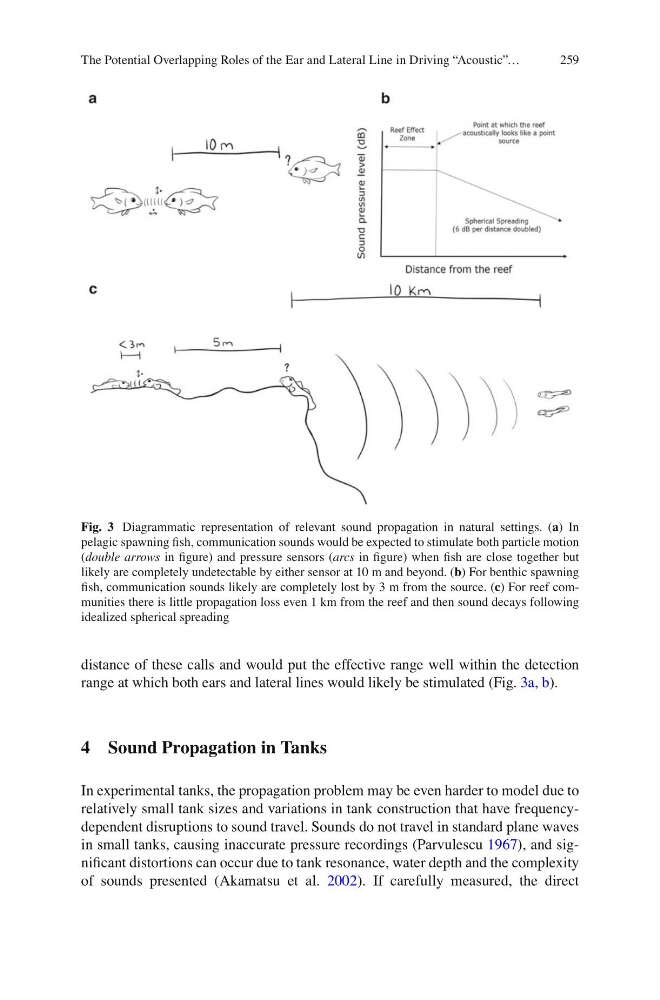
range at which both ears and lateral lines would likely be stimulated (Fig. 3a, b ).
4 Sound Propagation in Tanks
In experimental tanks, the propagation problem may be even harder to model due to
relatively small tank sizes and variations in tank construction that have frequencydependent disruptions to sound travel. Sounds do not travel in standard plane waves
in small tanks, causing inaccurate pressure recordings (Parvulescu 1967 ), and signifi cant distortions can occur due to tank resonance, water depth and the complexity
of sounds presented (Akamatsu et al. 2002 ). If carefully measured, the direct
Fig. 3 Diagrammatic representation of relevant sound propagation in natural settings. ( a ) In
pelagic spawning fi sh, communication sounds would be expected to stimulate both particle motion
( double arrows in fi gure) and pressure sensors ( arcs in fi gure) when fi sh are close together but
likely are completely undetectable by either sensor at 10 m and beyond. ( b ) For benthic spawning
fi sh, communication sounds likely are completely lost by 3 m from the source. ( c ) For reef communities there is little propagation loss even 1 km from the reef and then sound decays following
idealized spherical spreading
The Potential Overlapping Roles of the Ear and Lateral Line in Driving “Acoustic”…
distance of these calls and would put the effective range well within the detection
range at which both ears and lateral lines would likely be stimulated (Fig. 3a, b ).
4 Sound Propagation in Tanks
In experimental tanks, the propagation problem may be even harder to model due to
relatively small tank sizes and variations in tank construction that have frequencydependent disruptions to sound travel. Sounds do not travel in standard plane waves
in small tanks, causing inaccurate pressure recordings (Parvulescu 1967 ), and signifi cant distortions can occur due to tank resonance, water depth and the complexity
of sounds presented (Akamatsu et al. 2002 ). If carefully measured, the direct
Fig. 3 Diagrammatic representation of relevant sound propagation in natural settings. ( a ) In
pelagic spawning fi sh, communication sounds would be expected to stimulate both particle motion
( double arrows in fi gure) and pressure sensors ( arcs in fi gure) when fi sh are close together but
likely are completely undetectable by either sensor at 10 m and beyond. ( b ) For benthic spawning
fi sh, communication sounds likely are completely lost by 3 m from the source. ( c ) For reef communities there is little propagation loss even 1 km from the reef and then sound decays following
idealized spherical spreading
The Potential Overlapping Roles of the Ear and Lateral Line in Driving “Acoustic”…