

257
Cox 1988 ; Montgomery et al. 2006 ), through the differential movement of the
denser otolith with the body motions of the fi sh. Sound pressure can be detected by
fi sh from pressure-induced oscillations of the walls of an air pocket, such as the
swim bladder, that then are transduced into mechanical stimuli appropriate to sensors (Higgs et al. 2006), such as the hair cells of the inner ear (Montgomery et al.
2006 ) or possibly the hair cells of the neuromasts that overlie laterophysic or otolaterophysic connections (Webb 1998 ; Webb and Smith 2000 ; Radford et al. 2013 ).
The inner ear often lies just medial to the confl uence of several cephalic lateral line
canals (Fig. 2 ), so mechanical transduction to inner ear hair cells is also likely to be
passed on to at least those neuromasts in the cephalic lateral line.
3 Underwater Sound Propagation
The behaviour of sound underwater is well characterized for ideal situations so will
not be extensively reviewed here (see Rogers and Cox 1988 ; Montgomery et al.
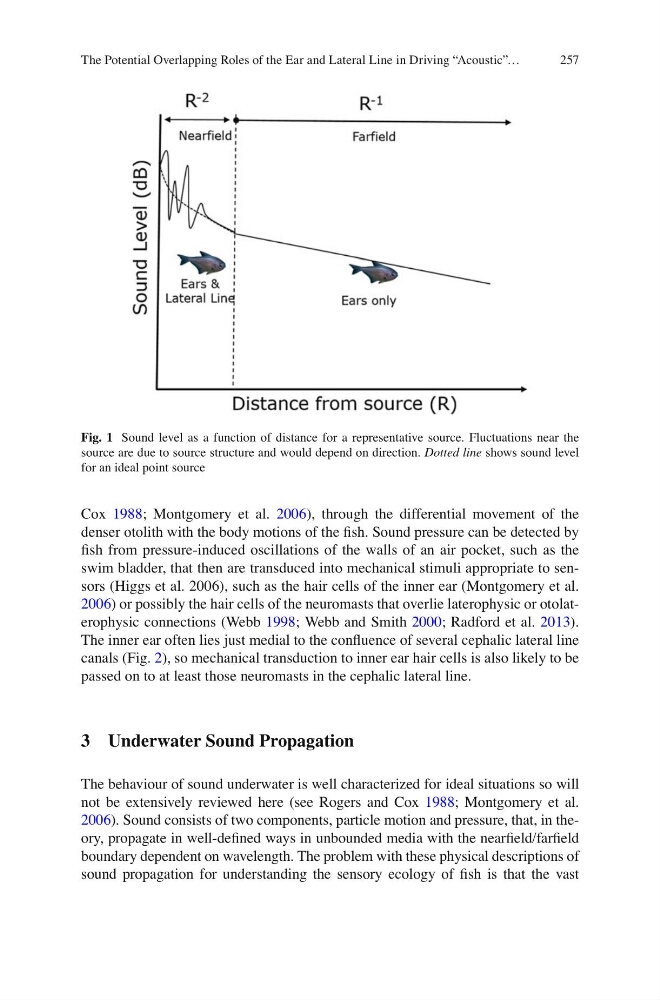
2006 ). Sound consists of two components, particle motion and pressure, that, in theory, propagate in well-defi ned ways in unbounded media with the nearfi eld/farfi eld
boundary dependent on wavelength. The problem with these physical descriptions of
sound propagation for understanding the sensory ecology of fi sh is that the vast
Fig. 1 Sound level as a function of distance for a representative source. Fluctuations near the
source are due to source structure and would depend on direction. Dotted line shows sound level
for an ideal point source
The Potential Overlapping Roles of the Ear and Lateral Line in Driving “Acoustic”…
Cox 1988 ; Montgomery et al. 2006 ), through the differential movement of the
denser otolith with the body motions of the fi sh. Sound pressure can be detected by
fi sh from pressure-induced oscillations of the walls of an air pocket, such as the
swim bladder, that then are transduced into mechanical stimuli appropriate to sensors (Higgs et al. 2006), such as the hair cells of the inner ear (Montgomery et al.
2006 ) or possibly the hair cells of the neuromasts that overlie laterophysic or otolaterophysic connections (Webb 1998 ; Webb and Smith 2000 ; Radford et al. 2013 ).
The inner ear often lies just medial to the confl uence of several cephalic lateral line
canals (Fig. 2 ), so mechanical transduction to inner ear hair cells is also likely to be
passed on to at least those neuromasts in the cephalic lateral line.
3 Underwater Sound Propagation
The behaviour of sound underwater is well characterized for ideal situations so will
not be extensively reviewed here (see Rogers and Cox 1988 ; Montgomery et al.
2006 ). Sound consists of two components, particle motion and pressure, that, in theory, propagate in well-defi ned ways in unbounded media with the nearfi eld/farfi eld
boundary dependent on wavelength. The problem with these physical descriptions of
sound propagation for understanding the sensory ecology of fi sh is that the vast
Fig. 1 Sound level as a function of distance for a representative source. Fluctuations near the
source are due to source structure and would depend on direction. Dotted line shows sound level
for an ideal point source
The Potential Overlapping Roles of the Ear and Lateral Line in Driving “Acoustic”…