

170
thresholds obtained from electrophysiological measures, such as microphonic
potentials or AEPs, suggesting that it greatly underestimates the hearing ability of
fi shes. Finally, although startle responses can occur with other reticulospinal neural
networks, an M-cell pathway is necessary for the “fast-startle” responses currently
described. Therefore, the ASR can only be reliably tested in fi sh species that exhibit
the characteristic fast “C-start” startle response mediated by the M-cell pathway.
3.1.2 Prepulse Inhibition
One variant of the ASR paradigm is the use of refl ex suppression in order to determine auditory sensitivity. Refl ex suppression has been used to determine sensitivity
of sensory systems since the early twentieth century when Yerkes ( 1903 ) used it to
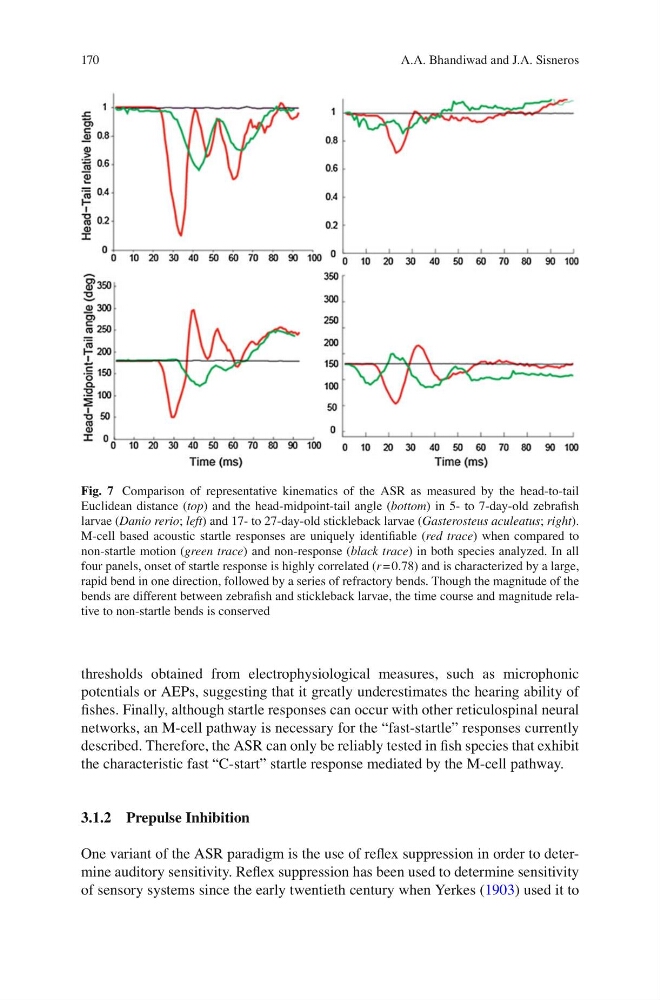
Fig. 7 Comparison of representative kinematics of the ASR as measured by the head-to-tail
Euclidean distance ( top ) and the head-midpoint-tail angle ( bottom ) in 5- to 7-day-old zebrafi sh
larvae ( Danio rerio ; left ) and 17- to 27-day-old stickleback larvae ( Gasterosteus aculeatus ; right ).
M-cell based acoustic startle responses are uniquely identifi able ( red trace ) when compared to
non-startle motion ( green trace ) and non-response ( black trace ) in both species analyzed. In all
four panels, onset of startle response is highly correlated ( r = 0.78) and is characterized by a large,
rapid bend in one direction, followed by a series of refractory bends. Though the magnitude of the
bends are different between zebrafi sh and stickleback larvae, the time course and magnitude relative to non-startle bends is conserved
A.A. Bhandiwad and J.A. Sisneros
thresholds obtained from electrophysiological measures, such as microphonic
potentials or AEPs, suggesting that it greatly underestimates the hearing ability of
fi shes. Finally, although startle responses can occur with other reticulospinal neural
networks, an M-cell pathway is necessary for the “fast-startle” responses currently
described. Therefore, the ASR can only be reliably tested in fi sh species that exhibit
the characteristic fast “C-start” startle response mediated by the M-cell pathway.
3.1.2 Prepulse Inhibition
One variant of the ASR paradigm is the use of refl ex suppression in order to determine auditory sensitivity. Refl ex suppression has been used to determine sensitivity
of sensory systems since the early twentieth century when Yerkes ( 1903 ) used it to
Fig. 7 Comparison of representative kinematics of the ASR as measured by the head-to-tail
Euclidean distance ( top ) and the head-midpoint-tail angle ( bottom ) in 5- to 7-day-old zebrafi sh
larvae ( Danio rerio ; left ) and 17- to 27-day-old stickleback larvae ( Gasterosteus aculeatus ; right ).
M-cell based acoustic startle responses are uniquely identifi able ( red trace ) when compared to
non-startle motion ( green trace ) and non-response ( black trace ) in both species analyzed. In all
four panels, onset of startle response is highly correlated ( r = 0.78) and is characterized by a large,
rapid bend in one direction, followed by a series of refractory bends. Though the magnitude of the
bends are different between zebrafi sh and stickleback larvae, the time course and magnitude relative to non-startle bends is conserved
A.A. Bhandiwad and J.A. Sisneros