

169
ences were observed in the thresholds across 24–31 dph; therefore, the thresholds
were pooled for all sticklebacks tested. Zebrafi sh were tested at 5 dpf. At the onset
of the auditory startle response, sticklebacks had much higher startle thresholds (up
to 25 dB at 30 Hz) than larval zebrafi sh (Fig. 9 ). Furthermore, zebrafi sh exhibited
ASRs to acoustic frequencies as high as 320 Hz, whereas sticklebacks only showed
ASR to frequencies ≤180 Hz (Fig. 9 ).
Refl ex responses like the ASR also have certain limitations. The fi rst, and most
prominent, is the habituation of the refl ex response to repeated auditory stimuli.
Habituation is a non-associative learning process by which an organism decreases
the strength of its response after repeated presentations. Although the effects of
habituation can be reduced by increasing the inter-stimulus interval between stimulus presentations (Zeddies and Fay 2005 ), there is an upper limit of approximately
15 stimulus presentations before the response rate is degraded (Roberts et al. 2011 ;
Bhandiwad et al. 2013 ). Another potential problem with the ASR assay is that a
very intense acoustic stimulus is required to facilitate the startle response. The
threshold for the ASR is very high because it is often evoked by a predatory attack
and requires a large energetic output for the response. Thus, repeated presentations
of high intensity stimuli can often lead to habituation very quickly. Furthermore, the
sound levels necessary to evoke the ASR are signifi cantly higher than auditory
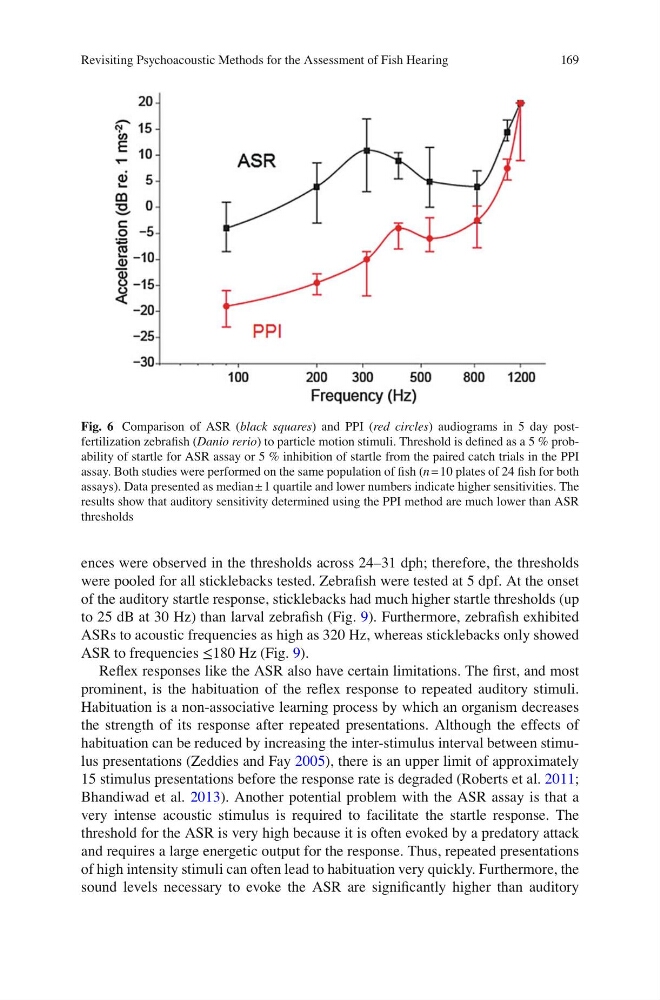
Fig. 6 Comparison of ASR ( black squares ) and PPI ( red circles ) audiograms in 5 day postfertilization zebrafi sh ( Danio rerio ) to particle motion stimuli. Threshold is defi ned as a 5 % probability of startle for ASR assay or 5 % inhibition of startle from the paired catch trials in the PPI
assay. Both studies were performed on the same population of fi sh ( n = 10 plates of 24 fi sh for both
assays). Data presented as median ± 1 quartile and lower numbers indicate higher sensitivities. The
results show that auditory sensitivity determined using the PPI method are much lower than ASR
thresholds
Revisiting Psychoacoustic Methods for the Assessment of Fish Hearing
ences were observed in the thresholds across 24–31 dph; therefore, the thresholds
were pooled for all sticklebacks tested. Zebrafi sh were tested at 5 dpf. At the onset
of the auditory startle response, sticklebacks had much higher startle thresholds (up
to 25 dB at 30 Hz) than larval zebrafi sh (Fig. 9 ). Furthermore, zebrafi sh exhibited
ASRs to acoustic frequencies as high as 320 Hz, whereas sticklebacks only showed
ASR to frequencies ≤180 Hz (Fig. 9 ).
Refl ex responses like the ASR also have certain limitations. The fi rst, and most
prominent, is the habituation of the refl ex response to repeated auditory stimuli.
Habituation is a non-associative learning process by which an organism decreases
the strength of its response after repeated presentations. Although the effects of
habituation can be reduced by increasing the inter-stimulus interval between stimulus presentations (Zeddies and Fay 2005 ), there is an upper limit of approximately
15 stimulus presentations before the response rate is degraded (Roberts et al. 2011 ;
Bhandiwad et al. 2013 ). Another potential problem with the ASR assay is that a
very intense acoustic stimulus is required to facilitate the startle response. The
threshold for the ASR is very high because it is often evoked by a predatory attack
and requires a large energetic output for the response. Thus, repeated presentations
of high intensity stimuli can often lead to habituation very quickly. Furthermore, the
sound levels necessary to evoke the ASR are signifi cantly higher than auditory
Fig. 6 Comparison of ASR ( black squares ) and PPI ( red circles ) audiograms in 5 day postfertilization zebrafi sh ( Danio rerio ) to particle motion stimuli. Threshold is defi ned as a 5 % probability of startle for ASR assay or 5 % inhibition of startle from the paired catch trials in the PPI
assay. Both studies were performed on the same population of fi sh ( n = 10 plates of 24 fi sh for both
assays). Data presented as median ± 1 quartile and lower numbers indicate higher sensitivities. The
results show that auditory sensitivity determined using the PPI method are much lower than ASR
thresholds
Revisiting Psychoacoustic Methods for the Assessment of Fish Hearing