

88
become the tool of choice when precise records of coastal movements of cetaceans
were required, a way to observe cetaceans from afar, eliminating reliance on seagoing vessels, which can be disruptive to animals or restrictive to research budgets”
(Samuels and Tyack 2000).
The total station and the theodolite are topographical equipments with monocular vision, normally with a magnification of 30×. The total station is a more complete device; its main advantage for animals tracking is the internal capacity of data
storage. Both equipment’s’ enable the positioning of a target indirectly. They provide two angles, the vertical, which is the angle between the theodolite eye-piece
and the target, and the horizontal, which is the angulation marking the azimuth, both
in degrees (°), minutes (‘) and seconds (“). Theodolite and total station do not have
an internal compass, it is necessary to mechanically input the right azimuth before
collecting data, so the horizontal angle must be set at some fixed and known landmark in relation to the theodolite location, every time it is set up (Fig. 4.5). The
theodolite/total station should always be on level (checked by levelling bubbles in
the equipment) in order to give the correct vertical angle. With these two angles
measured, plus the exact height of the station in relation to the sea level, considering
the tide variation and Earth curvature, applying basic trigonometric calculus, the
position of the target animal is obtained (Fig. 4.5). This conversion enables to faithfully reproduce the animals’ movement and/or distribution (Fig. 4.6) and to extract
desired movement parameters (e.g., speed, bearing, and turning angle) and measures of interest (e.g., distance among animals, distance between animal and vessel,
between animal and sound source or hydrophone).
Data collection should be accomplished by a team of minimum three people: the
principal theodolite observer, the binocular observer and the note taker. The binocular observer acts as a backup observer to assist the principal theodolite/total station
observer. As theodolite/total station has a greater magnificent power, with a narrow
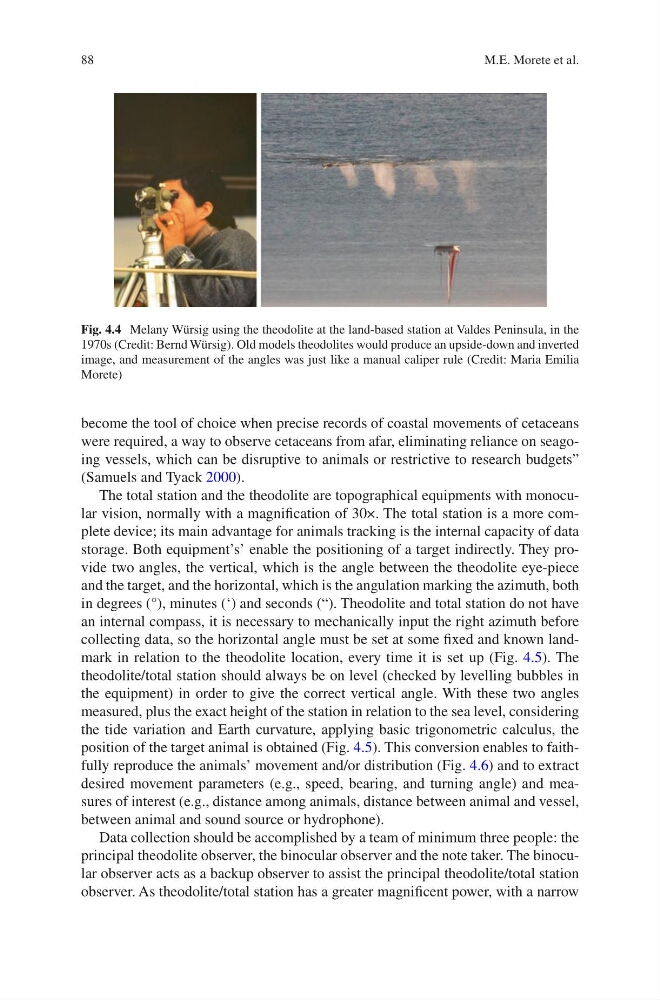
Fig. 4.4 Melany Würsig using the theodolite at the land-based station at Valdes Peninsula, in the
1970s (Credit: Bernd Würsig). Old models theodolites would produce an upside-down and inverted
image, and measurement of the angles was just like a manual caliper rule (Credit: Maria Emilia
Morete)
M.E. Morete et al.
become the tool of choice when precise records of coastal movements of cetaceans
were required, a way to observe cetaceans from afar, eliminating reliance on seagoing vessels, which can be disruptive to animals or restrictive to research budgets”
(Samuels and Tyack 2000).
The total station and the theodolite are topographical equipments with monocular vision, normally with a magnification of 30×. The total station is a more complete device; its main advantage for animals tracking is the internal capacity of data
storage. Both equipment’s’ enable the positioning of a target indirectly. They provide two angles, the vertical, which is the angle between the theodolite eye-piece
and the target, and the horizontal, which is the angulation marking the azimuth, both
in degrees (°), minutes (‘) and seconds (“). Theodolite and total station do not have
an internal compass, it is necessary to mechanically input the right azimuth before
collecting data, so the horizontal angle must be set at some fixed and known landmark in relation to the theodolite location, every time it is set up (Fig. 4.5). The
theodolite/total station should always be on level (checked by levelling bubbles in
the equipment) in order to give the correct vertical angle. With these two angles
measured, plus the exact height of the station in relation to the sea level, considering
the tide variation and Earth curvature, applying basic trigonometric calculus, the
position of the target animal is obtained (Fig. 4.5). This conversion enables to faithfully reproduce the animals’ movement and/or distribution (Fig. 4.6) and to extract
desired movement parameters (e.g., speed, bearing, and turning angle) and measures of interest (e.g., distance among animals, distance between animal and vessel,
between animal and sound source or hydrophone).
Data collection should be accomplished by a team of minimum three people: the
principal theodolite observer, the binocular observer and the note taker. The binocular observer acts as a backup observer to assist the principal theodolite/total station
observer. As theodolite/total station has a greater magnificent power, with a narrow
Fig. 4.4 Melany Würsig using the theodolite at the land-based station at Valdes Peninsula, in the
1970s (Credit: Bernd Würsig). Old models theodolites would produce an upside-down and inverted
image, and measurement of the angles was just like a manual caliper rule (Credit: Maria Emilia
Morete)
M.E. Morete et al.