

87
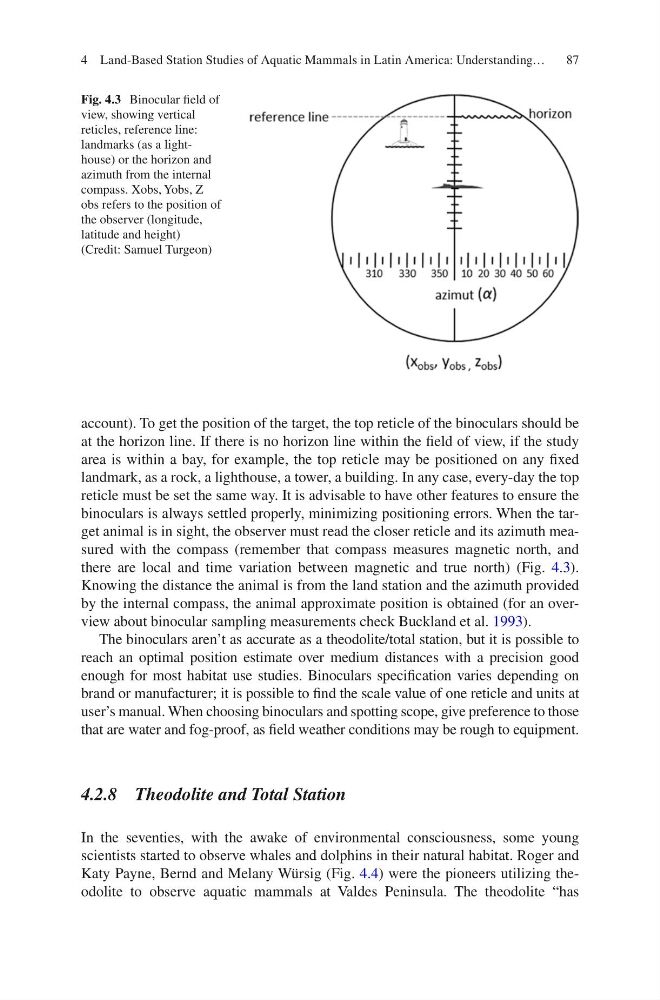
account). To get the position of the target, the top reticle of the binoculars should be
at the horizon line. If there is no horizon line within the field of view, if the study
area is within a bay, for example, the top reticle may be positioned on any fixed
landmark, as a rock, a lighthouse, a tower, a building. In any case, every-day the top
reticle must be set the same way. It is advisable to have other features to ensure the
binoculars is always settled properly, minimizing positioning errors. When the target animal is in sight, the observer must read the closer reticle and its azimuth measured with the compass (remember that compass measures magnetic north, and
there are local and time variation between magnetic and true north) (Fig. 4.3).
Knowing the distance the animal is from the land station and the azimuth provided
by the internal compass, the animal approximate position is obtained (for an overview about binocular sampling measurements check Buckland et al. 1993).
The binoculars aren’t as accurate as a theodolite/total station, but it is possible to
reach an optimal position estimate over medium distances with a precision good
enough for most habitat use studies. Binoculars specification varies depending on
brand or manufacturer; it is possible to find the scale value of one reticle and units at
user’s manual. When choosing binoculars and spotting scope, give preference to those
that are water and fog-proof, as field weather conditions may be rough to equipment.
4.2.8 Theodolite and Total Station
In the seventies, with the awake of environmental consciousness, some young
scientists started to observe whales and dolphins in their natural habitat. Roger and
Katy Payne, Bernd and Melany Würsig (Fig. 4.4) were the pioneers utilizing theodolite to observe aquatic mammals at Valdes Peninsula. The theodolite “has
Fig. 4.3 Binocular field of
view, showing vertical
reticles, reference line:
landmarks (as a lighthouse) or the horizon and
azimuth from the internal
compass. Xobs, Yobs, Z
obs refers to the position of
the observer (longitude,
latitude and height)
(Credit: Samuel Turgeon)
4 Land-Based Station Studies of Aquatic Mammals in Latin America: Understanding…
account). To get the position of the target, the top reticle of the binoculars should be
at the horizon line. If there is no horizon line within the field of view, if the study
area is within a bay, for example, the top reticle may be positioned on any fixed
landmark, as a rock, a lighthouse, a tower, a building. In any case, every-day the top
reticle must be set the same way. It is advisable to have other features to ensure the
binoculars is always settled properly, minimizing positioning errors. When the target animal is in sight, the observer must read the closer reticle and its azimuth measured with the compass (remember that compass measures magnetic north, and
there are local and time variation between magnetic and true north) (Fig. 4.3).
Knowing the distance the animal is from the land station and the azimuth provided
by the internal compass, the animal approximate position is obtained (for an overview about binocular sampling measurements check Buckland et al. 1993).
The binoculars aren’t as accurate as a theodolite/total station, but it is possible to
reach an optimal position estimate over medium distances with a precision good
enough for most habitat use studies. Binoculars specification varies depending on
brand or manufacturer; it is possible to find the scale value of one reticle and units at
user’s manual. When choosing binoculars and spotting scope, give preference to those
that are water and fog-proof, as field weather conditions may be rough to equipment.
4.2.8 Theodolite and Total Station
In the seventies, with the awake of environmental consciousness, some young
scientists started to observe whales and dolphins in their natural habitat. Roger and
Katy Payne, Bernd and Melany Würsig (Fig. 4.4) were the pioneers utilizing theodolite to observe aquatic mammals at Valdes Peninsula. The theodolite “has
Fig. 4.3 Binocular field of
view, showing vertical
reticles, reference line:
landmarks (as a lighthouse) or the horizon and
azimuth from the internal
compass. Xobs, Yobs, Z
obs refers to the position of
the observer (longitude,
latitude and height)
(Credit: Samuel Turgeon)
4 Land-Based Station Studies of Aquatic Mammals in Latin America: Understanding…