

482
This species has been considered under threat of extinction in Brazil since 2014
(MMA 2014), however the IUCN classifies it as “data deficient” (Secchi 2012).
Only two populations live in Santa Catarina state, one in the southern limit (North
Bay in Florianópolis), and the other in Babitonga Bay. The main conservation threat
to the species is accidental catch by fishing nets (Secchi 2012).
17.3.2 The Franciscana Dolphin, Pontoporia blainvillei
The franciscana dolphin is one of the smallest cetaceans in the world. Females are
larger and can reach a body length of 1.8 m, while male maximum body length is
around 1.6 m. Individuals in the southern portion of the species distribution are
larger than those living further north. Maximum weight recorded for the species is
53 kg, and maximum age recorded was 21 years. Calves are born with a body length
of about 71 cm (Rosas and Monteiro-Filho 2001). Coloration varies from greyish
brown on the back to light brown or light gray in the belly region. A distinguishing
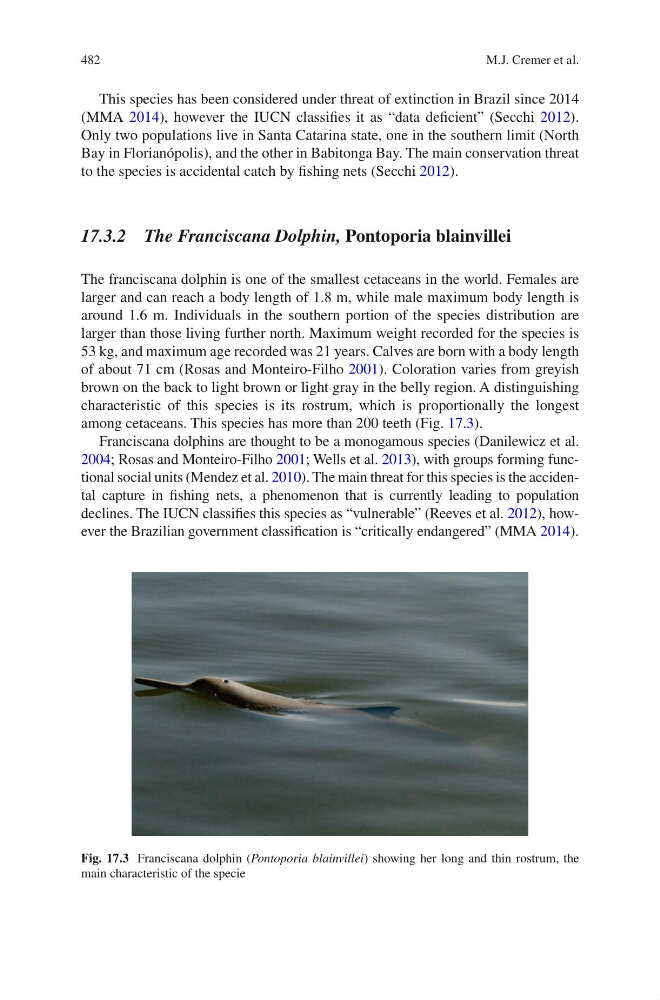
characteristic of this species is its rostrum, which is proportionally the longest
among cetaceans. This species has more than 200 teeth (Fig. 17.3).
Franciscana dolphins are thought to be a monogamous species (Danilewicz et al.
2004; Rosas and Monteiro-Filho 2001; Wells et al. 2013), with groups forming functional social units (Mendez et al. 2010). The main threat for this species is the accidental capture in fishing nets, a phenomenon that is currently leading to population
declines. The IUCN classifies this species as “vulnerable” (Reeves et al. 2012), however the Brazilian government classification is “critically endangered” (MMA 2014).
Fig. 17.3 Franciscana dolphin (Pontoporia blainvillei) showing her long and thin rostrum, the
main characteristic of the specie
M.J. Cremer et al.
This species has been considered under threat of extinction in Brazil since 2014
(MMA 2014), however the IUCN classifies it as “data deficient” (Secchi 2012).
Only two populations live in Santa Catarina state, one in the southern limit (North
Bay in Florianópolis), and the other in Babitonga Bay. The main conservation threat
to the species is accidental catch by fishing nets (Secchi 2012).
17.3.2 The Franciscana Dolphin, Pontoporia blainvillei
The franciscana dolphin is one of the smallest cetaceans in the world. Females are
larger and can reach a body length of 1.8 m, while male maximum body length is
around 1.6 m. Individuals in the southern portion of the species distribution are
larger than those living further north. Maximum weight recorded for the species is
53 kg, and maximum age recorded was 21 years. Calves are born with a body length
of about 71 cm (Rosas and Monteiro-Filho 2001). Coloration varies from greyish
brown on the back to light brown or light gray in the belly region. A distinguishing
characteristic of this species is its rostrum, which is proportionally the longest
among cetaceans. This species has more than 200 teeth (Fig. 17.3).
Franciscana dolphins are thought to be a monogamous species (Danilewicz et al.
2004; Rosas and Monteiro-Filho 2001; Wells et al. 2013), with groups forming functional social units (Mendez et al. 2010). The main threat for this species is the accidental capture in fishing nets, a phenomenon that is currently leading to population
declines. The IUCN classifies this species as “vulnerable” (Reeves et al. 2012), however the Brazilian government classification is “critically endangered” (MMA 2014).
Fig. 17.3 Franciscana dolphin (Pontoporia blainvillei) showing her long and thin rostrum, the
main characteristic of the specie
M.J. Cremer et al.