

481
mining, tourism, and aquaculture. Despite its economic importance, the area has
been designated as a “priority area for conservation, sustainable use and sharing of
benefits from Brazilian biodiversity”, by the Brazilian government, in the “extremely
high” priority category (PROBIO 2007).
17.3 Sympatric Species in Babitonga Bay
17.3.1 The Guiana Dolphin, Sotalia guianensis
Among the small cetacean species of the Brazilian coast, the Guiana dolphin is
undoubtedly, the best studied. Along its coastal distribution it is often found associated with bays, estuaries, and coves, and these areas are amenable to the observation
of populations. The maximum body length recorded for this species is 2.20 m, with
a weight of 121 kg (Rosas and Monteiro-Filho 2002). The Guiana dolphin has gray
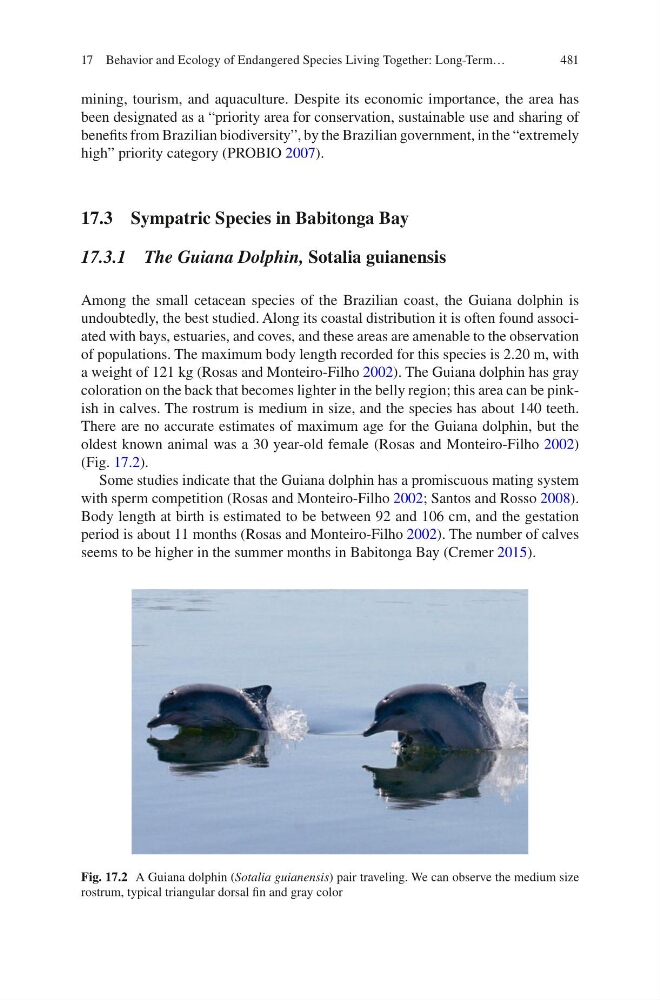
coloration on the back that becomes lighter in the belly region; this area can be pinkish in calves. The rostrum is medium in size, and the species has about 140 teeth.
There are no accurate estimates of maximum age for the Guiana dolphin, but the
oldest known animal was a 30 year-old female (Rosas and Monteiro-Filho 2002)
(Fig. 17.2).
Some studies indicate that the Guiana dolphin has a promiscuous mating system
with sperm competition (Rosas and Monteiro-Filho 2002; Santos and Rosso 2008).
Body length at birth is estimated to be between 92 and 106 cm, and the gestation
period is about 11 months (Rosas and Monteiro-Filho 2002). The number of calves
seems to be higher in the summer months in Babitonga Bay (Cremer 2015).
Fig. 17.2 A Guiana dolphin (Sotalia guianensis) pair traveling. We can observe the medium size
rostrum, typical triangular dorsal fin and gray color
17 Behavior and Ecology of Endangered Species Living Together: Long-Term…
mining, tourism, and aquaculture. Despite its economic importance, the area has
been designated as a “priority area for conservation, sustainable use and sharing of
benefits from Brazilian biodiversity”, by the Brazilian government, in the “extremely
high” priority category (PROBIO 2007).
17.3 Sympatric Species in Babitonga Bay
17.3.1 The Guiana Dolphin, Sotalia guianensis
Among the small cetacean species of the Brazilian coast, the Guiana dolphin is
undoubtedly, the best studied. Along its coastal distribution it is often found associated with bays, estuaries, and coves, and these areas are amenable to the observation
of populations. The maximum body length recorded for this species is 2.20 m, with
a weight of 121 kg (Rosas and Monteiro-Filho 2002). The Guiana dolphin has gray
coloration on the back that becomes lighter in the belly region; this area can be pinkish in calves. The rostrum is medium in size, and the species has about 140 teeth.
There are no accurate estimates of maximum age for the Guiana dolphin, but the
oldest known animal was a 30 year-old female (Rosas and Monteiro-Filho 2002)
(Fig. 17.2).
Some studies indicate that the Guiana dolphin has a promiscuous mating system
with sperm competition (Rosas and Monteiro-Filho 2002; Santos and Rosso 2008).
Body length at birth is estimated to be between 92 and 106 cm, and the gestation
period is about 11 months (Rosas and Monteiro-Filho 2002). The number of calves
seems to be higher in the summer months in Babitonga Bay (Cremer 2015).
Fig. 17.2 A Guiana dolphin (Sotalia guianensis) pair traveling. We can observe the medium size
rostrum, typical triangular dorsal fin and gray color
17 Behavior and Ecology of Endangered Species Living Together: Long-Term…