

483
17.4 Group Size and Behavior
Franciscana dolphin group size varies along the species distribution, driven mainly
by differences in prey abundances and habitat quality (Cremer et al. 2011). These
differences in group size are related to several variables, including physical characteristics, prey concentration and distribution, and population social organization.
Data on the Babitonga Bay franciscana population indicate group sizes ranging
from one to 22 individuals (mean = 7.1 ± 5.42, n = 79) (Cremer and Simões-Lopes
2005). Solitary individuals are uncommon (3.8% of total observations). Groups
with two or three individuals are most common (35.4%), and 59.5% of the groups
have more than four individuals. Calves were observed in all seasons, and were
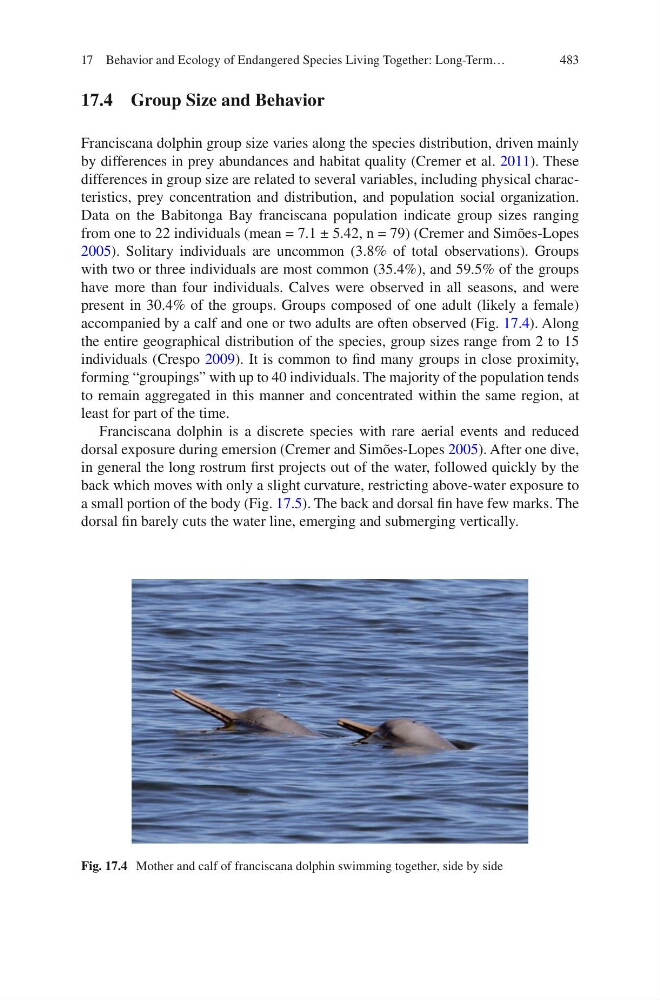
present in 30.4% of the groups. Groups composed of one adult (likely a female)
accompanied by a calf and one or two adults are often observed (Fig. 17.4). Along
the entire geographical distribution of the species, group sizes range from 2 to 15
individuals (Crespo 2009). It is common to find many groups in close proximity,
forming “groupings” with up to 40 individuals. The majority of the population tends
to remain aggregated in this manner and concentrated within the same region, at
least for part of the time.
Franciscana dolphin is a discrete species with rare aerial events and reduced
dorsal exposure during emersion (Cremer and Simões-Lopes 2005). After one dive,
in general the long rostrum first projects out of the water, followed quickly by the
back which moves with only a slight curvature, restricting above-water exposure to
a small portion of the body (Fig. 17.5). The back and dorsal fin have few marks. The
dorsal fin barely cuts the water line, emerging and submerging vertically.
Fig. 17.4 Mother and calf of franciscana dolphin swimming together, side by side
17 Behavior and Ecology of Endangered Species Living Together: Long-Term…
17.4 Group Size and Behavior
Franciscana dolphin group size varies along the species distribution, driven mainly
by differences in prey abundances and habitat quality (Cremer et al. 2011). These
differences in group size are related to several variables, including physical characteristics, prey concentration and distribution, and population social organization.
Data on the Babitonga Bay franciscana population indicate group sizes ranging
from one to 22 individuals (mean = 7.1 ± 5.42, n = 79) (Cremer and Simões-Lopes
2005). Solitary individuals are uncommon (3.8% of total observations). Groups
with two or three individuals are most common (35.4%), and 59.5% of the groups
have more than four individuals. Calves were observed in all seasons, and were
present in 30.4% of the groups. Groups composed of one adult (likely a female)
accompanied by a calf and one or two adults are often observed (Fig. 17.4). Along
the entire geographical distribution of the species, group sizes range from 2 to 15
individuals (Crespo 2009). It is common to find many groups in close proximity,
forming “groupings” with up to 40 individuals. The majority of the population tends
to remain aggregated in this manner and concentrated within the same region, at
least for part of the time.
Franciscana dolphin is a discrete species with rare aerial events and reduced
dorsal exposure during emersion (Cremer and Simões-Lopes 2005). After one dive,
in general the long rostrum first projects out of the water, followed quickly by the
back which moves with only a slight curvature, restricting above-water exposure to
a small portion of the body (Fig. 17.5). The back and dorsal fin have few marks. The
dorsal fin barely cuts the water line, emerging and submerging vertically.
Fig. 17.4 Mother and calf of franciscana dolphin swimming together, side by side
17 Behavior and Ecology of Endangered Species Living Together: Long-Term…