

420
15.3 Results
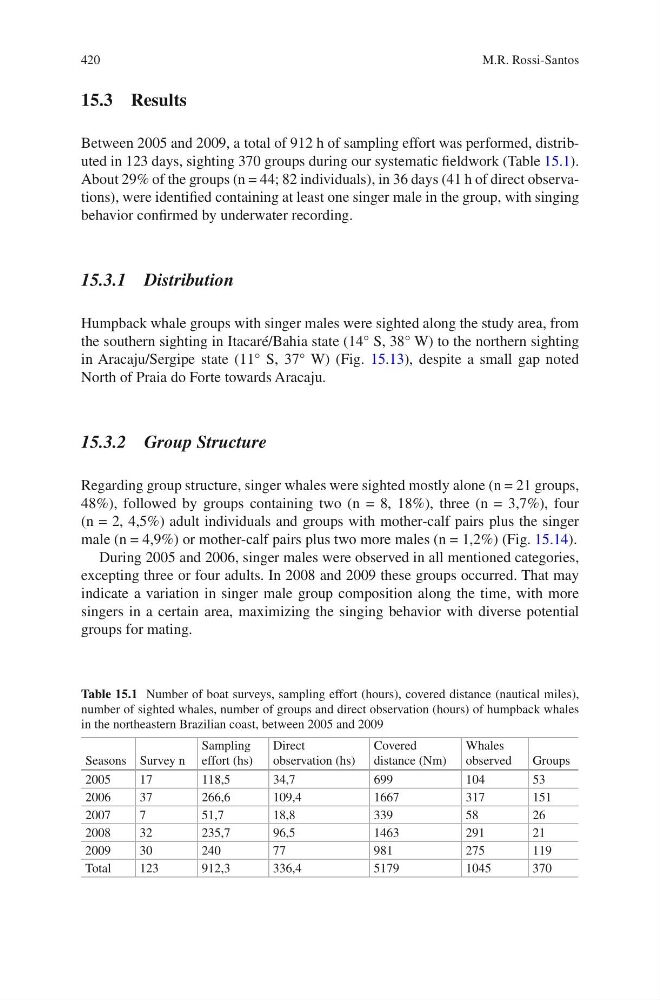
Between 2005 and 2009, a total of 912 h of sampling effort was performed, distributed in 123 days, sighting 370 groups during our systematic fieldwork (Table 15.1).
About 29% of the groups (n = 44; 82 individuals), in 36 days (41 h of direct observations), were identified containing at least one singer male in the group, with singing
behavior confirmed by underwater recording.
15.3.1 Distribution
Humpback whale groups with singer males were sighted along the study area, from
the southern sighting in Itacaré/Bahia state (14° S, 38° W) to the northern sighting
in Aracaju/Sergipe state (11° S, 37° W) (Fig. 15.13), despite a small gap noted
North of Praia do Forte towards Aracaju.
15.3.2 Group Structure
Regarding group structure, singer whales were sighted mostly alone (n = 21 groups,
48%), followed by groups containing two (n = 8, 18%), three (n = 3,7%), four
(n = 2, 4,5%) adult individuals and groups with mother-calf pairs plus the singer
male (n = 4,9%) or mother-calf pairs plus two more males (n = 1,2%) (Fig. 15.14).
During 2005 and 2006, singer males were observed in all mentioned categories,
excepting three or four adults. In 2008 and 2009 these groups occurred. That may
indicate a variation in singer male group composition along the time, with more
singers in a certain area, maximizing the singing behavior with diverse potential
groups for mating.
Table 15.1 Number of boat surveys, sampling effort (hours), covered distance (nautical miles),
number of sighted whales, number of groups and direct observation (hours) of humpback whales
in the northeastern Brazilian coast, between 2005 and 2009
Seasons Survey n
Sampling
effort (hs)
Direct
observation (hs)
Covered
distance (Nm)
Whales
observed
Groups
2005
17
118,5
34,7
699
104
53
2006
37
266,6
109,4
1667
317
151
2007
7
51,7
18,8
339
58
26
2008
32
235,7
96,5
1463
291
21
2009
30
240
77
981
275
119
Total
123
912,3
336,4
5179
1045
370
M.R. Rossi-Santos
15.3 Results
Between 2005 and 2009, a total of 912 h of sampling effort was performed, distributed in 123 days, sighting 370 groups during our systematic fieldwork (Table 15.1).
About 29% of the groups (n = 44; 82 individuals), in 36 days (41 h of direct observations), were identified containing at least one singer male in the group, with singing
behavior confirmed by underwater recording.
15.3.1 Distribution
Humpback whale groups with singer males were sighted along the study area, from
the southern sighting in Itacaré/Bahia state (14° S, 38° W) to the northern sighting
in Aracaju/Sergipe state (11° S, 37° W) (Fig. 15.13), despite a small gap noted
North of Praia do Forte towards Aracaju.
15.3.2 Group Structure
Regarding group structure, singer whales were sighted mostly alone (n = 21 groups,
48%), followed by groups containing two (n = 8, 18%), three (n = 3,7%), four
(n = 2, 4,5%) adult individuals and groups with mother-calf pairs plus the singer
male (n = 4,9%) or mother-calf pairs plus two more males (n = 1,2%) (Fig. 15.14).
During 2005 and 2006, singer males were observed in all mentioned categories,
excepting three or four adults. In 2008 and 2009 these groups occurred. That may
indicate a variation in singer male group composition along the time, with more
singers in a certain area, maximizing the singing behavior with diverse potential
groups for mating.
Table 15.1 Number of boat surveys, sampling effort (hours), covered distance (nautical miles),
number of sighted whales, number of groups and direct observation (hours) of humpback whales
in the northeastern Brazilian coast, between 2005 and 2009
Seasons Survey n
Sampling
effort (hs)
Direct
observation (hs)
Covered
distance (Nm)
Whales
observed
Groups
2005
17
118,5
34,7
699
104
53
2006
37
266,6
109,4
1667
317
151
2007
7
51,7
18,8
339
58
26
2008
32
235,7
96,5
1463
291
21
2009
30
240
77
981
275
119
Total
123
912,3
336,4
5179
1045
370
M.R. Rossi-Santos