

349
rate as a possible way to avoid masking) in only 1.4% of the time, while in 100% of
the encounters of animals with aluminum boats equipped with petrol engines this
avoidance behavior was recorded.
Therefore, it can be suggested that internal diesel engines are relatively less
harmful to the Guiana dolphin, mainly because these animals can shift their signals
to higher frequencies and also for the reason that they have fewer hearing sensitivity
at low frequencies (Martins et al. 2016).
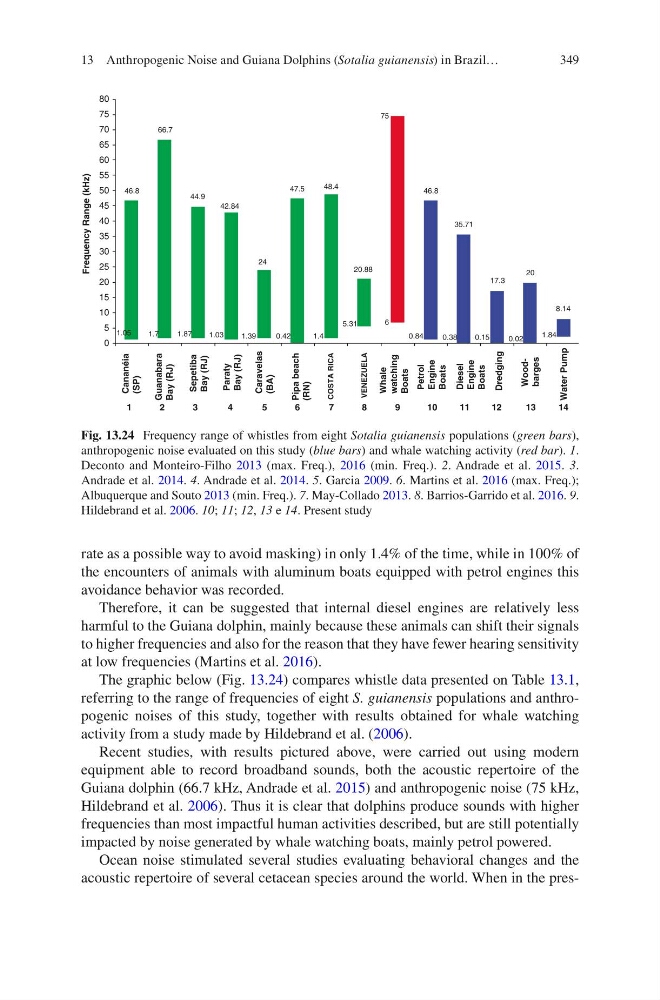
The graphic below (Fig. 13.24) compares whistle data presented on Table 13.1,
referring to the range of frequencies of eight S. guianensis populations and anthropogenic noises of this study, together with results obtained for whale watching
activity from a study made by Hildebrand et al. (2006).
Recent studies, with results pictured above, were carried out using modern
equipment able to record broadband sounds, both the acoustic repertoire of the
Guiana dolphin (66.7 kHz, Andrade et al. 2015) and anthropogenic noise (75 kHz,
Hildebrand et al. 2006). Thus it is clear that dolphins produce sounds with higher
frequencies than most impactful human activities described, but are still potentially
impacted by noise generated by whale watching boats, mainly petrol powered.
Ocean noise stimulated several studies evaluating behavioral changes and the
acoustic repertoire of several cetacean species around the world. When in the pres80
75
70
65
60
55
50
45
40
35
Frequency Range (kHz)
30
25
20
15
10
5
0
1.05
Cananéia
(SP)
1
2
3
4
5
6
7
8
9
1 0
1 1
1 2
1 3
1 4
Guanabara
Bay (RJ)
Sepetiba
Bay (RJ)
Paraty
Bay (RJ)
Caravelas
(BA)
Pipa beach
(RN)
COSTA RICA
VENEZUELA
Whale
watching
Boats
Petrol
Engine
Boats
Diesel
Engine
Boats
Dredging
Woodbarges
Water Pump
46.8
66.7
44.9
42.84
24
47.5
48.4
75
46.8
35.71
1.7
1 .87
1.03
1.39
0.42
1.4
5.31
20.88
6
0.84
0.38
0.15
17.3
0.02
20
8.14
1.84
Fig. 13.24 Frequency range of whistles from eight Sotalia guianensis populations (green bars),
anthropogenic noise evaluated on this study (blue bars) and whale watching activity (red bar). 1.
Deconto and Monteiro-Filho 2013 (max. Freq.), 2016 (min. Freq.). 2. Andrade et al. 2015. 3.
Andrade et al. 2014. 4. Andrade et al. 2014. 5. Garcia 2009. 6. Martins et al. 2016 (max. Freq.);
Albuquerque and Souto 2013 (min. Freq.). 7. May-Collado 2013. 8. Barrios-Garrido et al. 2016. 9.
Hildebrand et al. 2006. 10; 11; 12, 13 e 14. Present study
13 Anthropogenic Noise and Guiana Dolphins (Sotalia guianensis) in Brazil…
rate as a possible way to avoid masking) in only 1.4% of the time, while in 100% of
the encounters of animals with aluminum boats equipped with petrol engines this
avoidance behavior was recorded.
Therefore, it can be suggested that internal diesel engines are relatively less
harmful to the Guiana dolphin, mainly because these animals can shift their signals
to higher frequencies and also for the reason that they have fewer hearing sensitivity
at low frequencies (Martins et al. 2016).
The graphic below (Fig. 13.24) compares whistle data presented on Table 13.1,
referring to the range of frequencies of eight S. guianensis populations and anthropogenic noises of this study, together with results obtained for whale watching
activity from a study made by Hildebrand et al. (2006).
Recent studies, with results pictured above, were carried out using modern
equipment able to record broadband sounds, both the acoustic repertoire of the
Guiana dolphin (66.7 kHz, Andrade et al. 2015) and anthropogenic noise (75 kHz,
Hildebrand et al. 2006). Thus it is clear that dolphins produce sounds with higher
frequencies than most impactful human activities described, but are still potentially
impacted by noise generated by whale watching boats, mainly petrol powered.
Ocean noise stimulated several studies evaluating behavioral changes and the
acoustic repertoire of several cetacean species around the world. When in the pres80
75
70
65
60
55
50
45
40
35
Frequency Range (kHz)
30
25
20
15
10
5
0
1.05
Cananéia
(SP)
1
2
3
4
5
6
7
8
9
1 0
1 1
1 2
1 3
1 4
Guanabara
Bay (RJ)
Sepetiba
Bay (RJ)
Paraty
Bay (RJ)
Caravelas
(BA)
Pipa beach
(RN)
COSTA RICA
VENEZUELA
Whale
watching
Boats
Petrol
Engine
Boats
Diesel
Engine
Boats
Dredging
Woodbarges
Water Pump
46.8
66.7
44.9
42.84
24
47.5
48.4
75
46.8
35.71
1.7
1 .87
1.03
1.39
0.42
1.4
5.31
20.88
6
0.84
0.38
0.15
17.3
0.02
20
8.14
1.84
Fig. 13.24 Frequency range of whistles from eight Sotalia guianensis populations (green bars),
anthropogenic noise evaluated on this study (blue bars) and whale watching activity (red bar). 1.
Deconto and Monteiro-Filho 2013 (max. Freq.), 2016 (min. Freq.). 2. Andrade et al. 2015. 3.
Andrade et al. 2014. 4. Andrade et al. 2014. 5. Garcia 2009. 6. Martins et al. 2016 (max. Freq.);
Albuquerque and Souto 2013 (min. Freq.). 7. May-Collado 2013. 8. Barrios-Garrido et al. 2016. 9.
Hildebrand et al. 2006. 10; 11; 12, 13 e 14. Present study
13 Anthropogenic Noise and Guiana Dolphins (Sotalia guianensis) in Brazil…