

348
The interaction of these threats with continuous exposure to anthropogenic noise,
presents a major risk to cetacean species that inhabit and use these coastal areas,
particularly even more alarming for animal populations which already presents a
classification status as vulnerable or endangered (Perry 1998), as is the case of
Sotalia guianensis in Brazil.
By comparing the sounds emitted by the Guiana dolphin in the three areas with
anthropogenic noise (Fig. 13.22), there is an overlapping of frequency ranges for all
populations, indicating a possible masking on the acoustic signals of this species by
anthropogenic noise.
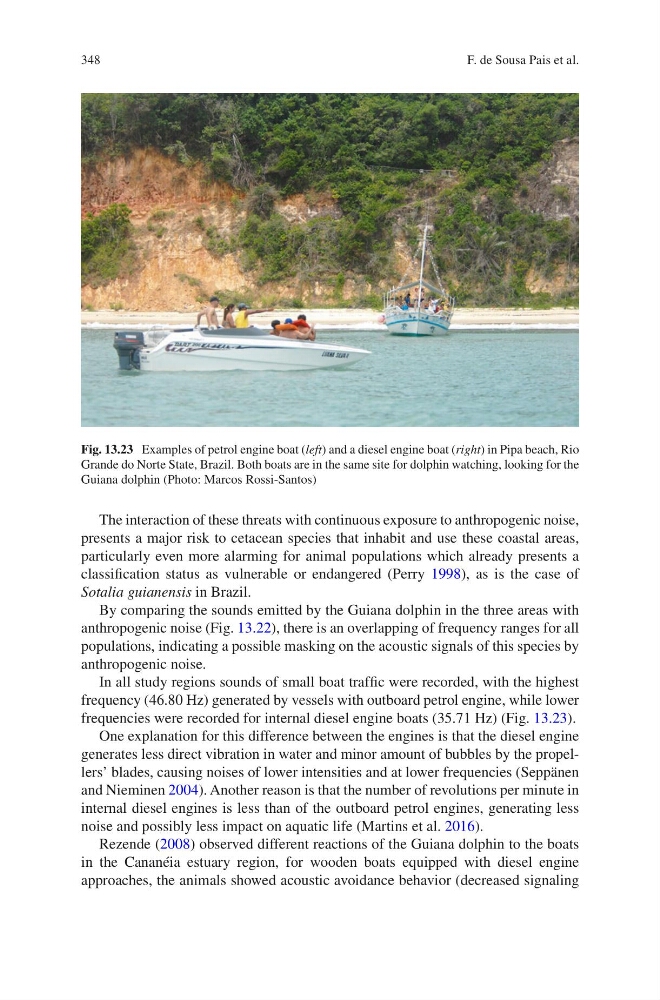
In all study regions sounds of small boat traffic were recorded, with the highest
frequency (46.80 Hz) generated by vessels with outboard petrol engine, while lower
frequencies were recorded for internal diesel engine boats (35.71 Hz) (Fig. 13.23).
One explanation for this difference between the engines is that the diesel engine
generates less direct vibration in water and minor amount of bubbles by the propellers’ blades, causing noises of lower intensities and at lower frequencies (Seppänen
and Nieminen 2004). Another reason is that the number of revolutions per minute in
internal diesel engines is less than of the outboard petrol engines, generating less
noise and possibly less impact on aquatic life (Martins et al. 2016).
Rezende (2008) observed different reactions of the Guiana dolphin to the boats
in the Cananéia estuary region, for wooden boats equipped with diesel engine
approaches, the animals showed acoustic avoidance behavior (decreased signaling
Fig. 13.23 Examples of petrol engine boat (left) and a diesel engine boat (right) in Pipa beach, Rio
Grande do Norte State, Brazil. Both boats are in the same site for dolphin watching, looking for the
Guiana dolphin (Photo: Marcos Rossi-Santos)
F. de Sousa Pais et al.
The interaction of these threats with continuous exposure to anthropogenic noise,
presents a major risk to cetacean species that inhabit and use these coastal areas,
particularly even more alarming for animal populations which already presents a
classification status as vulnerable or endangered (Perry 1998), as is the case of
Sotalia guianensis in Brazil.
By comparing the sounds emitted by the Guiana dolphin in the three areas with
anthropogenic noise (Fig. 13.22), there is an overlapping of frequency ranges for all
populations, indicating a possible masking on the acoustic signals of this species by
anthropogenic noise.
In all study regions sounds of small boat traffic were recorded, with the highest
frequency (46.80 Hz) generated by vessels with outboard petrol engine, while lower
frequencies were recorded for internal diesel engine boats (35.71 Hz) (Fig. 13.23).
One explanation for this difference between the engines is that the diesel engine
generates less direct vibration in water and minor amount of bubbles by the propellers’ blades, causing noises of lower intensities and at lower frequencies (Seppänen
and Nieminen 2004). Another reason is that the number of revolutions per minute in
internal diesel engines is less than of the outboard petrol engines, generating less
noise and possibly less impact on aquatic life (Martins et al. 2016).
Rezende (2008) observed different reactions of the Guiana dolphin to the boats
in the Cananéia estuary region, for wooden boats equipped with diesel engine
approaches, the animals showed acoustic avoidance behavior (decreased signaling
Fig. 13.23 Examples of petrol engine boat (left) and a diesel engine boat (right) in Pipa beach, Rio
Grande do Norte State, Brazil. Both boats are in the same site for dolphin watching, looking for the
Guiana dolphin (Photo: Marcos Rossi-Santos)
F. de Sousa Pais et al.