

347
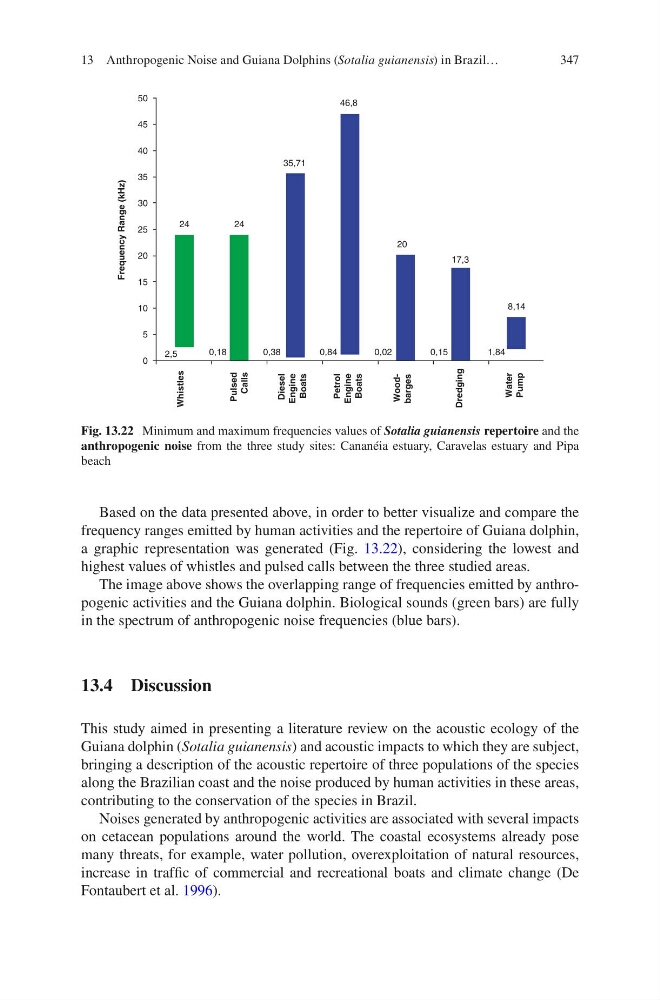
Based on the data presented above, in order to better visualize and compare the
frequency ranges emitted by human activities and the repertoire of Guiana dolphin,
a graphic representation was generated (Fig. 13.22), considering the lowest and
highest values of whistles and pulsed calls between the three studied areas.
The image above shows the overlapping range of frequencies emitted by anthropogenic activities and the Guiana dolphin. Biological sounds (green bars) are fully
in the spectrum of anthropogenic noise frequencies (blue bars).
13.4 Discussion
This study aimed in presenting a literature review on the acoustic ecology of the
Guiana dolphin (Sotalia guianensis) and acoustic impacts to which they are subject,
bringing a description of the acoustic repertoire of three populations of the species
along the Brazilian coast and the noise produced by human activities in these areas,
contributing to the conservation of the species in Brazil.
Noises generated by anthropogenic activities are associated with several impacts
on cetacean populations around the world. The coastal ecosystems already pose
many threats, for example, water pollution, overexploitation of natural resources,
increase in traffic of commercial and recreational boats and climate change (De
Fontaubert et al. 1996).
50
45
40
35
30
25
20
15
10
5
0
Whistles
Frequency Range (kHz)
Pulsed
Calls
Diesel
Engine
Boats
Petrol
Engine
Boats
Woodbarges
Dredging
Water
Pump
2,5
24
24
35,71
46,8
20
17,3
8,14
0,18
0,38
0,84
0,02
0,15
1,84
Fig. 13.22 Minimum and maximum frequencies values of Sotalia guianensis repertoire and the
anthropogenic noise from the three study sites: Cananéia estuary, Caravelas estuary and Pipa
beach
13 Anthropogenic Noise and Guiana Dolphins (Sotalia guianensis) in Brazil…
Based on the data presented above, in order to better visualize and compare the
frequency ranges emitted by human activities and the repertoire of Guiana dolphin,
a graphic representation was generated (Fig. 13.22), considering the lowest and
highest values of whistles and pulsed calls between the three studied areas.
The image above shows the overlapping range of frequencies emitted by anthropogenic activities and the Guiana dolphin. Biological sounds (green bars) are fully
in the spectrum of anthropogenic noise frequencies (blue bars).
13.4 Discussion
This study aimed in presenting a literature review on the acoustic ecology of the
Guiana dolphin (Sotalia guianensis) and acoustic impacts to which they are subject,
bringing a description of the acoustic repertoire of three populations of the species
along the Brazilian coast and the noise produced by human activities in these areas,
contributing to the conservation of the species in Brazil.
Noises generated by anthropogenic activities are associated with several impacts
on cetacean populations around the world. The coastal ecosystems already pose
many threats, for example, water pollution, overexploitation of natural resources,
increase in traffic of commercial and recreational boats and climate change (De
Fontaubert et al. 1996).
50
45
40
35
30
25
20
15
10
5
0
Whistles
Frequency Range (kHz)
Pulsed
Calls
Diesel
Engine
Boats
Petrol
Engine
Boats
Woodbarges
Dredging
Water
Pump
2,5
24
24
35,71
46,8
20
17,3
8,14
0,18
0,38
0,84
0,02
0,15
1,84
Fig. 13.22 Minimum and maximum frequencies values of Sotalia guianensis repertoire and the
anthropogenic noise from the three study sites: Cananéia estuary, Caravelas estuary and Pipa
beach
13 Anthropogenic Noise and Guiana Dolphins (Sotalia guianensis) in Brazil…