

350
ence of tourism boats, dolphins reduced time spent in foraging activities from
10 min to 6 min and when stopped, animals took 54% more time than normal to
return to the activity (Stockin et al. 2008).
The presence of a boat reduced by 49% the foraging activity on bottlenose dolphins (Tursiops truncatus), and the greater the amount of vessels in the region the
greater the impact on feeding, also considering that the physical presence of vessels,
and not only the noise generated by them, showed an important role in these disturbances (Pirotta et al. 2015). In Mississipi, bottlenose dolphins changed their
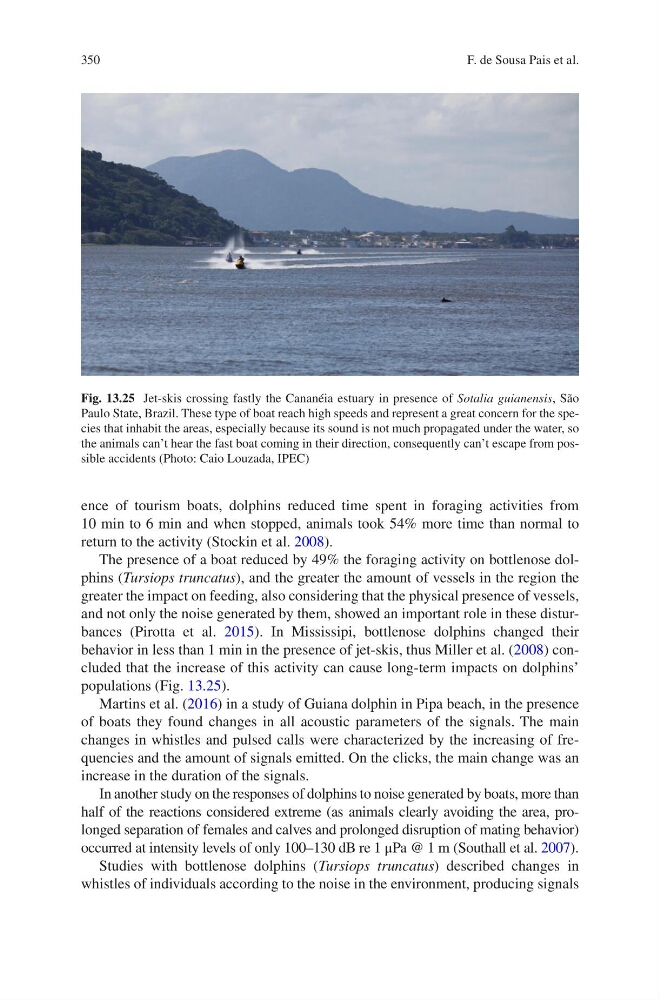
behavior in less than 1 min in the presence of jet-skis, thus Miller et al. (2008) concluded that the increase of this activity can cause long-term impacts on dolphins’
populations (Fig. 13.25).
Martins et al. (2016) in a study of Guiana dolphin in Pipa beach, in the presence
of boats they found changes in all acoustic parameters of the signals. The main
changes in whistles and pulsed calls were characterized by the increasing of frequencies and the amount of signals emitted. On the clicks, the main change was an
increase in the duration of the signals.
In another study on the responses of dolphins to noise generated by boats, more than
half of the reactions considered extreme (as animals clearly avoiding the area, prolonged separation of females and calves and prolonged disruption of mating behavior)
occurred at intensity levels of only 100–130 dB re 1 μPa @ 1 m (Southall et al. 2007).
Studies with bottlenose dolphins (Tursiops truncatus) described changes in
whistles of individuals according to the noise in the environment, producing signals
Fig. 13.25 Jet-skis crossing fastly the Cananéia estuary in presence of Sotalia guianensis, São
Paulo State, Brazil. These type of boat reach high speeds and represent a great concern for the species that inhabit the areas, especially because its sound is not much propagated under the water, so
the animals can’t hear the fast boat coming in their direction, consequently can’t escape from possible accidents (Photo: Caio Louzada, IPEC)
F. de Sousa Pais et al.
ence of tourism boats, dolphins reduced time spent in foraging activities from
10 min to 6 min and when stopped, animals took 54% more time than normal to
return to the activity (Stockin et al. 2008).
The presence of a boat reduced by 49% the foraging activity on bottlenose dolphins (Tursiops truncatus), and the greater the amount of vessels in the region the
greater the impact on feeding, also considering that the physical presence of vessels,
and not only the noise generated by them, showed an important role in these disturbances (Pirotta et al. 2015). In Mississipi, bottlenose dolphins changed their
behavior in less than 1 min in the presence of jet-skis, thus Miller et al. (2008) concluded that the increase of this activity can cause long-term impacts on dolphins’
populations (Fig. 13.25).
Martins et al. (2016) in a study of Guiana dolphin in Pipa beach, in the presence
of boats they found changes in all acoustic parameters of the signals. The main
changes in whistles and pulsed calls were characterized by the increasing of frequencies and the amount of signals emitted. On the clicks, the main change was an
increase in the duration of the signals.
In another study on the responses of dolphins to noise generated by boats, more than
half of the reactions considered extreme (as animals clearly avoiding the area, prolonged separation of females and calves and prolonged disruption of mating behavior)
occurred at intensity levels of only 100–130 dB re 1 μPa @ 1 m (Southall et al. 2007).
Studies with bottlenose dolphins (Tursiops truncatus) described changes in
whistles of individuals according to the noise in the environment, producing signals
Fig. 13.25 Jet-skis crossing fastly the Cananéia estuary in presence of Sotalia guianensis, São
Paulo State, Brazil. These type of boat reach high speeds and represent a great concern for the species that inhabit the areas, especially because its sound is not much propagated under the water, so
the animals can’t hear the fast boat coming in their direction, consequently can’t escape from possible accidents (Photo: Caio Louzada, IPEC)
F. de Sousa Pais et al.