

342
13.2.2 Data Collection
The bioacoustic data used in this study was collected between the years 2005 and
2009 by different researchers, grouped in this chapter for a better evaluation of
acoustic conditions that the Guiana dolphin are exposed to in three different areas
along the Brazilian coast.
The data was collected in a similar way in the three areas sampled through field
activities, using different equipment that gradually improved the ability to capture
the sounds in the aquatic environment. Initially tape deck (usually Sony TCD – 5
M), digital recorder Sony DAT D8, both recorders with frequency responses of
about 24 kHz, replaced by a Panasonic PV-GS 120 digital camera (frequency
response of 48 kHz), and as from 2008, a M-Audio Microtrack II Professional
recorder, with the capacity to record higher frequencies (frequency response up to
96 kHz). Hydrophones used were basically two HTI SSQ 94 and HTI 90 min
(Fig. 13.17).
At laboratory, the sounds collected in field trips were transferred to the computer
and processed through the RAVEN 1.3 Pro software (Cornell University). The following parameters were obtained: minimum and maximum frequency, initial and
final frequency, delta frequencies and duration of the signal.
Currently, knowledge of the acoustic repertoire of aquatic mammals evolved significantly due to the use of equipment with higher frequency response and sampling rate.
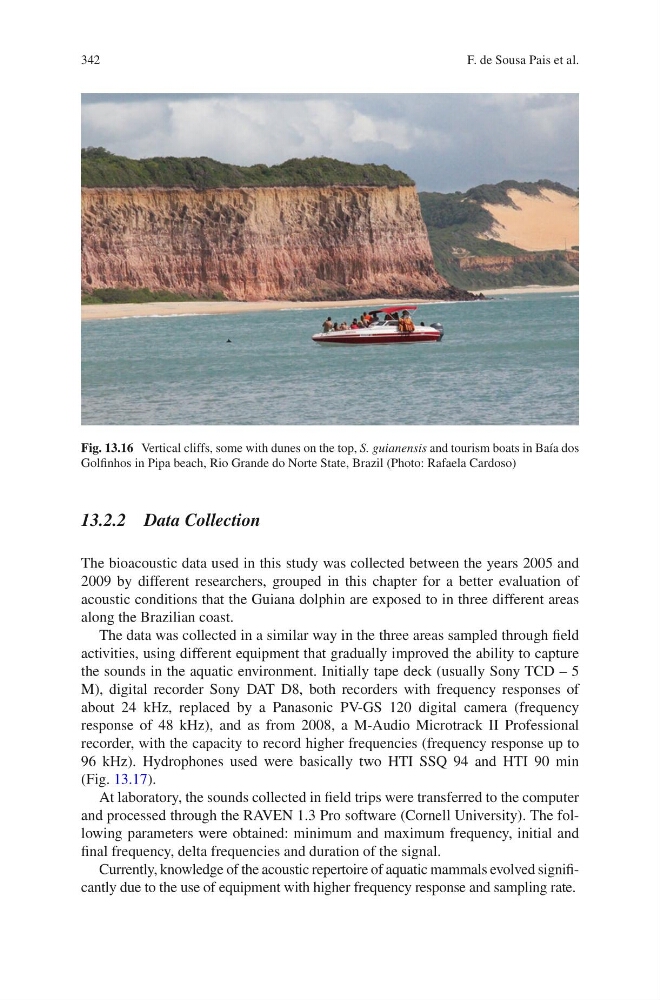
Fig. 13.16 Vertical cliffs, some with dunes on the top, S. guianensis and tourism boats in Baía dos
Golfinhos in Pipa beach, Rio Grande do Norte State, Brazil (Photo: Rafaela Cardoso)
F. de Sousa Pais et al.
13.2.2 Data Collection
The bioacoustic data used in this study was collected between the years 2005 and
2009 by different researchers, grouped in this chapter for a better evaluation of
acoustic conditions that the Guiana dolphin are exposed to in three different areas
along the Brazilian coast.
The data was collected in a similar way in the three areas sampled through field
activities, using different equipment that gradually improved the ability to capture
the sounds in the aquatic environment. Initially tape deck (usually Sony TCD – 5
M), digital recorder Sony DAT D8, both recorders with frequency responses of
about 24 kHz, replaced by a Panasonic PV-GS 120 digital camera (frequency
response of 48 kHz), and as from 2008, a M-Audio Microtrack II Professional
recorder, with the capacity to record higher frequencies (frequency response up to
96 kHz). Hydrophones used were basically two HTI SSQ 94 and HTI 90 min
(Fig. 13.17).
At laboratory, the sounds collected in field trips were transferred to the computer
and processed through the RAVEN 1.3 Pro software (Cornell University). The following parameters were obtained: minimum and maximum frequency, initial and
final frequency, delta frequencies and duration of the signal.
Currently, knowledge of the acoustic repertoire of aquatic mammals evolved significantly due to the use of equipment with higher frequency response and sampling rate.
Fig. 13.16 Vertical cliffs, some with dunes on the top, S. guianensis and tourism boats in Baía dos
Golfinhos in Pipa beach, Rio Grande do Norte State, Brazil (Photo: Rafaela Cardoso)
F. de Sousa Pais et al.