

341
13.2.1.3 Pipa Beach (PIP)
Pipa beach (PIP) is located in the municipality of Tibau do Sul, a Sustainable Use
Reserve, in Rio Grande do Norte State. The region called Baía dos Golfinhos is
about 0.4 km
2
area and is bounded by vertical cliffs that reach heights of 40 m, in
some areas are covered by sand dunes, increasing the overall height to 70 m high
(Carrera et al. 2008) (Fig. 13.16).
The southern coast of Baía dos Golfinhos is well protected from strong southeast
winds and currents (Beaufort scale <1.0), while the northern coast is more susceptible to these factors. Its maximum depth reaches 7 m (Garri 2006), with temperatures ranging from 19 to 28 °C and salinity between 36 and 37‰ (Souto et al. 2006)
and slightly turbidity in the water column. The bottom is composed mainly of sand
except the edges, composed of sedimentary rocks. The region is also influenced by
Guaraíra estuary, located about 5 km northwards.
Pipa beach is characterized as a growing tourist region, with particular attention
to the increase in whale watching activities aimed at the S. guianensis in Baía dos
Golfinhos. Due to its unique features, the region is largely inhabited by Guiana
dolphin that primarily use for foraging activity (Araújo et al. 2003). According to
Carrera et al. (2008), the average number of animals using this region is about 2–4
individuals, varying according to the presence or absence of vessels.
The acoustic data used in this study was collected at Baía dos Golfinhos during
five campaigns in April 2009 and can be found in Martins (2010).
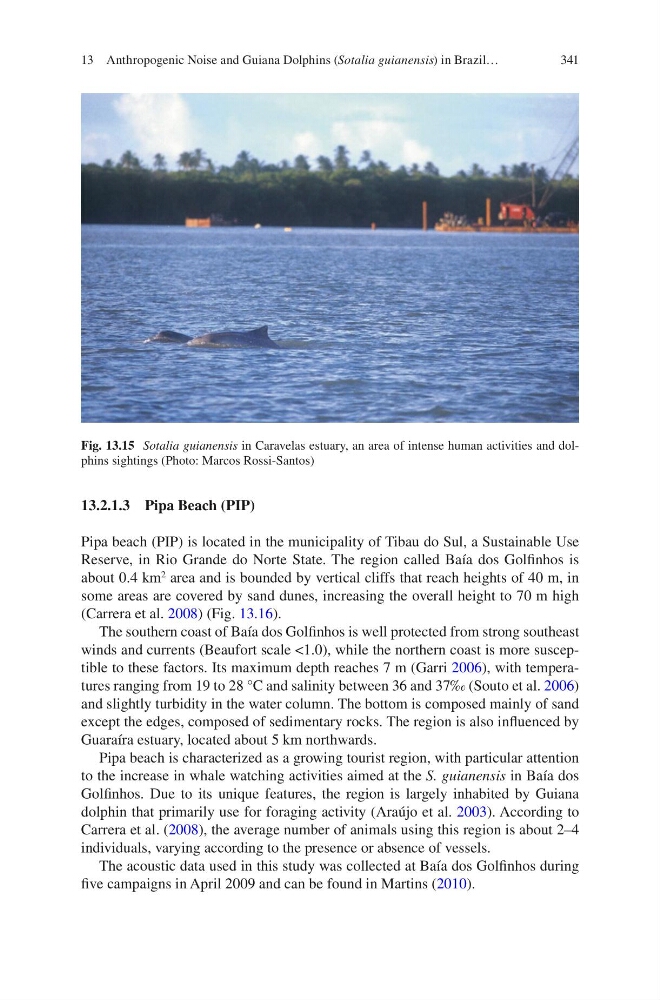
Fig. 13.15 Sotalia guianensis in Caravelas estuary, an area of intense human activities and dolphins sightings (Photo: Marcos Rossi-Santos)
13 Anthropogenic Noise and Guiana Dolphins (Sotalia guianensis) in Brazil…
13.2.1.3 Pipa Beach (PIP)
Pipa beach (PIP) is located in the municipality of Tibau do Sul, a Sustainable Use
Reserve, in Rio Grande do Norte State. The region called Baía dos Golfinhos is
about 0.4 km
2
area and is bounded by vertical cliffs that reach heights of 40 m, in
some areas are covered by sand dunes, increasing the overall height to 70 m high
(Carrera et al. 2008) (Fig. 13.16).
The southern coast of Baía dos Golfinhos is well protected from strong southeast
winds and currents (Beaufort scale <1.0), while the northern coast is more susceptible to these factors. Its maximum depth reaches 7 m (Garri 2006), with temperatures ranging from 19 to 28 °C and salinity between 36 and 37‰ (Souto et al. 2006)
and slightly turbidity in the water column. The bottom is composed mainly of sand
except the edges, composed of sedimentary rocks. The region is also influenced by
Guaraíra estuary, located about 5 km northwards.
Pipa beach is characterized as a growing tourist region, with particular attention
to the increase in whale watching activities aimed at the S. guianensis in Baía dos
Golfinhos. Due to its unique features, the region is largely inhabited by Guiana
dolphin that primarily use for foraging activity (Araújo et al. 2003). According to
Carrera et al. (2008), the average number of animals using this region is about 2–4
individuals, varying according to the presence or absence of vessels.
The acoustic data used in this study was collected at Baía dos Golfinhos during
five campaigns in April 2009 and can be found in Martins (2010).
Fig. 13.15 Sotalia guianensis in Caravelas estuary, an area of intense human activities and dolphins sightings (Photo: Marcos Rossi-Santos)
13 Anthropogenic Noise and Guiana Dolphins (Sotalia guianensis) in Brazil…