

339
The region of Cananéia has a high density and intense use by Sotalia guianensis
(Bisi 2001). The region has a total abundance of 195 animals and most of the Guiana
dolphin groups occur with two individuals (Havukainen et al. 2011).
The recordings used in this study were obtained between the years 2005 and
2008, and can be found in Monteiro-Filho and Monteiro (2001); (Monteiro-Filho et
al. 2008) and Rezende (2008). Data were recorded in the waters of the Trapandé
Bay, south opening of Cananéia estuary and region adjacent to the Cananéia Island,
Comprida Island and Cardoso Island. This area is the region of the estuary with
highest occurrence of S. guianensis (Oliveira 2007) (Fig. 13.14).
13.2.1.2 Caravelas Estuary (CVL)
The Caravelas estuary (CVL) is located in the southern portion of Bahia State and
is the second largest mangrove forest in northeastern Brazil, comprising an area of
approximately 66 km
2
(Herz 1991).
Caravelas is the main city of the National Marine Park Abrolhos Bank. The
region is characterized by a pronounced increase in the extension of the continental
shelf, protected by banks of coral reefs, with a predominance of sandy beaches and
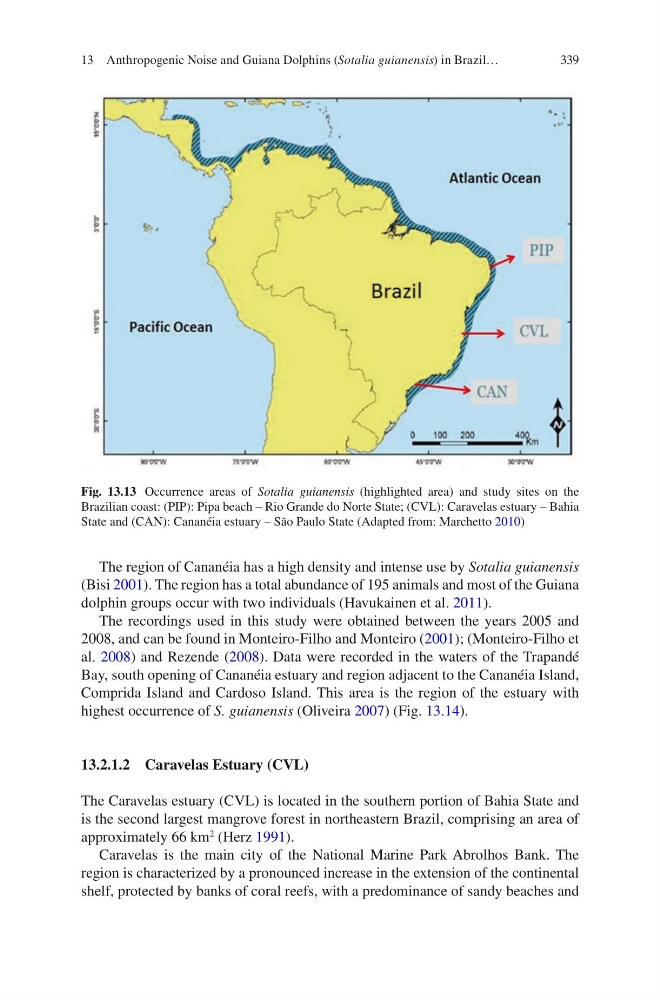
Fig. 13.13 Occurrence areas of Sotalia guianensis (highlighted area) and study sites on the
Brazilian coast: (PIP): Pipa beach – Rio Grande do Norte State; (CVL): Caravelas estuary – Bahia
State and (CAN): Cananéia estuary – São Paulo State (Adapted from: Marchetto 2010)
13 Anthropogenic Noise and Guiana Dolphins (Sotalia guianensis) in Brazil…
The region of Cananéia has a high density and intense use by Sotalia guianensis
(Bisi 2001). The region has a total abundance of 195 animals and most of the Guiana
dolphin groups occur with two individuals (Havukainen et al. 2011).
The recordings used in this study were obtained between the years 2005 and
2008, and can be found in Monteiro-Filho and Monteiro (2001); (Monteiro-Filho et
al. 2008) and Rezende (2008). Data were recorded in the waters of the Trapandé
Bay, south opening of Cananéia estuary and region adjacent to the Cananéia Island,
Comprida Island and Cardoso Island. This area is the region of the estuary with
highest occurrence of S. guianensis (Oliveira 2007) (Fig. 13.14).
13.2.1.2 Caravelas Estuary (CVL)
The Caravelas estuary (CVL) is located in the southern portion of Bahia State and
is the second largest mangrove forest in northeastern Brazil, comprising an area of
approximately 66 km
2
(Herz 1991).
Caravelas is the main city of the National Marine Park Abrolhos Bank. The
region is characterized by a pronounced increase in the extension of the continental
shelf, protected by banks of coral reefs, with a predominance of sandy beaches and
Fig. 13.13 Occurrence areas of Sotalia guianensis (highlighted area) and study sites on the
Brazilian coast: (PIP): Pipa beach – Rio Grande do Norte State; (CVL): Caravelas estuary – Bahia
State and (CAN): Cananéia estuary – São Paulo State (Adapted from: Marchetto 2010)
13 Anthropogenic Noise and Guiana Dolphins (Sotalia guianensis) in Brazil…