

338
13.2 Material and Methods
13.2.1 Study Areas
Three regions were studied on the Brazilian coast from south to north: Cananéia
estuary (25° 04′S, 47° 56′W) in São Paulo State; Caravelas estuary (17° 30′S, 39°
30′W) in Bahia State and Pipa beach (06° 10′S, 35° 05′W) in Rio Grande do Norte
State (Fig. 13.13). The sampled areas were chosen because they represent typical
examples of how the coastal and estuarine regions have been shared between aquatic
mammals and increasing human activities.
13.2.1.1 Cananéia Estuary (CAN)
The Cananéia estuary (CAN) is located on the southern coast of São Paulo State
being part of a lagoon-estuarine system of about 180 km. It is an area of intense
fishing activity, characterized by mangroves, beaches and predominantly muddy
bottom (Monteiro-Filho and Monteiro 2001). The hydrodynamics of this estuary is
influenced mainly by the action of tidal waves, with contribution of fluvial waters
from rivers, shallow depths (up to 23 m), causing water with high turbidity throughout the year (Schaeffer-Novelli et al. 1990).
5
1
2
10
Tempo (s)
Freqüência (kHz)
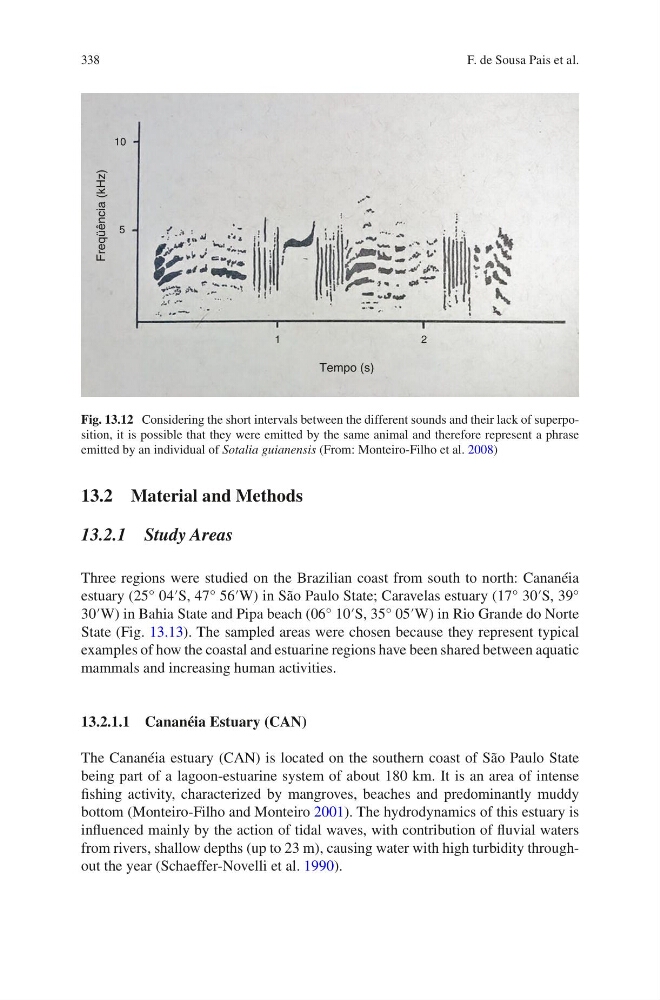
Fig. 13.12 Considering the short intervals between the different sounds and their lack of superposition, it is possible that they were emitted by the same animal and therefore represent a phrase
emitted by an individual of Sotalia guianensis (From: Monteiro-Filho et al. 2008)
F. de Sousa Pais et al.
13.2 Material and Methods
13.2.1 Study Areas
Three regions were studied on the Brazilian coast from south to north: Cananéia
estuary (25° 04′S, 47° 56′W) in São Paulo State; Caravelas estuary (17° 30′S, 39°
30′W) in Bahia State and Pipa beach (06° 10′S, 35° 05′W) in Rio Grande do Norte
State (Fig. 13.13). The sampled areas were chosen because they represent typical
examples of how the coastal and estuarine regions have been shared between aquatic
mammals and increasing human activities.
13.2.1.1 Cananéia Estuary (CAN)
The Cananéia estuary (CAN) is located on the southern coast of São Paulo State
being part of a lagoon-estuarine system of about 180 km. It is an area of intense
fishing activity, characterized by mangroves, beaches and predominantly muddy
bottom (Monteiro-Filho and Monteiro 2001). The hydrodynamics of this estuary is
influenced mainly by the action of tidal waves, with contribution of fluvial waters
from rivers, shallow depths (up to 23 m), causing water with high turbidity throughout the year (Schaeffer-Novelli et al. 1990).
5
1
2
10
Tempo (s)
Freqüência (kHz)
Fig. 13.12 Considering the short intervals between the different sounds and their lack of superposition, it is possible that they were emitted by the same animal and therefore represent a phrase
emitted by an individual of Sotalia guianensis (From: Monteiro-Filho et al. 2008)
F. de Sousa Pais et al.