

272
Aquiraz to Touros, with a concentration of manatees in the coast of Icapuí municipality, and an absence of records between São Miguel de Touros and Porto do
Mangue (RN) and west to Aquiraz.
Choi (2011) through interviews (n = 678) in 77 localities between Beberibe, in
east Ceará coast, and Touros, in northwestern Rio Grande do Norte state, indicated
the absence of manatees west to Aracati (Beberibe and Fortim) and in Guamaré. The
author also reported a high occurrence index in Icapuí and Aracati municipalities.
Also, according to interviews, manatees occur only in coastal areas, but used to be
observed in the six estuaries of the studied region. In these regions, manatees drink
freshwater from the underground aquifers which emerge in the bottom of the sea
(Aquasis 2006; Meirelles et al. 2016a).
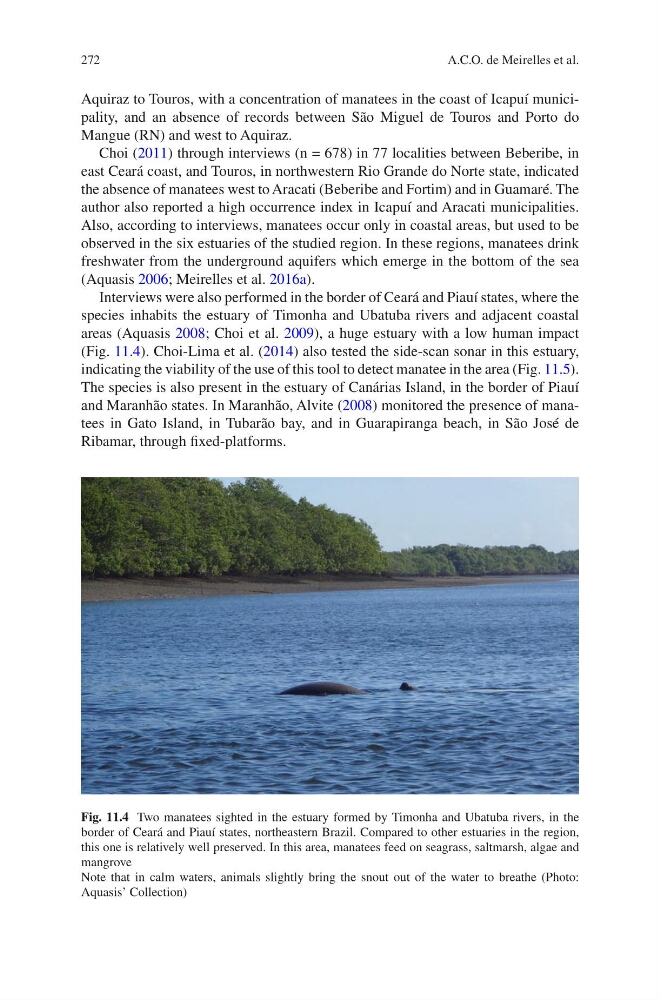
Interviews were also performed in the border of Ceará and Piauí states, where the
species inhabits the estuary of Timonha and Ubatuba rivers and adjacent coastal
areas (Aquasis 2008; Choi et al. 2009), a huge estuary with a low human impact
(Fig. 11.4). Choi-Lima et al. (2014) also tested the side-scan sonar in this estuary,
indicating the viability of the use of this tool to detect manatee in the area (Fig. 11.5).
The species is also present in the estuary of Canárias Island, in the border of Piauí
and Maranhão states. In Maranhão, Alvite (2008) monitored the presence of manatees in Gato Island, in Tubarão bay, and in Guarapiranga beach, in São José de
Ribamar, through fixed-platforms.
Fig. 11.4 Two manatees sighted in the estuary formed by Timonha and Ubatuba rivers, in the
border of Ceará and Piauí states, northeastern Brazil. Compared to other estuaries in the region,
this one is relatively well preserved. In this area, manatees feed on seagrass, saltmarsh, algae and
mangrove
Note that in calm waters, animals slightly bring the snout out of the water to breathe (Photo:
Aquasis’ Collection)
A.C.O. de Meirelles et al.
Aquiraz to Touros, with a concentration of manatees in the coast of Icapuí municipality, and an absence of records between São Miguel de Touros and Porto do
Mangue (RN) and west to Aquiraz.
Choi (2011) through interviews (n = 678) in 77 localities between Beberibe, in
east Ceará coast, and Touros, in northwestern Rio Grande do Norte state, indicated
the absence of manatees west to Aracati (Beberibe and Fortim) and in Guamaré. The
author also reported a high occurrence index in Icapuí and Aracati municipalities.
Also, according to interviews, manatees occur only in coastal areas, but used to be
observed in the six estuaries of the studied region. In these regions, manatees drink
freshwater from the underground aquifers which emerge in the bottom of the sea
(Aquasis 2006; Meirelles et al. 2016a).
Interviews were also performed in the border of Ceará and Piauí states, where the
species inhabits the estuary of Timonha and Ubatuba rivers and adjacent coastal
areas (Aquasis 2008; Choi et al. 2009), a huge estuary with a low human impact
(Fig. 11.4). Choi-Lima et al. (2014) also tested the side-scan sonar in this estuary,
indicating the viability of the use of this tool to detect manatee in the area (Fig. 11.5).
The species is also present in the estuary of Canárias Island, in the border of Piauí
and Maranhão states. In Maranhão, Alvite (2008) monitored the presence of manatees in Gato Island, in Tubarão bay, and in Guarapiranga beach, in São José de
Ribamar, through fixed-platforms.
Fig. 11.4 Two manatees sighted in the estuary formed by Timonha and Ubatuba rivers, in the
border of Ceará and Piauí states, northeastern Brazil. Compared to other estuaries in the region,
this one is relatively well preserved. In this area, manatees feed on seagrass, saltmarsh, algae and
mangrove
Note that in calm waters, animals slightly bring the snout out of the water to breathe (Photo:
Aquasis’ Collection)
A.C.O. de Meirelles et al.