

271
atees in most of Pernambuco coast, and the west coast of Ceará, where Lima (1997)
indicated that the species was not present. In Ceará west coast, we believe that the
absence of the species is related to the lack of favorable ecological characteristics,
which makes it the major discontinuity area in the manatee distribution in Brazil.
Lima (op. cit) also indicated that the species was not present in the southern portion
of Alagoas state. In 1994, Brazilian Government started a translocation program in
Alagoas and Paraíba states, to release rehabilitated calves stranded in the country’s
coast (Lima 2008; Normande et al. 2015; Normande et al. 2016) to re-colonize areas
of historic distribution.
In the states of Ceará and Rio Grande do Norte, interviews (Alves 2007; Aquasis
2006; Choi 2011), aerial (Alves et al. 2013; Aquasis 2006; Costa 2006; Petrobras
2014), boat (Aquasis 2006; Costa 2006) and land-based surveys (Alves 2003, 2007;
Aquasis 2006; Moretz-Sohn 2013) and beach monitoring for stranding records
(Meirelles 2008; Silva 2010) were performed to identify species distribution and
critical areas for conservation. Aerial (24 h effort) and boat surveys (157 h of effort
in Ceará coast; Aquasis 2006; Costa 2006), from Fortim to Icapuí, in the eastern
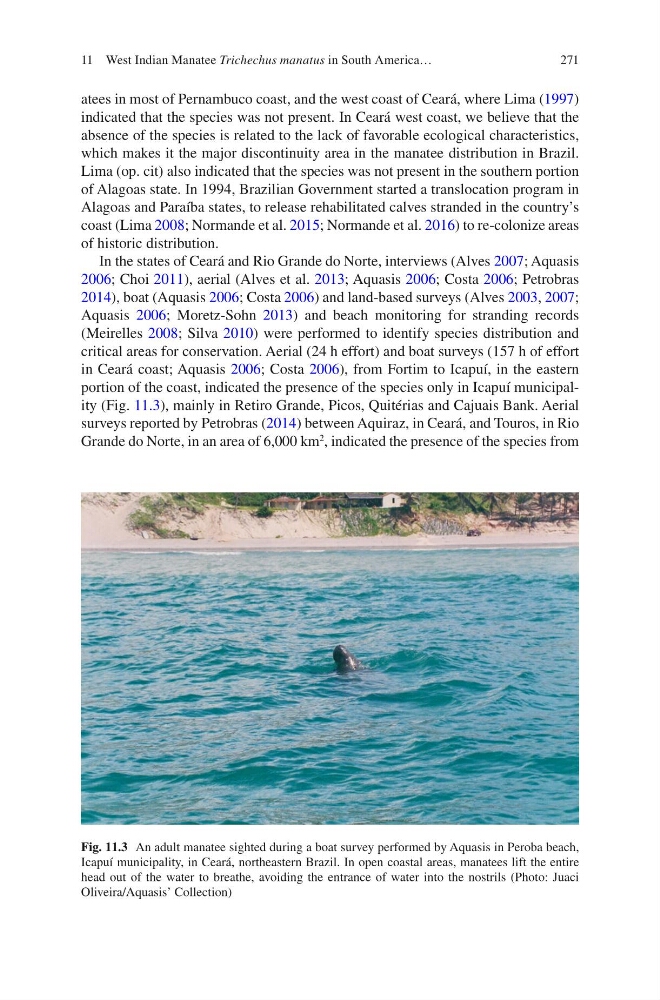
portion of the coast, indicated the presence of the species only in Icapuí municipality (Fig. 11.3), mainly in Retiro Grande, Picos, Quitérias and Cajuais Bank. Aerial
surveys reported by Petrobras (2014) between Aquiraz, in Ceará, and Touros, in Rio
Grande do Norte, in an area of 6,000 km
2
, indicated the presence of the species from
Fig. 11.3 An adult manatee sighted during a boat survey performed by Aquasis in Peroba beach,
Icapuí municipality, in Ceará, northeastern Brazil. In open coastal areas, manatees lift the entire
head out of the water to breathe, avoiding the entrance of water into the nostrils (Photo: Juaci
Oliveira/Aquasis’ Collection)
11 West Indian Manatee Trichechus manatus in South America…
atees in most of Pernambuco coast, and the west coast of Ceará, where Lima (1997)
indicated that the species was not present. In Ceará west coast, we believe that the
absence of the species is related to the lack of favorable ecological characteristics,
which makes it the major discontinuity area in the manatee distribution in Brazil.
Lima (op. cit) also indicated that the species was not present in the southern portion
of Alagoas state. In 1994, Brazilian Government started a translocation program in
Alagoas and Paraíba states, to release rehabilitated calves stranded in the country’s
coast (Lima 2008; Normande et al. 2015; Normande et al. 2016) to re-colonize areas
of historic distribution.
In the states of Ceará and Rio Grande do Norte, interviews (Alves 2007; Aquasis
2006; Choi 2011), aerial (Alves et al. 2013; Aquasis 2006; Costa 2006; Petrobras
2014), boat (Aquasis 2006; Costa 2006) and land-based surveys (Alves 2003, 2007;
Aquasis 2006; Moretz-Sohn 2013) and beach monitoring for stranding records
(Meirelles 2008; Silva 2010) were performed to identify species distribution and
critical areas for conservation. Aerial (24 h effort) and boat surveys (157 h of effort
in Ceará coast; Aquasis 2006; Costa 2006), from Fortim to Icapuí, in the eastern
portion of the coast, indicated the presence of the species only in Icapuí municipality (Fig. 11.3), mainly in Retiro Grande, Picos, Quitérias and Cajuais Bank. Aerial
surveys reported by Petrobras (2014) between Aquiraz, in Ceará, and Touros, in Rio
Grande do Norte, in an area of 6,000 km
2
, indicated the presence of the species from
Fig. 11.3 An adult manatee sighted during a boat survey performed by Aquasis in Peroba beach,
Icapuí municipality, in Ceará, northeastern Brazil. In open coastal areas, manatees lift the entire
head out of the water to breathe, avoiding the entrance of water into the nostrils (Photo: Juaci
Oliveira/Aquasis’ Collection)
11 West Indian Manatee Trichechus manatus in South America…