

256
10.4 Decision-Making, Health and Conservation.
The Concerns Grow!
According to consumer’s knowledge of a large city of southern Brazil, more than
70% of them are often unaware that “cação” refers to sharks, and more than half of
respondents claimed to have already eaten “cação” but never eaten sharks or rays
(Bornatowski et al. 2015). So, consumers are buying “a pig in a poke”. Beside of
that, in surveys made in southeastern Brazil (states of São Paulo and Rio de Janeiro),
62% of fish sold as groupers were actually sharks (Estrella et al. 2014). This mislabeling provokes a 25% increase in revenue. Unfortunately, the problem does not
stop there and this may be only the tip of the iceberg.
The mislabeling may preclude people from taking health- and/or conservationrelated decisions concerning the consumption of elasmobranch meat and thus interfere with efforts to reduce consumption or redirect consumption towards
non-threatened species (Barbuto et al. 2010; Bornatowski et al. 2013; Jacquet and
Pauly 2008). Furthermore, misleading product descriptions is a crime according to
Brazilian Consumer Protection Code (n° 8078/1990) (Brazil 1990). A recent study
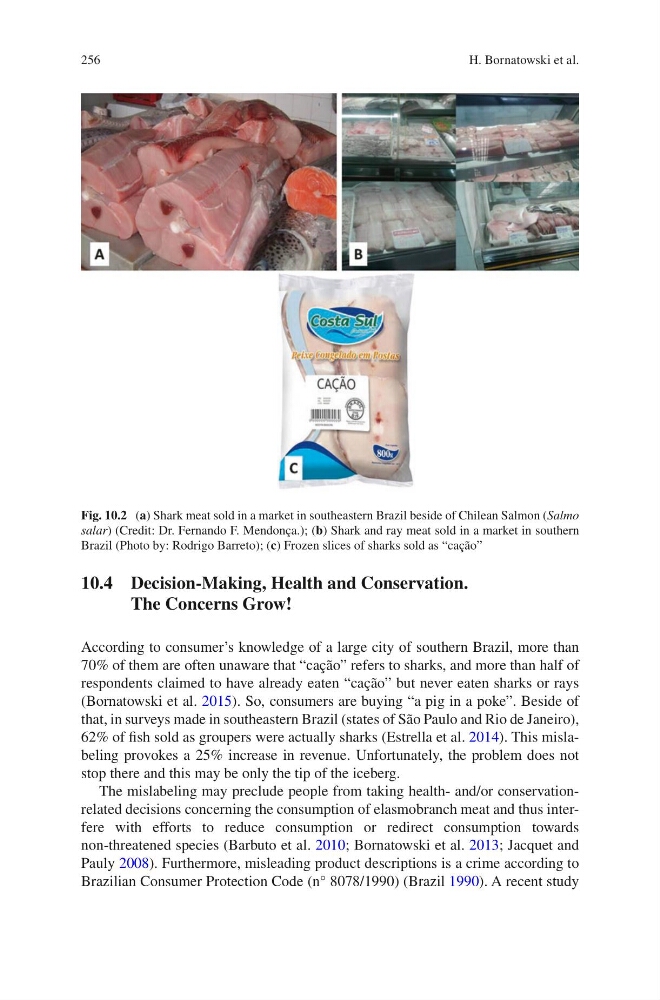
Fig. 10.2 (a) Shark meat sold in a market in southeastern Brazil beside of Chilean Salmon (Salmo
salar) (Credit: Dr. Fernando F. Mendonça.); (b) Shark and ray meat sold in a market in southern
Brazil (Photo by: Rodrigo Barreto); (c) Frozen slices of sharks sold as “cação”
H. Bornatowski et al.
10.4 Decision-Making, Health and Conservation.
The Concerns Grow!
According to consumer’s knowledge of a large city of southern Brazil, more than
70% of them are often unaware that “cação” refers to sharks, and more than half of
respondents claimed to have already eaten “cação” but never eaten sharks or rays
(Bornatowski et al. 2015). So, consumers are buying “a pig in a poke”. Beside of
that, in surveys made in southeastern Brazil (states of São Paulo and Rio de Janeiro),
62% of fish sold as groupers were actually sharks (Estrella et al. 2014). This mislabeling provokes a 25% increase in revenue. Unfortunately, the problem does not
stop there and this may be only the tip of the iceberg.
The mislabeling may preclude people from taking health- and/or conservationrelated decisions concerning the consumption of elasmobranch meat and thus interfere with efforts to reduce consumption or redirect consumption towards
non-threatened species (Barbuto et al. 2010; Bornatowski et al. 2013; Jacquet and
Pauly 2008). Furthermore, misleading product descriptions is a crime according to
Brazilian Consumer Protection Code (n° 8078/1990) (Brazil 1990). A recent study
Fig. 10.2 (a) Shark meat sold in a market in southeastern Brazil beside of Chilean Salmon (Salmo
salar) (Credit: Dr. Fernando F. Mendonça.); (b) Shark and ray meat sold in a market in southern
Brazil (Photo by: Rodrigo Barreto); (c) Frozen slices of sharks sold as “cação”
H. Bornatowski et al.