

255
In Brazil, sharks are sold as “cação” – a popular name attributed for any shark or
ray species (Fig. 10.2). People frequently purchase shark meat in pieces as ‘fillet’ or
‘thermidor’. The most common dish made with elasmobranch meat is a traditionally dish called “Muqueca”. This dish is originally from Espírito Santo, in the
Southeast of Brazil, and also from the state of Bahia, in the Northeast.
Curiously, shark meat were not part of the traditional Brazilian diet and is considered to be low-value seafood (values around U$2.00/Kg
−1
) if comparable to more
common fish such as tilapia (Tilapia spp. and Oreochromis niloticus), flatfish
(Paralichthyidae family), salmon (Salmon salari), croacker fish (Cynosion spp.),
snook (Centropomus spp.), groupers (Serranidae family) and snappers (Lutjanidae
family) and others. However, today the Brazilian market have a high interest in
encouraging people to eat “cação” meat, mainly because of their attractive prices (as
cited above), unfamiliarity with the product and to avoid meat waste (Ministério da
Agricultura, Pecuária e Abastecimento – MAPA). The high interest of Brazil for
elasmobranch meat turns it into the perfect “port for meat discard” (finning is prohibited in several regions).
Furthermore, shark meat is traded without labeling and at substantially lower
prices under the name of “cação” and not as “shark” or “ray” (Fig. 10.2). This raise
a number of questions, mainly in respect to the knowledge of people/consumers, as
what are they eating, and why the Brazilian meat market has grown so much in the
last years.
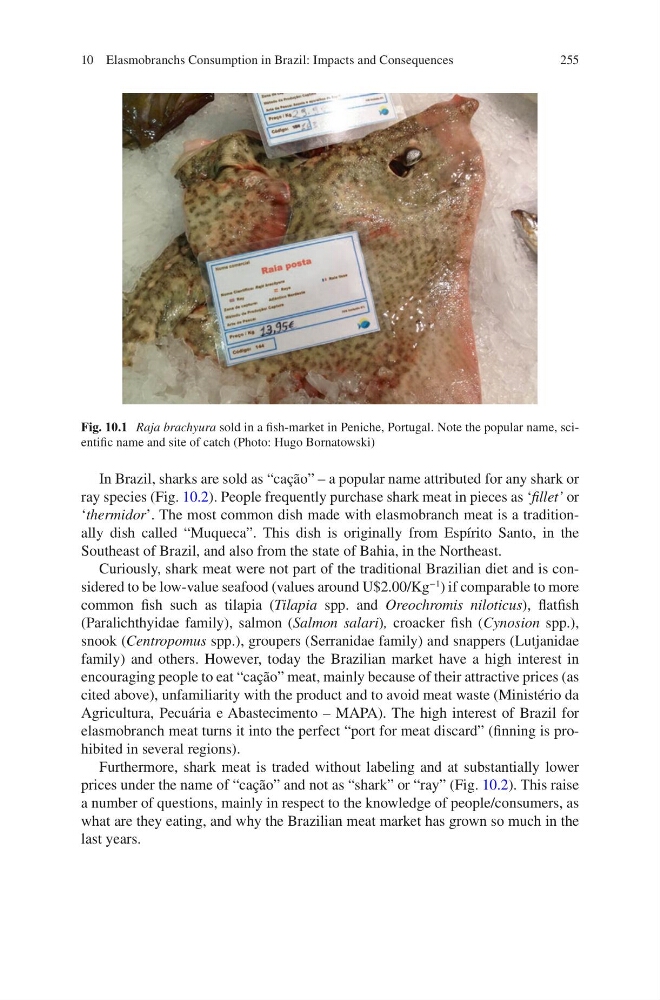
Fig. 10.1 Raja brachyura sold in a fish-market in Peniche, Portugal. Note the popular name, scientific name and site of catch (Photo: Hugo Bornatowski)
10 Elasmobranchs Consumption in Brazil: Impacts and Consequences
In Brazil, sharks are sold as “cação” – a popular name attributed for any shark or
ray species (Fig. 10.2). People frequently purchase shark meat in pieces as ‘fillet’ or
‘thermidor’. The most common dish made with elasmobranch meat is a traditionally dish called “Muqueca”. This dish is originally from Espírito Santo, in the
Southeast of Brazil, and also from the state of Bahia, in the Northeast.
Curiously, shark meat were not part of the traditional Brazilian diet and is considered to be low-value seafood (values around U$2.00/Kg
−1
) if comparable to more
common fish such as tilapia (Tilapia spp. and Oreochromis niloticus), flatfish
(Paralichthyidae family), salmon (Salmon salari), croacker fish (Cynosion spp.),
snook (Centropomus spp.), groupers (Serranidae family) and snappers (Lutjanidae
family) and others. However, today the Brazilian market have a high interest in
encouraging people to eat “cação” meat, mainly because of their attractive prices (as
cited above), unfamiliarity with the product and to avoid meat waste (Ministério da
Agricultura, Pecuária e Abastecimento – MAPA). The high interest of Brazil for
elasmobranch meat turns it into the perfect “port for meat discard” (finning is prohibited in several regions).
Furthermore, shark meat is traded without labeling and at substantially lower
prices under the name of “cação” and not as “shark” or “ray” (Fig. 10.2). This raise
a number of questions, mainly in respect to the knowledge of people/consumers, as
what are they eating, and why the Brazilian meat market has grown so much in the
last years.
Fig. 10.1 Raja brachyura sold in a fish-market in Peniche, Portugal. Note the popular name, scientific name and site of catch (Photo: Hugo Bornatowski)
10 Elasmobranchs Consumption in Brazil: Impacts and Consequences