

257
found that samples labeled under the name “cação” in Brazil were in fact made up
of endangered scalloped hammerhead (Carvalho et al. 2015). Another study showed
that 55% of “cação” samples were actually large-tooth sawfish, Pristis perotteti, a
species considered by the IUCN to be critically endangered and for which trade is
prohibited in Brazil (Palmeira et al. 2013). The generalization of species in a single
name (such as “cação”) is therefore puting in risk several threatened species. In 19
October 2016, an online journal published a matter on “Sharks and rays threatened
that are irregularly commercialized in Brazil” (http://economia.uol.com.br/noticias/
efe/2016/10/19/tubaroes-e-raias-em-extincao-sao-comercializados-irregularmenteno-brasil.htm). More than 16 different species of sharks and rays were sold as
“cação”, with special concern to the hidden angel shark Squatina occulta, and scalloped hammerhead shark Sphyrna lewini (23% of samples) classified as critically
endangered and vulnerable respectively according IUCN redlist. In southern Brazil,
artisanal fisheries capture a lot of sharks, including some threatened species that are
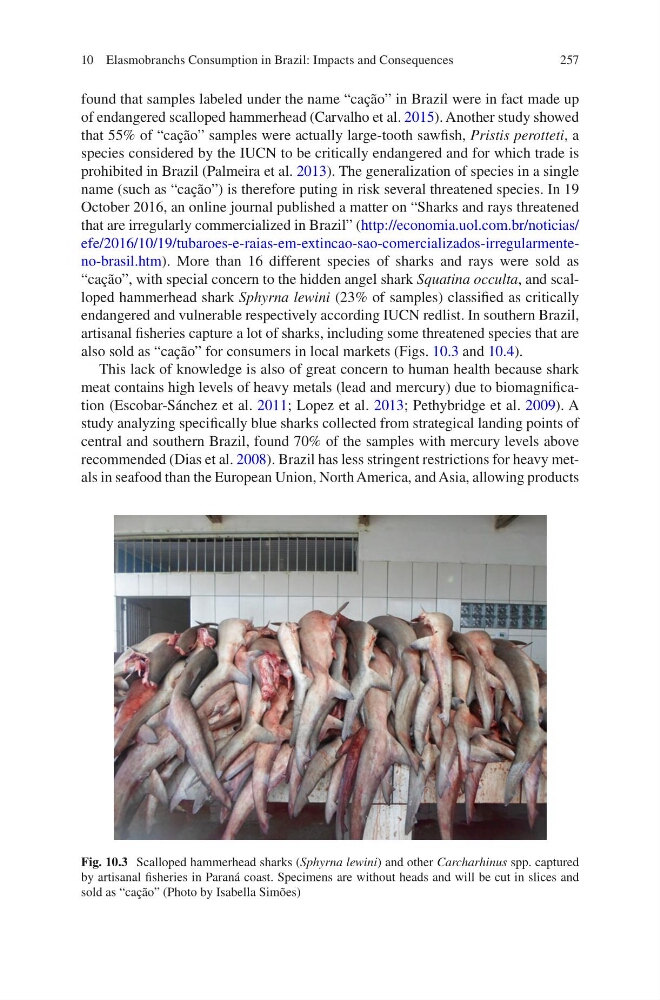
also sold as “cação” for consumers in local markets (Figs. 10.3 and 10.4).
This lack of knowledge is also of great concern to human health because shark
meat contains high levels of heavy metals (lead and mercury) due to biomagnification (Escobar-Sánchez et al. 2011; Lopez et al. 2013; Pethybridge et al. 2009). A
study analyzing specifically blue sharks collected from strategical landing points of
central and southern Brazil, found 70% of the samples with mercury levels above
recommended (Dias et al. 2008). Brazil has less stringent restrictions for heavy metals in seafood than the European Union, North America, and Asia, allowing products
Fig. 10.3 Scalloped hammerhead sharks (Sphyrna lewini) and other Carcharhinus spp. captured
by artisanal fisheries in Paraná coast. Specimens are without heads and will be cut in slices and
sold as “cação” (Photo by Isabella Simões)
10 Elasmobranchs Consumption in Brazil: Impacts and Consequences
found that samples labeled under the name “cação” in Brazil were in fact made up
of endangered scalloped hammerhead (Carvalho et al. 2015). Another study showed
that 55% of “cação” samples were actually large-tooth sawfish, Pristis perotteti, a
species considered by the IUCN to be critically endangered and for which trade is
prohibited in Brazil (Palmeira et al. 2013). The generalization of species in a single
name (such as “cação”) is therefore puting in risk several threatened species. In 19
October 2016, an online journal published a matter on “Sharks and rays threatened
that are irregularly commercialized in Brazil” (http://economia.uol.com.br/noticias/
efe/2016/10/19/tubaroes-e-raias-em-extincao-sao-comercializados-irregularmenteno-brasil.htm). More than 16 different species of sharks and rays were sold as
“cação”, with special concern to the hidden angel shark Squatina occulta, and scalloped hammerhead shark Sphyrna lewini (23% of samples) classified as critically
endangered and vulnerable respectively according IUCN redlist. In southern Brazil,
artisanal fisheries capture a lot of sharks, including some threatened species that are
also sold as “cação” for consumers in local markets (Figs. 10.3 and 10.4).
This lack of knowledge is also of great concern to human health because shark
meat contains high levels of heavy metals (lead and mercury) due to biomagnification (Escobar-Sánchez et al. 2011; Lopez et al. 2013; Pethybridge et al. 2009). A
study analyzing specifically blue sharks collected from strategical landing points of
central and southern Brazil, found 70% of the samples with mercury levels above
recommended (Dias et al. 2008). Brazil has less stringent restrictions for heavy metals in seafood than the European Union, North America, and Asia, allowing products
Fig. 10.3 Scalloped hammerhead sharks (Sphyrna lewini) and other Carcharhinus spp. captured
by artisanal fisheries in Paraná coast. Specimens are without heads and will be cut in slices and
sold as “cação” (Photo by Isabella Simões)
10 Elasmobranchs Consumption in Brazil: Impacts and Consequences