

200
8.2.2 Field Procedures
Opportunistic sightings of dolphins occurred between July and October, during the
years of 2001 and 2006, through the research cruises and the daily Whale Watching
tours, in which were embarked staff technicians from the Instituto Baleia Jubarte/
IBJ, in order to study the biology of humpback whales (Megaptera novaeangliae),
in this breeding ground (see details in Rossi-Santos et al. 2008). During every year
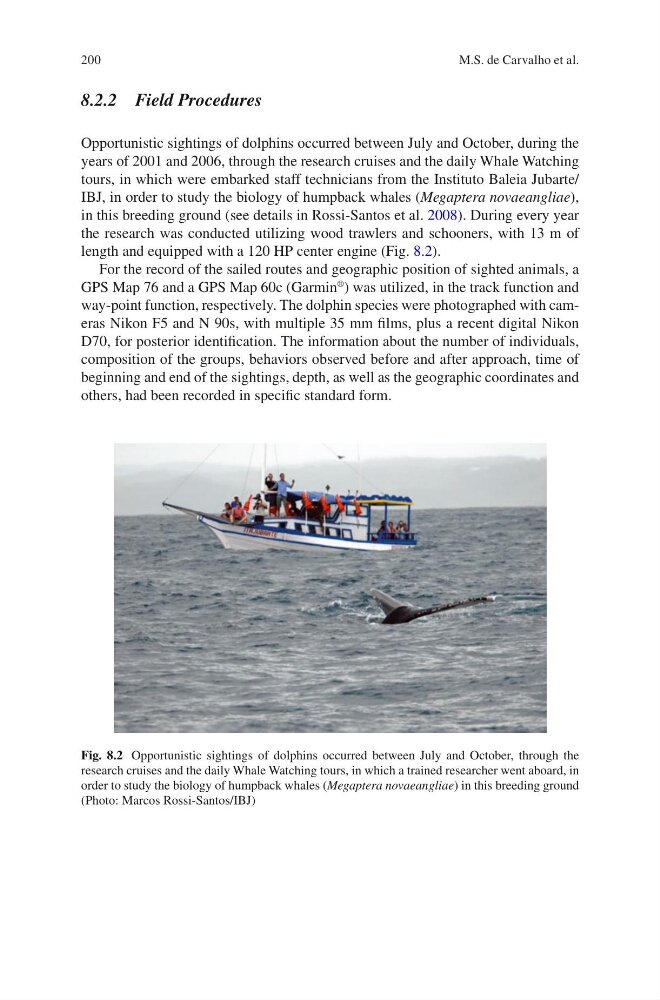
the research was conducted utilizing wood trawlers and schooners, with 13 m of
length and equipped with a 120 HP center engine (Fig. 8.2).
For the record of the sailed routes and geographic position of sighted animals, a
GPS Map 76 and a GPS Map 60c (Garmin
®
) was utilized, in the track function and
way-point function, respectively. The dolphin species were photographed with cameras Nikon F5 and N 90s, with multiple 35 mm films, plus a recent digital Nikon
D70, for posterior identification. The information about the number of individuals,
composition of the groups, behaviors observed before and after approach, time of
beginning and end of the sightings, depth, as well as the geographic coordinates and
others, had been recorded in specific standard form.
Fig. 8.2 Opportunistic sightings of dolphins occurred between July and October, through the
research cruises and the daily Whale Watching tours, in which a trained researcher went aboard, in
order to study the biology of humpback whales (Megaptera novaeangliae) in this breeding ground
(Photo: Marcos Rossi-Santos/IBJ)
M.S. de Carvalho et al.
8.2.2 Field Procedures
Opportunistic sightings of dolphins occurred between July and October, during the
years of 2001 and 2006, through the research cruises and the daily Whale Watching
tours, in which were embarked staff technicians from the Instituto Baleia Jubarte/
IBJ, in order to study the biology of humpback whales (Megaptera novaeangliae),
in this breeding ground (see details in Rossi-Santos et al. 2008). During every year
the research was conducted utilizing wood trawlers and schooners, with 13 m of
length and equipped with a 120 HP center engine (Fig. 8.2).
For the record of the sailed routes and geographic position of sighted animals, a
GPS Map 76 and a GPS Map 60c (Garmin
®
) was utilized, in the track function and
way-point function, respectively. The dolphin species were photographed with cameras Nikon F5 and N 90s, with multiple 35 mm films, plus a recent digital Nikon
D70, for posterior identification. The information about the number of individuals,
composition of the groups, behaviors observed before and after approach, time of
beginning and end of the sightings, depth, as well as the geographic coordinates and
others, had been recorded in specific standard form.
Fig. 8.2 Opportunistic sightings of dolphins occurred between July and October, through the
research cruises and the daily Whale Watching tours, in which a trained researcher went aboard, in
order to study the biology of humpback whales (Megaptera novaeangliae) in this breeding ground
(Photo: Marcos Rossi-Santos/IBJ)
M.S. de Carvalho et al.