

201
8.2.3 Data Analyses
The data obtained with GPS had been transferred to a computer using the GPS
Track Maker Professional Program (version 11.8). For posterior analysis and studies of the distribution of the dolphins in the showed area, the geographic coordinates
of the sightings had been located in digital nautical letter using the program Arc
View GIS (version 3.1), and the same program was used for elaboration of the distribution maps of the joined species.
8.3 Results
Between the period of July and November from 2001 to 2006, about 500 days of
sampling effort were carried out, resulting in 93 groups of dolphins sighted in the
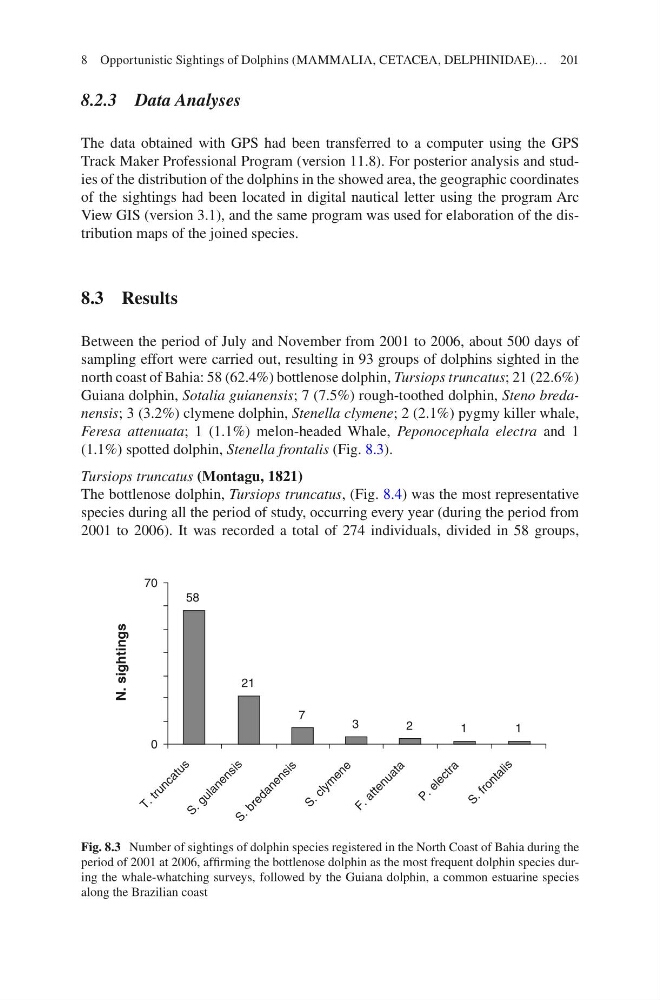
north coast of Bahia: 58 (62.4%) bottlenose dolphin, Tursiops truncatus; 21 (22.6%)
Guiana dolphin, Sotalia guianensis; 7 (7.5%) rough-toothed dolphin, Steno bredanensis; 3 (3.2%) clymene dolphin, Stenella clymene; 2 (2.1%) pygmy killer whale,
Feresa attenuata; 1 (1.1%) melon-headed Whale, Peponocephala electra and 1
(1.1%) spotted dolphin, Stenella frontalis (Fig. 8.3).
Tursiops truncatus (Montagu, 1821)
The bottlenose dolphin, Tursiops truncatus, (Fig. 8.4) was the most representative
species during all the period of study, occurring every year (during the period from
2001 to 2006). It was recorded a total of 274 individuals, divided in 58 groups,
70
0
58
21
7
3
2
1
1
T . t r u n c a t u s
S . g u l a n e n s i s
S . b r e d a n e n s i s
S . c l y m
e n e
F . a t t e n u a t a
P . e l e c t r a
S . f r o n t a l i s
N. sightings
Fig. 8.3 Number of sightings of dolphin species registered in the North Coast of Bahia during the
period of 2001 at 2006, affirming the bottlenose dolphin as the most frequent dolphin species during the whale-whatching surveys, followed by the Guiana dolphin, a common estuarine species
along the Brazilian coast
8 Opportunistic Sightings of Dolphins (MAMMALIA, CETACEA, DELPHINIDAE)…
8.2.3 Data Analyses
The data obtained with GPS had been transferred to a computer using the GPS
Track Maker Professional Program (version 11.8). For posterior analysis and studies of the distribution of the dolphins in the showed area, the geographic coordinates
of the sightings had been located in digital nautical letter using the program Arc
View GIS (version 3.1), and the same program was used for elaboration of the distribution maps of the joined species.
8.3 Results
Between the period of July and November from 2001 to 2006, about 500 days of
sampling effort were carried out, resulting in 93 groups of dolphins sighted in the
north coast of Bahia: 58 (62.4%) bottlenose dolphin, Tursiops truncatus; 21 (22.6%)
Guiana dolphin, Sotalia guianensis; 7 (7.5%) rough-toothed dolphin, Steno bredanensis; 3 (3.2%) clymene dolphin, Stenella clymene; 2 (2.1%) pygmy killer whale,
Feresa attenuata; 1 (1.1%) melon-headed Whale, Peponocephala electra and 1
(1.1%) spotted dolphin, Stenella frontalis (Fig. 8.3).
Tursiops truncatus (Montagu, 1821)
The bottlenose dolphin, Tursiops truncatus, (Fig. 8.4) was the most representative
species during all the period of study, occurring every year (during the period from
2001 to 2006). It was recorded a total of 274 individuals, divided in 58 groups,
70
0
58
21
7
3
2
1
1
T . t r u n c a t u s
S . g u l a n e n s i s
S . b r e d a n e n s i s
S . c l y m
e n e
F . a t t e n u a t a
P . e l e c t r a
S . f r o n t a l i s
N. sightings
Fig. 8.3 Number of sightings of dolphin species registered in the North Coast of Bahia during the
period of 2001 at 2006, affirming the bottlenose dolphin as the most frequent dolphin species during the whale-whatching surveys, followed by the Guiana dolphin, a common estuarine species
along the Brazilian coast
8 Opportunistic Sightings of Dolphins (MAMMALIA, CETACEA, DELPHINIDAE)…