

182
Differences among Brazilian feeding aggregation sites and others around the
world were also found (Vilaça et al. 2013, Proietti et al. 2014). Results from genetic
analysis estimates showed that the studied Brazilian feeding aggregations are mostly
composed of animals originating from the domestic rookeries Bahia and Pipa, but
some contributions from African and Caribbean rookeries were also observed
(Fig. 7.14).
7.3.4 Leatherback, Dermochelys coriacea
Comparing haplotypes distributions among nesting and foraging grounds, Vargas
et al. (2008) revealed a major contribution to a Brazilian pelagic aggregate (Fig. 7.15)
from Atlantic nesting populations (mean 96.1%) and the existence of six individuals
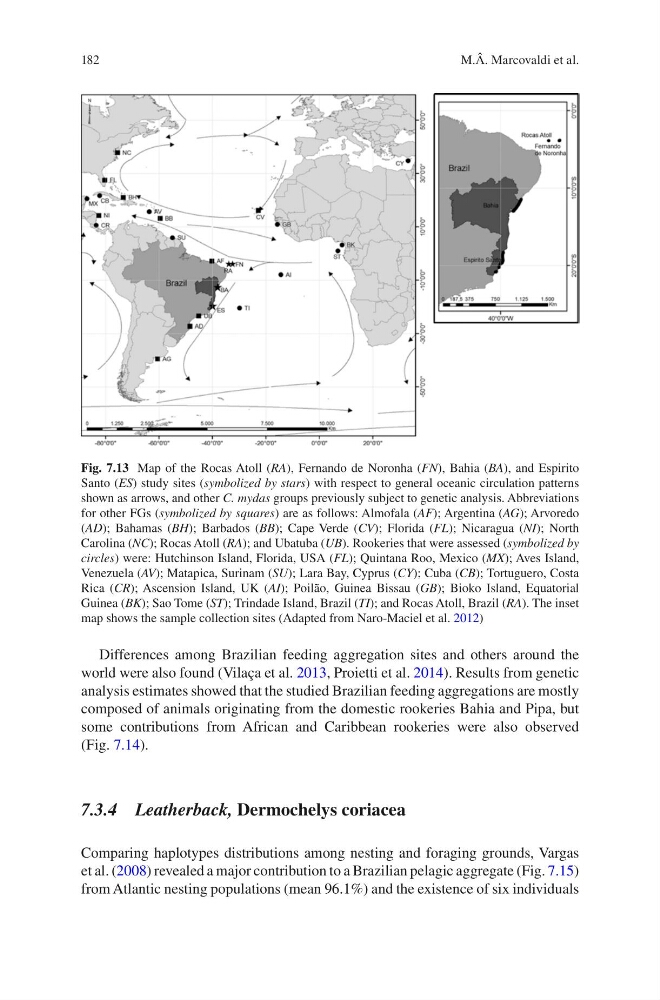
Fig. 7.13 Map of the Rocas Atoll (RA), Fernando de Noronha (FN), Bahia (BA), and Espirito
Santo (ES) study sites (symbolized by stars) with respect to general oceanic circulation patterns
shown as arrows, and other C. mydas groups previously subject to genetic analysis. Abbreviations
for other FGs (symbolized by squares) are as follows: Almofala (AF); Argentina (AG); Arvoredo
(AD); Bahamas (BH); Barbados (BB); Cape Verde (CV); Florida (FL); Nicaragua (NI); North
Carolina (NC); Rocas Atoll (RA); and Ubatuba (UB). Rookeries that were assessed (symbolized by
circles) were: Hutchinson Island, Florida, USA (FL); Quintana Roo, Mexico (MX); Aves Island,
Venezuela (AV); Matapica, Surinam (SU); Lara Bay, Cyprus (CY); Cuba (CB); Tortuguero, Costa
Rica (CR); Ascension Island, UK (AI); Poilão, Guinea Bissau (GB); Bioko Island, Equatorial
Guinea (BK); Sao Tome (ST); Trindade Island, Brazil (TI); and Rocas Atoll, Brazil (RA). The inset
map shows the sample collection sites (Adapted from Naro-Maciel et al. 2012)
M.Â. Marcovaldi et al.
Differences among Brazilian feeding aggregation sites and others around the
world were also found (Vilaça et al. 2013, Proietti et al. 2014). Results from genetic
analysis estimates showed that the studied Brazilian feeding aggregations are mostly
composed of animals originating from the domestic rookeries Bahia and Pipa, but
some contributions from African and Caribbean rookeries were also observed
(Fig. 7.14).
7.3.4 Leatherback, Dermochelys coriacea
Comparing haplotypes distributions among nesting and foraging grounds, Vargas
et al. (2008) revealed a major contribution to a Brazilian pelagic aggregate (Fig. 7.15)
from Atlantic nesting populations (mean 96.1%) and the existence of six individuals
Fig. 7.13 Map of the Rocas Atoll (RA), Fernando de Noronha (FN), Bahia (BA), and Espirito
Santo (ES) study sites (symbolized by stars) with respect to general oceanic circulation patterns
shown as arrows, and other C. mydas groups previously subject to genetic analysis. Abbreviations
for other FGs (symbolized by squares) are as follows: Almofala (AF); Argentina (AG); Arvoredo
(AD); Bahamas (BH); Barbados (BB); Cape Verde (CV); Florida (FL); Nicaragua (NI); North
Carolina (NC); Rocas Atoll (RA); and Ubatuba (UB). Rookeries that were assessed (symbolized by
circles) were: Hutchinson Island, Florida, USA (FL); Quintana Roo, Mexico (MX); Aves Island,
Venezuela (AV); Matapica, Surinam (SU); Lara Bay, Cyprus (CY); Cuba (CB); Tortuguero, Costa
Rica (CR); Ascension Island, UK (AI); Poilão, Guinea Bissau (GB); Bioko Island, Equatorial
Guinea (BK); Sao Tome (ST); Trindade Island, Brazil (TI); and Rocas Atoll, Brazil (RA). The inset
map shows the sample collection sites (Adapted from Naro-Maciel et al. 2012)
M.Â. Marcovaldi et al.