

177
loggerhead sea turtles were satellite tagged using modified small-scale solarpowered satellite tags. Turtles were lab-reared until reaching a minimum size (>10
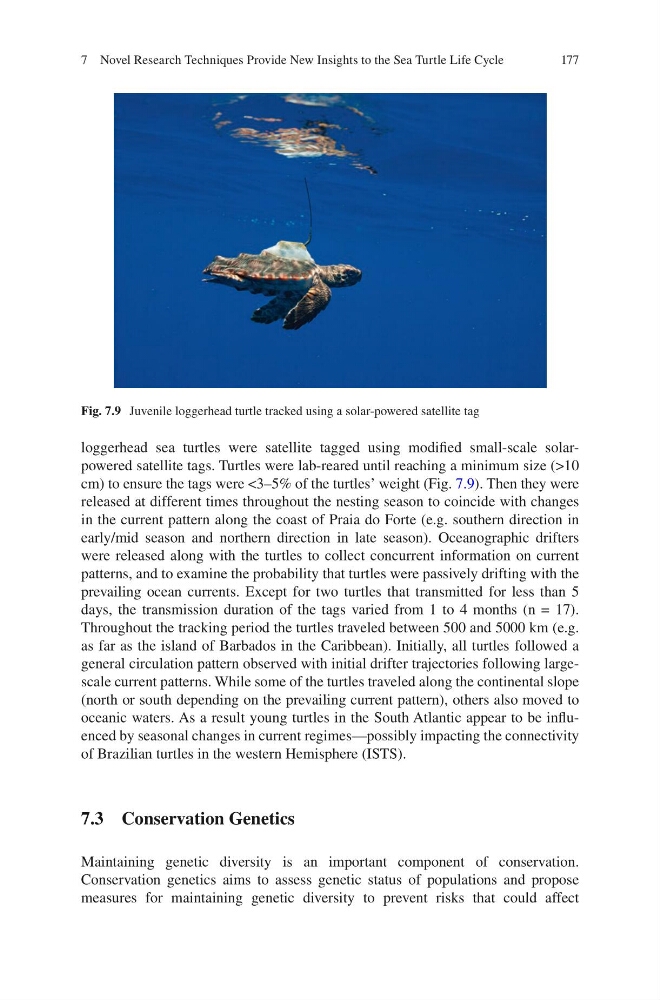
cm) to ensure the tags were <3–5% of the turtles’ weight (Fig. 7.9). Then they were
released at different times throughout the nesting season to coincide with changes
in the current pattern along the coast of Praia do Forte (e.g. southern direction in
early/mid season and northern direction in late season). Oceanographic drifters
were released along with the turtles to collect concurrent information on current
patterns, and to examine the probability that turtles were passively drifting with the
prevailing ocean currents. Except for two turtles that transmitted for less than 5
days, the transmission duration of the tags varied from 1 to 4 months (n = 17).
Throughout the tracking period the turtles traveled between 500 and 5000 km (e.g.
as far as the island of Barbados in the Caribbean). Initially, all turtles followed a
general circulation pattern observed with initial drifter trajectories following largescale current patterns. While some of the turtles traveled along the continental slope
(north or south depending on the prevailing current pattern), others also moved to
oceanic waters. As a result young turtles in the South Atlantic appear to be influenced by seasonal changes in current regimes—possibly impacting the connectivity
of Brazilian turtles in the western Hemisphere (ISTS).
7.3 Conservation Genetics
Maintaining genetic diversity is an important component of conservation.
Conservation genetics aims to assess genetic status of populations and propose
measures for maintaining genetic diversity to prevent risks that could affect
Fig. 7.9 Juvenile loggerhead turtle tracked using a solar-powered satellite tag
7 Novel Research Techniques Provide New Insights to the Sea Turtle Life Cycle
loggerhead sea turtles were satellite tagged using modified small-scale solarpowered satellite tags. Turtles were lab-reared until reaching a minimum size (>10
cm) to ensure the tags were <3–5% of the turtles’ weight (Fig. 7.9). Then they were
released at different times throughout the nesting season to coincide with changes
in the current pattern along the coast of Praia do Forte (e.g. southern direction in
early/mid season and northern direction in late season). Oceanographic drifters
were released along with the turtles to collect concurrent information on current
patterns, and to examine the probability that turtles were passively drifting with the
prevailing ocean currents. Except for two turtles that transmitted for less than 5
days, the transmission duration of the tags varied from 1 to 4 months (n = 17).
Throughout the tracking period the turtles traveled between 500 and 5000 km (e.g.
as far as the island of Barbados in the Caribbean). Initially, all turtles followed a
general circulation pattern observed with initial drifter trajectories following largescale current patterns. While some of the turtles traveled along the continental slope
(north or south depending on the prevailing current pattern), others also moved to
oceanic waters. As a result young turtles in the South Atlantic appear to be influenced by seasonal changes in current regimes—possibly impacting the connectivity
of Brazilian turtles in the western Hemisphere (ISTS).
7.3 Conservation Genetics
Maintaining genetic diversity is an important component of conservation.
Conservation genetics aims to assess genetic status of populations and propose
measures for maintaining genetic diversity to prevent risks that could affect
Fig. 7.9 Juvenile loggerhead turtle tracked using a solar-powered satellite tag
7 Novel Research Techniques Provide New Insights to the Sea Turtle Life Cycle