

176
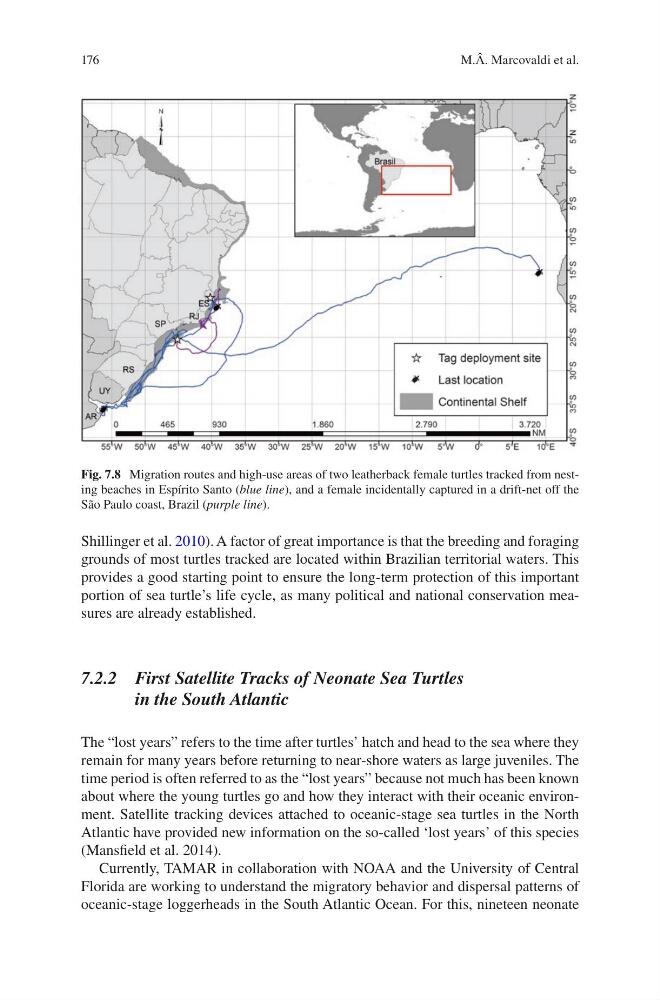
Shillinger et al. 2010). A factor of great importance is that the breeding and foraging
grounds of most turtles tracked are located within Brazilian territorial waters. This
provides a good starting point to ensure the long-term protection of this important
portion of sea turtle’s life cycle, as many political and national conservation measures are already established.
7.2.2 First Satellite Tracks of Neonate Sea Turtles
in the South Atlantic
The “lost years” refers to the time after turtles’ hatch and head to the sea where they
remain for many years before returning to near-shore waters as large juveniles. The
time period is often referred to as the “lost years” because not much has been known
about where the young turtles go and how they interact with their oceanic environment. Satellite tracking devices attached to oceanic-stage sea turtles in the North
Atlantic have provided new information on the so-called ‘lost years’ of this species
(Mansfield et al. 2014).
Currently, TAMAR in collaboration with NOAA and the University of Central
Florida are working to understand the migratory behavior and dispersal patterns of
oceanic-stage loggerheads in the South Atlantic Ocean. For this, nineteen neonate
Fig. 7.8 Migration routes and high-use areas of two leatherback female turtles tracked from nesting beaches in Espírito Santo (blue line), and a female incidentally captured in a drift-net off the
São Paulo coast, Brazil (purple line).
M.Â. Marcovaldi et al.
Shillinger et al. 2010). A factor of great importance is that the breeding and foraging
grounds of most turtles tracked are located within Brazilian territorial waters. This
provides a good starting point to ensure the long-term protection of this important
portion of sea turtle’s life cycle, as many political and national conservation measures are already established.
7.2.2 First Satellite Tracks of Neonate Sea Turtles
in the South Atlantic
The “lost years” refers to the time after turtles’ hatch and head to the sea where they
remain for many years before returning to near-shore waters as large juveniles. The
time period is often referred to as the “lost years” because not much has been known
about where the young turtles go and how they interact with their oceanic environment. Satellite tracking devices attached to oceanic-stage sea turtles in the North
Atlantic have provided new information on the so-called ‘lost years’ of this species
(Mansfield et al. 2014).
Currently, TAMAR in collaboration with NOAA and the University of Central
Florida are working to understand the migratory behavior and dispersal patterns of
oceanic-stage loggerheads in the South Atlantic Ocean. For this, nineteen neonate
Fig. 7.8 Migration routes and high-use areas of two leatherback female turtles tracked from nesting beaches in Espírito Santo (blue line), and a female incidentally captured in a drift-net off the
São Paulo coast, Brazil (purple line).
M.Â. Marcovaldi et al.