

173
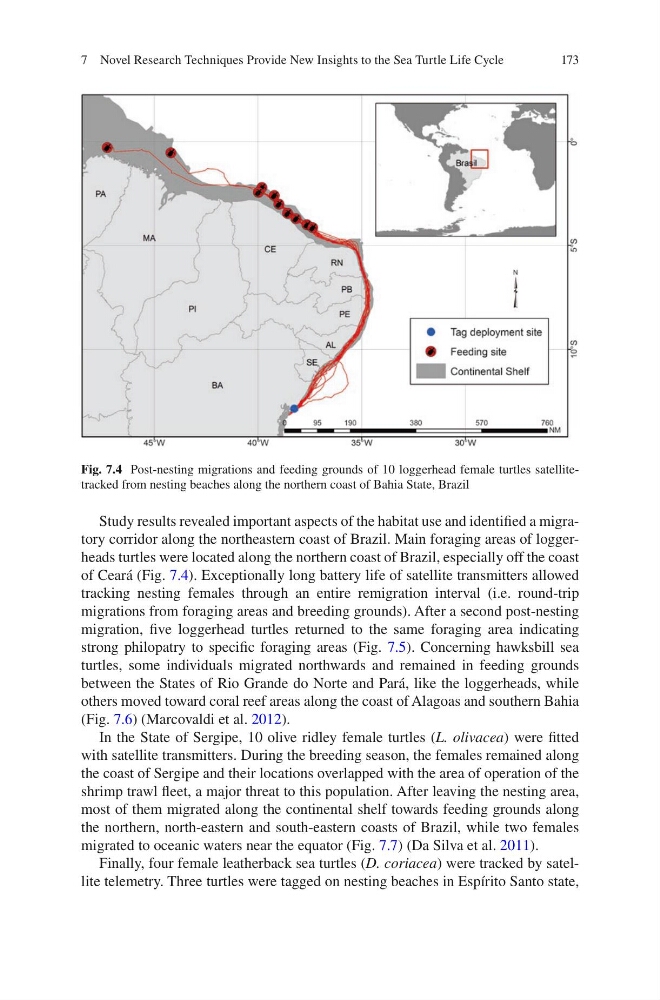
Study results revealed important aspects of the habitat use and identified a migratory corridor along the northeastern coast of Brazil. Main foraging areas of loggerheads turtles were located along the northern coast of Brazil, especially off the coast
of Ceará (Fig. 7.4). Exceptionally long battery life of satellite transmitters allowed
tracking nesting females through an entire remigration interval (i.e. round-trip
migrations from foraging areas and breeding grounds). After a second post-nesting
migration, five loggerhead turtles returned to the same foraging area indicating
strong philopatry to specific foraging areas (Fig. 7.5). Concerning hawksbill sea
turtles, some individuals migrated northwards and remained in feeding grounds
between the States of Rio Grande do Norte and Pará, like the loggerheads, while
others moved toward coral reef areas along the coast of Alagoas and southern Bahia
(Fig. 7.6) (Marcovaldi et al. 2012).
In the State of Sergipe, 10 olive ridley female turtles (L. olivacea) were fitted
with satellite transmitters. During the breeding season, the females remained along
the coast of Sergipe and their locations overlapped with the area of operation of the
shrimp trawl fleet, a major threat to this population. After leaving the nesting area,
most of them migrated along the continental shelf towards feeding grounds along
the northern, north-eastern and south-eastern coasts of Brazil, while two females
migrated to oceanic waters near the equator (Fig. 7.7) (Da Silva et al. 2011).
Finally, four female leatherback sea turtles (D. coriacea) were tracked by satellite telemetry. Three turtles were tagged on nesting beaches in Espírito Santo state,
Fig. 7.4 Post-nesting migrations and feeding grounds of 10 loggerhead female turtles satellitetracked from nesting beaches along the northern coast of Bahia State, Brazil
7 Novel Research Techniques Provide New Insights to the Sea Turtle Life Cycle
Study results revealed important aspects of the habitat use and identified a migratory corridor along the northeastern coast of Brazil. Main foraging areas of loggerheads turtles were located along the northern coast of Brazil, especially off the coast
of Ceará (Fig. 7.4). Exceptionally long battery life of satellite transmitters allowed
tracking nesting females through an entire remigration interval (i.e. round-trip
migrations from foraging areas and breeding grounds). After a second post-nesting
migration, five loggerhead turtles returned to the same foraging area indicating
strong philopatry to specific foraging areas (Fig. 7.5). Concerning hawksbill sea
turtles, some individuals migrated northwards and remained in feeding grounds
between the States of Rio Grande do Norte and Pará, like the loggerheads, while
others moved toward coral reef areas along the coast of Alagoas and southern Bahia
(Fig. 7.6) (Marcovaldi et al. 2012).
In the State of Sergipe, 10 olive ridley female turtles (L. olivacea) were fitted
with satellite transmitters. During the breeding season, the females remained along
the coast of Sergipe and their locations overlapped with the area of operation of the
shrimp trawl fleet, a major threat to this population. After leaving the nesting area,
most of them migrated along the continental shelf towards feeding grounds along
the northern, north-eastern and south-eastern coasts of Brazil, while two females
migrated to oceanic waters near the equator (Fig. 7.7) (Da Silva et al. 2011).
Finally, four female leatherback sea turtles (D. coriacea) were tracked by satellite telemetry. Three turtles were tagged on nesting beaches in Espírito Santo state,
Fig. 7.4 Post-nesting migrations and feeding grounds of 10 loggerhead female turtles satellitetracked from nesting beaches along the northern coast of Bahia State, Brazil
7 Novel Research Techniques Provide New Insights to the Sea Turtle Life Cycle