

172
allows the reconstruction of the actual routes followed by marked individuals
(Godley et al. 2008). Adult females, for example, can migrate thousands of kilometers between breeding sites and feeding grounds, thus satellite telemetry provide the
opportunity to map migratory routes and identify foraging and high-use areas.
7.2.1 Migratory Destinations and Foraging Areas of Adult
Females
Initial studies using satellite telemetry in Brazil began in 2000–2001. Satellite transmitters were deployed on eight loggerhead-nesting females in Espírito Santo, and
eight green turtles from foraging areas in Ceará, including juvenile and adult turtles.
In the case of the loggerheads, it was not possible to determine any general pattern
after they left the nesting beaches, as most of the transmissions were relatively short
in duration (Lemke et al. 2003). On the other hand, green turtles remained in coastal
areas; some exhibited high fidelity to their foraging areas while others displayed
medium and long distance movements (Godley et al. 2003).
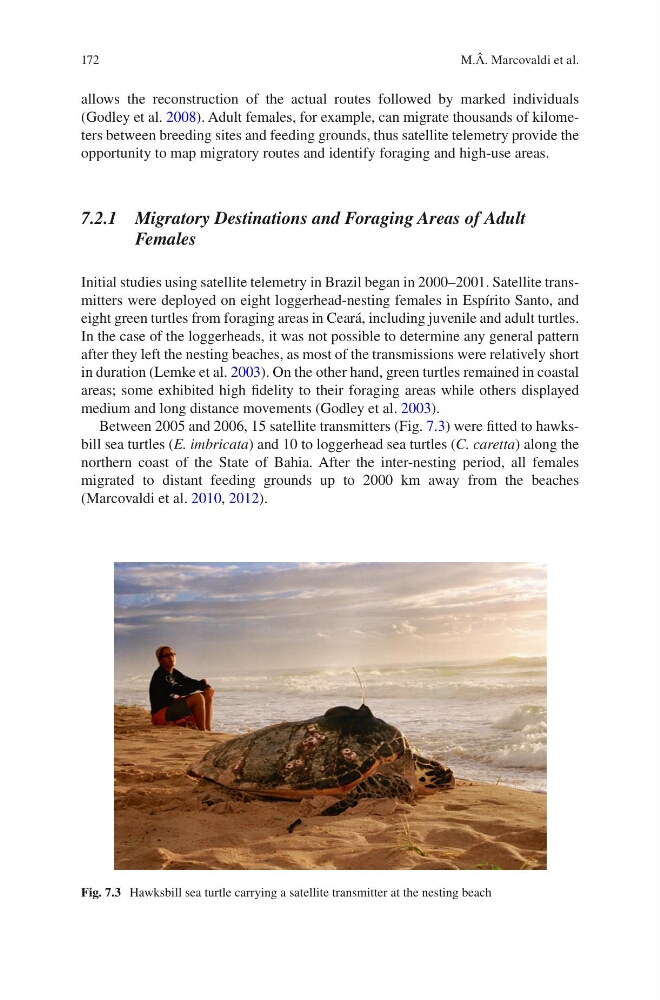
Between 2005 and 2006, 15 satellite transmitters (Fig. 7.3) were fitted to hawksbill sea turtles (E. imbricata) and 10 to loggerhead sea turtles (C. caretta) along the
northern coast of the State of Bahia. After the inter-nesting period, all females
migrated to distant feeding grounds up to 2000 km away from the beaches
(Marcovaldi et al. 2010, 2012).
Fig. 7.3 Hawksbill sea turtle carrying a satellite transmitter at the nesting beach
M.Â. Marcovaldi et al.
allows the reconstruction of the actual routes followed by marked individuals
(Godley et al. 2008). Adult females, for example, can migrate thousands of kilometers between breeding sites and feeding grounds, thus satellite telemetry provide the
opportunity to map migratory routes and identify foraging and high-use areas.
7.2.1 Migratory Destinations and Foraging Areas of Adult
Females
Initial studies using satellite telemetry in Brazil began in 2000–2001. Satellite transmitters were deployed on eight loggerhead-nesting females in Espírito Santo, and
eight green turtles from foraging areas in Ceará, including juvenile and adult turtles.
In the case of the loggerheads, it was not possible to determine any general pattern
after they left the nesting beaches, as most of the transmissions were relatively short
in duration (Lemke et al. 2003). On the other hand, green turtles remained in coastal
areas; some exhibited high fidelity to their foraging areas while others displayed
medium and long distance movements (Godley et al. 2003).
Between 2005 and 2006, 15 satellite transmitters (Fig. 7.3) were fitted to hawksbill sea turtles (E. imbricata) and 10 to loggerhead sea turtles (C. caretta) along the
northern coast of the State of Bahia. After the inter-nesting period, all females
migrated to distant feeding grounds up to 2000 km away from the beaches
(Marcovaldi et al. 2010, 2012).
Fig. 7.3 Hawksbill sea turtle carrying a satellite transmitter at the nesting beach
M.Â. Marcovaldi et al.