

171
7.2 Satellite Telemetry
Understanding the spatial behavior of marine turtles during their migrations and
prolonged movement phases is central to elucidating key aspects of their complex
life cycle and ecology. The development of satellite telemetry in the late 1980s
allowed the first in-depth studies of animal movement patterns (Duron-Dufrenne
1987, Fancy et al. 1988). Since then, continuing improvements to the satellite network, transmitter miniaturization, and new deployment techniques have expanded
the range of species that can be studied with satellite-tracking (Coyne and Godley
2005). In this way, satellite-tracking studies have become particularly prevalent in
recent decades and has led to substantial progress in the field, as this technique
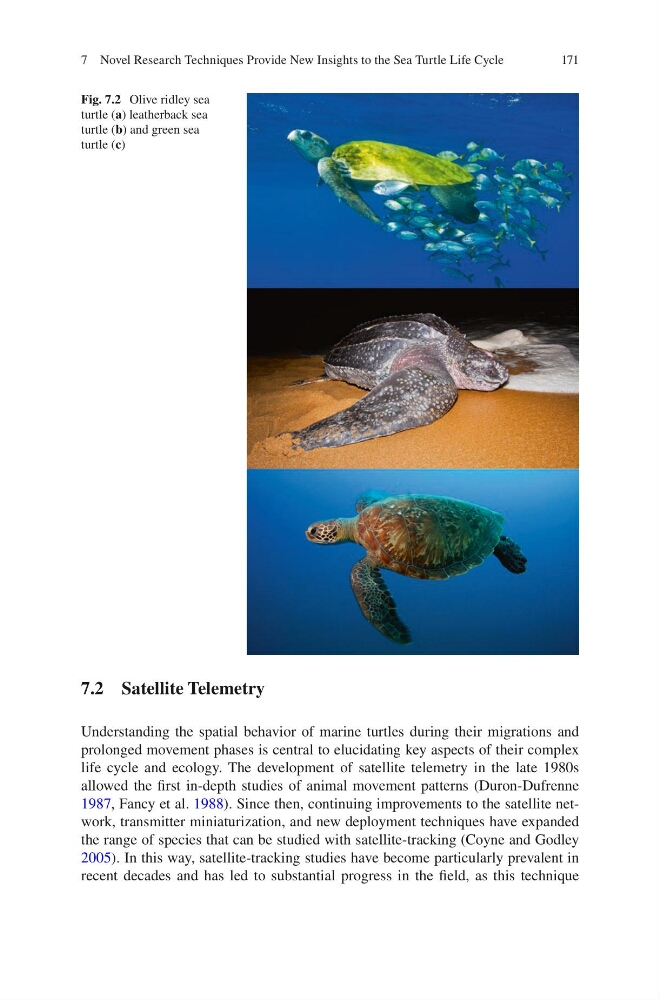
Fig. 7.2 Olive ridley sea
turtle (a) leatherback sea
turtle (b) and green sea
turtle (c)
7 Novel Research Techniques Provide New Insights to the Sea Turtle Life Cycle
7.2 Satellite Telemetry
Understanding the spatial behavior of marine turtles during their migrations and
prolonged movement phases is central to elucidating key aspects of their complex
life cycle and ecology. The development of satellite telemetry in the late 1980s
allowed the first in-depth studies of animal movement patterns (Duron-Dufrenne
1987, Fancy et al. 1988). Since then, continuing improvements to the satellite network, transmitter miniaturization, and new deployment techniques have expanded
the range of species that can be studied with satellite-tracking (Coyne and Godley
2005). In this way, satellite-tracking studies have become particularly prevalent in
recent decades and has led to substantial progress in the field, as this technique
Fig. 7.2 Olive ridley sea
turtle (a) leatherback sea
turtle (b) and green sea
turtle (c)
7 Novel Research Techniques Provide New Insights to the Sea Turtle Life Cycle