

98
Ribamar (Maranhão), some of which are within Marine Protected Areas. The
land-based monitoring program was established in 1987 as part of the species
recovery plan (Alvite et al. 2002). From land stations observers characterize
frequency of occurrence, density and abundance (Alvite et al. 2002). Behavior
and interactions with anthropogenic activities are also observed serving in the
establishment of new protected areas and supporting the development of management plans (Information gathered through the web survey: João Carlos
Gomes Borges – Fundação Mamíferos Aquáticos; Ana Carolina Meirelles –
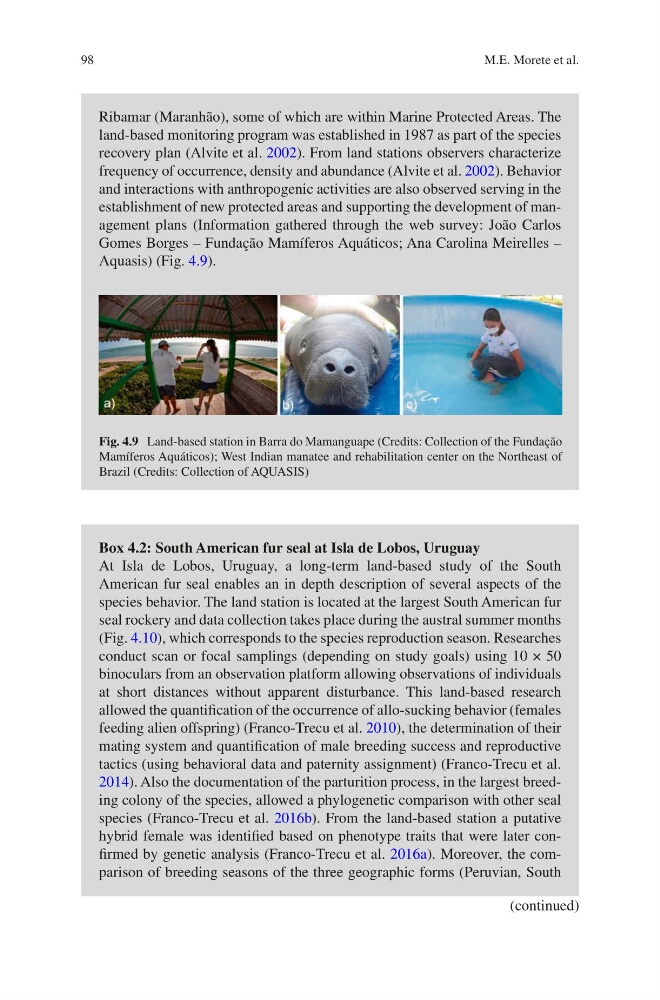
Aquasis) (Fig. 4.9).
Fig. 4.9 Land-based station in Barra do Mamanguape (Credits: Collection of the Fundação
Mamíferos Aquáticos); West Indian manatee and rehabilitation center on the Northeast of
Brazil (Credits: Collection of AQUASIS)
Box 4.2: South American fur seal at Isla de Lobos, Uruguay
At Isla de Lobos, Uruguay, a long-term land-based study of the South
American fur seal enables an in depth description of several aspects of the
species behavior. The land station is located at the largest South American fur
seal rockery and data collection takes place during the austral summer months
(Fig. 4.10), which corresponds to the species reproduction season. Researches
conduct scan or focal samplings (depending on study goals) using 10 × 50
binoculars from an observation platform allowing observations of individuals
at short distances without apparent disturbance. This land-based research
allowed the quantification of the occurrence of allo-sucking behavior (females
feeding alien offspring) (Franco-Trecu et al. 2010), the determination of their
mating system and quantification of male breeding success and reproductive
tactics (using behavioral data and paternity assignment) (Franco-Trecu et al.
2014). Also the documentation of the parturition process, in the largest breeding colony of the species, allowed a phylogenetic comparison with other seal
species (Franco-Trecu et al. 2016b). From the land-based station a putative
hybrid female was identified based on phenotype traits that were later confirmed by genetic analysis (Franco-Trecu et al. 2016a). Moreover, the comparison of breeding seasons of the three geographic forms (Peruvian, South
(continued)
M.E. Morete et al.
Ribamar (Maranhão), some of which are within Marine Protected Areas. The
land-based monitoring program was established in 1987 as part of the species
recovery plan (Alvite et al. 2002). From land stations observers characterize
frequency of occurrence, density and abundance (Alvite et al. 2002). Behavior
and interactions with anthropogenic activities are also observed serving in the
establishment of new protected areas and supporting the development of management plans (Information gathered through the web survey: João Carlos
Gomes Borges – Fundação Mamíferos Aquáticos; Ana Carolina Meirelles –
Aquasis) (Fig. 4.9).
Fig. 4.9 Land-based station in Barra do Mamanguape (Credits: Collection of the Fundação
Mamíferos Aquáticos); West Indian manatee and rehabilitation center on the Northeast of
Brazil (Credits: Collection of AQUASIS)
Box 4.2: South American fur seal at Isla de Lobos, Uruguay
At Isla de Lobos, Uruguay, a long-term land-based study of the South
American fur seal enables an in depth description of several aspects of the
species behavior. The land station is located at the largest South American fur
seal rockery and data collection takes place during the austral summer months
(Fig. 4.10), which corresponds to the species reproduction season. Researches
conduct scan or focal samplings (depending on study goals) using 10 × 50
binoculars from an observation platform allowing observations of individuals
at short distances without apparent disturbance. This land-based research
allowed the quantification of the occurrence of allo-sucking behavior (females
feeding alien offspring) (Franco-Trecu et al. 2010), the determination of their
mating system and quantification of male breeding success and reproductive
tactics (using behavioral data and paternity assignment) (Franco-Trecu et al.
2014). Also the documentation of the parturition process, in the largest breeding colony of the species, allowed a phylogenetic comparison with other seal
species (Franco-Trecu et al. 2016b). From the land-based station a putative
hybrid female was identified based on phenotype traits that were later confirmed by genetic analysis (Franco-Trecu et al. 2016a). Moreover, the comparison of breeding seasons of the three geographic forms (Peruvian, South
(continued)
M.E. Morete et al.