

97
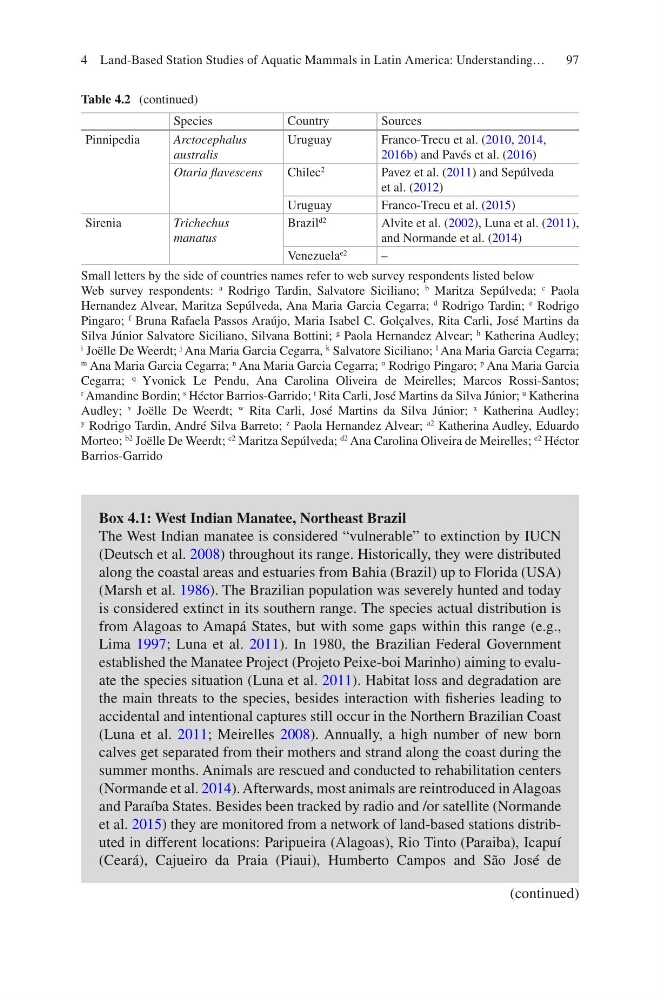
Table 4.2 (continued)
Species
Country
Sources
Pinnipedia
Arctocephalus
australis
Uruguay
Franco-Trecu et al. (2010, 2014,
2016b) and Pavés et al. (2016)
Otaria flavescens
Chilec
2
Pavez et al. (2011) and Sepúlveda
et al. (2012)
Uruguay
Franco-Trecu et al. (2015)
Sirenia
Trichechus
manatus
Brazil
d2
Alvite et al. (2002), Luna et al. (2011),
and Normande et al. (2014)
Venezuela
e2
–
Small letters by the side of countries names refer to web survey respondents listed below
Web survey respondents:
a Rodrigo Tardin, Salvatore Siciliano;
b Maritza Sepúlveda;
c Paola
Hernandez Alvear, Maritza Sepúlveda, Ana Maria Garcia Cegarra;
d Rodrigo Tardin;
e Rodrigo
Pingaro;
f Bruna Rafaela Passos Araújo, Maria Isabel C. Golçalves, Rita Carli, José Martins da
Silva Júnior Salvatore Siciliano, Silvana Bottini;
g Paola Hernandez Alvear;
h Katherina Audley;
i Joëlle De Weerdt;
j Ana Maria Garcia Cegarra,
k Salvatore Siciliano;
l Ana Maria Garcia Cegarra;
m Ana Maria Garcia Cegarra;
n Ana Maria Garcia Cegarra;
o Rodrigo Pingaro;
p Ana Maria Garcia
Cegarra;
q Yvonick Le Pendu, Ana Carolina Oliveira de Meirelles; Marcos Rossi-Santos;
r Amandine Bordin;
s Héctor Barrios-Garrido;
t Rita Carli, José Martins da Silva Júnior;
u Katherina
Audley;
v Joëlle De Weerdt;
w Rita Carli, José Martins da Silva Júnior;
x Katherina Audley;
y Rodrigo Tardin, André Silva Barreto;
z Paola Hernandez Alvear;
a2 Katherina Audley, Eduardo
Morteo;
b2 Joëlle De Weerdt;
c2 Maritza Sepúlveda;
d2 Ana Carolina Oliveira de Meirelles;
e2 Héctor
Barrios-Garrido
Box 4.1: West Indian Manatee, Northeast Brazil
The West Indian manatee is considered “vulnerable” to extinction by IUCN
(Deutsch et al. 2008) throughout its range. Historically, they were distributed
along the coastal areas and estuaries from Bahia (Brazil) up to Florida (USA)
(Marsh et al. 1986). The Brazilian population was severely hunted and today
is considered extinct in its southern range. The species actual distribution is
from Alagoas to Amapá States, but with some gaps within this range (e.g.,
Lima 1997; Luna et al. 2011). In 1980, the Brazilian Federal Government
established the Manatee Project (Projeto Peixe-boi Marinho) aiming to evaluate the species situation (Luna et al. 2011). Habitat loss and degradation are
the main threats to the species, besides interaction with fisheries leading to
accidental and intentional captures still occur in the Northern Brazilian Coast
(Luna et al. 2011; Meirelles 2008). Annually, a high number of new born
calves get separated from their mothers and strand along the coast during the
summer months. Animals are rescued and conducted to rehabilitation centers
(Normande et al. 2014). Afterwards, most animals are reintroduced in Alagoas
and Paraíba States. Besides been tracked by radio and /or satellite (Normande
et al. 2015) they are monitored from a network of land-based stations distributed in different locations: Paripueira (Alagoas), Rio Tinto (Paraiba), Icapuí
(Ceará), Cajueiro da Praia (Piaui), Humberto Campos and São José de
(continued)
4 Land-Based Station Studies of Aquatic Mammals in Latin America: Understanding…
Table 4.2 (continued)
Species
Country
Sources
Pinnipedia
Arctocephalus
australis
Uruguay
Franco-Trecu et al. (2010, 2014,
2016b) and Pavés et al. (2016)
Otaria flavescens
Chilec
2
Pavez et al. (2011) and Sepúlveda
et al. (2012)
Uruguay
Franco-Trecu et al. (2015)
Sirenia
Trichechus
manatus
Brazil
d2
Alvite et al. (2002), Luna et al. (2011),
and Normande et al. (2014)
Venezuela
e2
–
Small letters by the side of countries names refer to web survey respondents listed below
Web survey respondents:
a Rodrigo Tardin, Salvatore Siciliano;
b Maritza Sepúlveda;
c Paola
Hernandez Alvear, Maritza Sepúlveda, Ana Maria Garcia Cegarra;
d Rodrigo Tardin;
e Rodrigo
Pingaro;
f Bruna Rafaela Passos Araújo, Maria Isabel C. Golçalves, Rita Carli, José Martins da
Silva Júnior Salvatore Siciliano, Silvana Bottini;
g Paola Hernandez Alvear;
h Katherina Audley;
i Joëlle De Weerdt;
j Ana Maria Garcia Cegarra,
k Salvatore Siciliano;
l Ana Maria Garcia Cegarra;
m Ana Maria Garcia Cegarra;
n Ana Maria Garcia Cegarra;
o Rodrigo Pingaro;
p Ana Maria Garcia
Cegarra;
q Yvonick Le Pendu, Ana Carolina Oliveira de Meirelles; Marcos Rossi-Santos;
r Amandine Bordin;
s Héctor Barrios-Garrido;
t Rita Carli, José Martins da Silva Júnior;
u Katherina
Audley;
v Joëlle De Weerdt;
w Rita Carli, José Martins da Silva Júnior;
x Katherina Audley;
y Rodrigo Tardin, André Silva Barreto;
z Paola Hernandez Alvear;
a2 Katherina Audley, Eduardo
Morteo;
b2 Joëlle De Weerdt;
c2 Maritza Sepúlveda;
d2 Ana Carolina Oliveira de Meirelles;
e2 Héctor
Barrios-Garrido
Box 4.1: West Indian Manatee, Northeast Brazil
The West Indian manatee is considered “vulnerable” to extinction by IUCN
(Deutsch et al. 2008) throughout its range. Historically, they were distributed
along the coastal areas and estuaries from Bahia (Brazil) up to Florida (USA)
(Marsh et al. 1986). The Brazilian population was severely hunted and today
is considered extinct in its southern range. The species actual distribution is
from Alagoas to Amapá States, but with some gaps within this range (e.g.,
Lima 1997; Luna et al. 2011). In 1980, the Brazilian Federal Government
established the Manatee Project (Projeto Peixe-boi Marinho) aiming to evaluate the species situation (Luna et al. 2011). Habitat loss and degradation are
the main threats to the species, besides interaction with fisheries leading to
accidental and intentional captures still occur in the Northern Brazilian Coast
(Luna et al. 2011; Meirelles 2008). Annually, a high number of new born
calves get separated from their mothers and strand along the coast during the
summer months. Animals are rescued and conducted to rehabilitation centers
(Normande et al. 2014). Afterwards, most animals are reintroduced in Alagoas
and Paraíba States. Besides been tracked by radio and /or satellite (Normande
et al. 2015) they are monitored from a network of land-based stations distributed in different locations: Paripueira (Alagoas), Rio Tinto (Paraiba), Icapuí
(Ceará), Cajueiro da Praia (Piaui), Humberto Campos and São José de
(continued)
4 Land-Based Station Studies of Aquatic Mammals in Latin America: Understanding…