

99
4.3.1 Argentina
Three species of odontocetes and the Southern Right whale were studied from land
station in Argentina. One of the pioneer studies from land-based station was with
Bottlenose dolphins (Tursiops truncatus) in the Golfo San Jose (Würsig and Würsig
1978), today a Marine Protected Area in northern Patagonia. The study describes
general movement patterns, aerial and social behavior, and contributed to the knowledge of the population’s ecology. About 30 years later, the sighting rates of the species at Golfo San Jose were re-assessed using aerial, boat and land-based surveys
(Coscarella et al. 2011). The authors confirmed an abundance decline in the area
that could be explained by increased natural and human-induced mortality and disturbance, resources depletion and environmental shift. Bottlenose dolphin was also
studied from land-based stations in Bahía San Antonio (Vermeulen et al. 2015),
using binoculars and a mix of scan and focal follows. Observations from land station were combined with boat-based observations allowing the characterization of
the species seasonal behavior in the area, which is probably a result of seasonal
variations in prey availability (Vermeulen et al. 2015).
The Commersons’ dolphin (Cephalorhynchus commersonii) was studied by
Coscarella and collaborators (2010) through scans conducted from a land-based
station located 21 m above sea level (asl), at Bahía Enganõ (near the mouth of the
Chubut River). The daily activity patterns and variation in relative abundance was
verified. Seasonal changes in the frequency of behaviors were recorded and group
Chilean and Atlantic) provided support that these populations have distinct
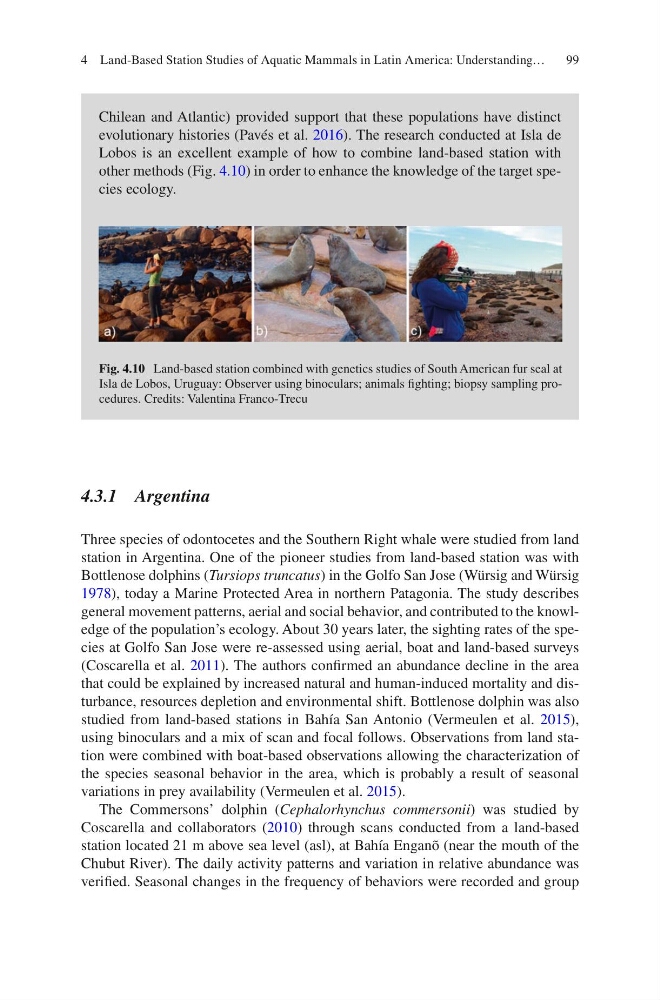
evolutionary histories (Pavés et al. 2016). The research conducted at Isla de
Lobos is an excellent example of how to combine land-based station with
other methods (Fig. 4.10) in order to enhance the knowledge of the target species ecology.
Fig. 4.10 Land-based station combined with genetics studies of South American fur seal at
Isla de Lobos, Uruguay: Observer using binoculars; animals fighting; biopsy sampling procedures. Credits: Valentina Franco-Trecu
4 Land-Based Station Studies of Aquatic Mammals in Latin America: Understanding…
4.3.1 Argentina
Three species of odontocetes and the Southern Right whale were studied from land
station in Argentina. One of the pioneer studies from land-based station was with
Bottlenose dolphins (Tursiops truncatus) in the Golfo San Jose (Würsig and Würsig
1978), today a Marine Protected Area in northern Patagonia. The study describes
general movement patterns, aerial and social behavior, and contributed to the knowledge of the population’s ecology. About 30 years later, the sighting rates of the species at Golfo San Jose were re-assessed using aerial, boat and land-based surveys
(Coscarella et al. 2011). The authors confirmed an abundance decline in the area
that could be explained by increased natural and human-induced mortality and disturbance, resources depletion and environmental shift. Bottlenose dolphin was also
studied from land-based stations in Bahía San Antonio (Vermeulen et al. 2015),
using binoculars and a mix of scan and focal follows. Observations from land station were combined with boat-based observations allowing the characterization of
the species seasonal behavior in the area, which is probably a result of seasonal
variations in prey availability (Vermeulen et al. 2015).
The Commersons’ dolphin (Cephalorhynchus commersonii) was studied by
Coscarella and collaborators (2010) through scans conducted from a land-based
station located 21 m above sea level (asl), at Bahía Enganõ (near the mouth of the
Chubut River). The daily activity patterns and variation in relative abundance was
verified. Seasonal changes in the frequency of behaviors were recorded and group
Chilean and Atlantic) provided support that these populations have distinct
evolutionary histories (Pavés et al. 2016). The research conducted at Isla de
Lobos is an excellent example of how to combine land-based station with
other methods (Fig. 4.10) in order to enhance the knowledge of the target species ecology.
Fig. 4.10 Land-based station combined with genetics studies of South American fur seal at
Isla de Lobos, Uruguay: Observer using binoculars; animals fighting; biopsy sampling procedures. Credits: Valentina Franco-Trecu
4 Land-Based Station Studies of Aquatic Mammals in Latin America: Understanding…