

6.5
Moritella viscosa
Moritella viscosa is one of the causative agents of ‘winter
ulcers’, a commonly occurring skin disease of farmed salmon
and rainbow trout that has been diagnosed in Norway,
Iceland, Faroe Islands and Scotland. M. marina has also
been described. Infection results in increased mortality rates
and major economic losses due to downgrade of the fish at
slaughter, and typically occurs at a low but consistent prevalence in farmed Atlantic salmon during the coldest months of
the year. The significance of the disease is associated to poor
animal welfare, reduced osmoregulatory capacity, increased
susceptibility to other infections and reduced marketability.
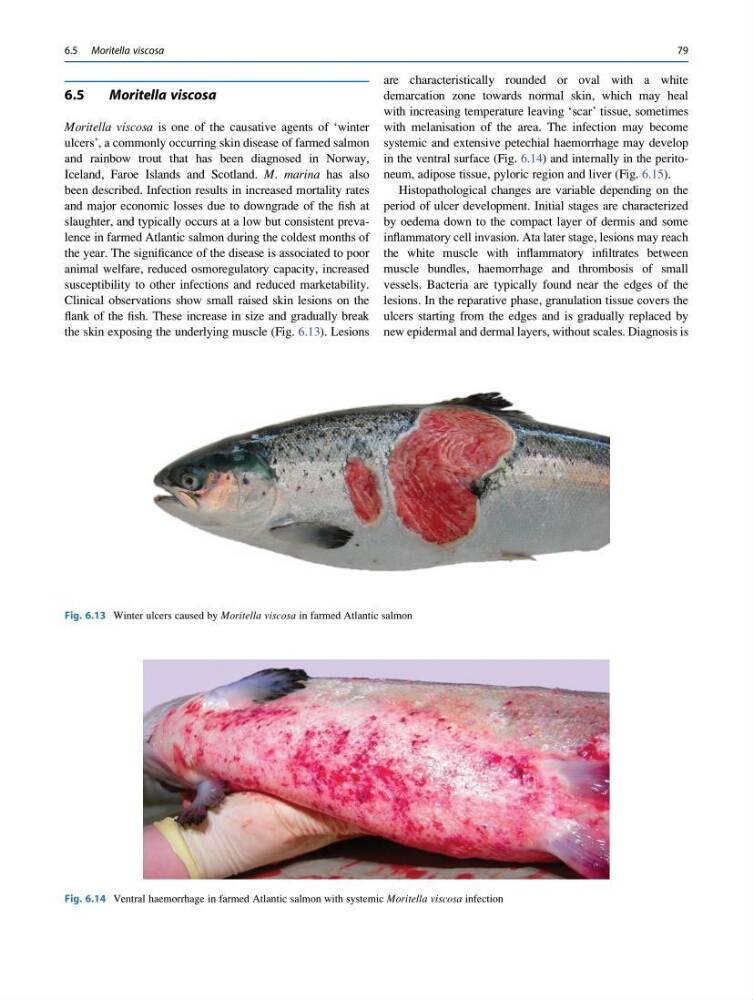
Clinical observations show small raised skin lesions on the
flank of the fish. These increase in size and gradually break
the skin exposing the underlying muscle (Fig. 6.13). Lesions
are characteristically rounded or oval with a white
demarcation zone towards normal skin, which may heal
with increasing temperature leaving ‘scar’ tissue, sometimes
with melanisation of the area. The infection may become
systemic and extensive petechial haemorrhage may develop
in the ventral surface (Fig. 6.14) and internally in the peritoneum, adipose tissue, pyloric region and liver (Fig. 6.15).
Histopathological changes are variable depending on the
period of ulcer development. Initial stages are characterized
by oedema down to the compact layer of dermis and some
inflammatory cell invasion. Ata later stage, lesions may reach
the white muscle with inflammatory infiltrates between
muscle bundles, haemorrhage and thrombosis of small
vessels. Bacteria are typically found near the edges of the
lesions. In the reparative phase, granulation tissue covers the
ulcers starting from the edges and is gradually replaced by
new epidermal and dermal layers, without scales. Diagnosis is
Fig. 6.13 Winter ulcers caused by Moritella viscosa in farmed Atlantic salmon
Fig. 6.14 Ventral haemorrhage in farmed Atlantic salmon with systemic Moritella viscosa infection
6.5 Moritella viscosa
79
Moritella viscosa
Moritella viscosa is one of the causative agents of ‘winter
ulcers’, a commonly occurring skin disease of farmed salmon
and rainbow trout that has been diagnosed in Norway,
Iceland, Faroe Islands and Scotland. M. marina has also
been described. Infection results in increased mortality rates
and major economic losses due to downgrade of the fish at
slaughter, and typically occurs at a low but consistent prevalence in farmed Atlantic salmon during the coldest months of
the year. The significance of the disease is associated to poor
animal welfare, reduced osmoregulatory capacity, increased
susceptibility to other infections and reduced marketability.
Clinical observations show small raised skin lesions on the
flank of the fish. These increase in size and gradually break
the skin exposing the underlying muscle (Fig. 6.13). Lesions
are characteristically rounded or oval with a white
demarcation zone towards normal skin, which may heal
with increasing temperature leaving ‘scar’ tissue, sometimes
with melanisation of the area. The infection may become
systemic and extensive petechial haemorrhage may develop
in the ventral surface (Fig. 6.14) and internally in the peritoneum, adipose tissue, pyloric region and liver (Fig. 6.15).
Histopathological changes are variable depending on the
period of ulcer development. Initial stages are characterized
by oedema down to the compact layer of dermis and some
inflammatory cell invasion. Ata later stage, lesions may reach
the white muscle with inflammatory infiltrates between
muscle bundles, haemorrhage and thrombosis of small
vessels. Bacteria are typically found near the edges of the
lesions. In the reparative phase, granulation tissue covers the
ulcers starting from the edges and is gradually replaced by
new epidermal and dermal layers, without scales. Diagnosis is
Fig. 6.13 Winter ulcers caused by Moritella viscosa in farmed Atlantic salmon
Fig. 6.14 Ventral haemorrhage in farmed Atlantic salmon with systemic Moritella viscosa infection
6.5 Moritella viscosa
79