

activity on blood agar. Serovars O1 and O2 are the most
common causing infection in salmonids, but more than 20
different serovars have been described.
Diagnosis is based upon classical pathology and isolation
of L. anguillarum on NaCl-supplemented blood agar or TSA at
room temperature and confirmation by ELISA. Serologically
identification can be carried using a rapid agglutination test kit.
Oil-adjuvant multivalent vaccines usually provide excellent
protection against both O1 and O2 serovars of L. anguillarum.
6.4
Aliivibrio (Vibrio) salmonicida
Cold water vibriosis (Hitra disease or haemorrhagic syndrome) is a septicaemic condition of farmed Atlantic salmon
caused by the motile bacterium Aliivibrio (Vibrio)
salmonicida. The first observations were recorded in northern Norway in 1977 and the disease was a serious threat to
the rapidly growing farming industry in the early 1980s.
Outbreaks have also been recorded in Scotland, Faroe
Islands, Iceland and the east coast of USA and Canada.
Currently, oil-adjuvant multivalent vaccines give excellent
protection against cold-water vibriosis and overall the
impact of the disease has been greatly reduced.
Cold-water vibriosis typically occurs during the winter
months. Affected fish go off the feed, are lethargic and dark
coloured and often stay near the surface. As with some other
diseases of farmed salmonids, apparently ‘healthy fish’ are
often heavily affected. External lesions include exophthalmia,
a swollen and haemorrhagic vent, petechial haemorrhage
under the belly and at the base of the pectoral and pelvic
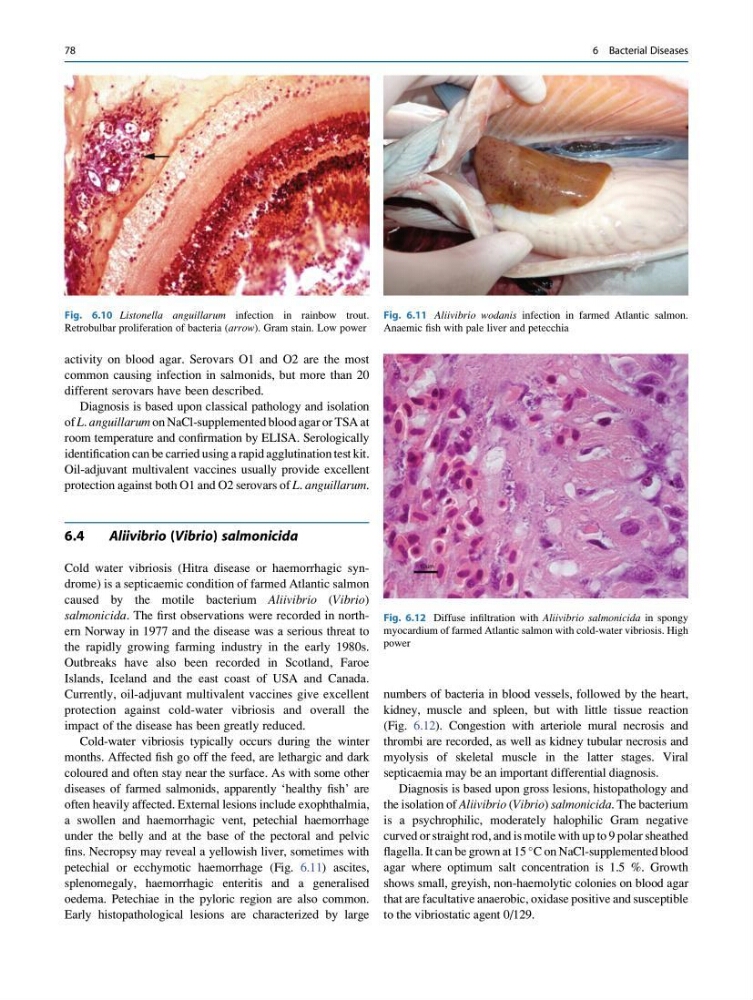
fins. Necropsy may reveal a yellowish liver, sometimes with
petechial or ecchymotic haemorrhage (Fig. 6.11) ascites,
splenomegaly, haemorrhagic enteritis and a generalised
oedema. Petechiae in the pyloric region are also common.
Early histopathological lesions are characterized by large
numbers of bacteria in blood vessels, followed by the heart,
kidney, muscle and spleen, but with little tissue reaction
(Fig. 6.12). Congestion with arteriole mural necrosis and
thrombi are recorded, as well as kidney tubular necrosis and
myolysis of skeletal muscle in the latter stages. Viral
septicaemia may be an important differential diagnosis.
Diagnosis is based upon gross lesions, histopathology and
the isolation of Aliivibrio (Vibrio) salmonicida. The bacterium
is a psychrophilic, moderately halophilic Gram negative
curved or straight rod, and is motile with up to 9 polar sheathed
flagella. It can be grown at 15
C on NaCl-supplemented blood
agar where optimum salt concentration is 1.5 %. Growth
shows small, greyish, non-haemolytic colonies on blood agar
that are facultative anaerobic, oxidase positive and susceptible
to the vibriostatic agent 0/129.
Fig. 6.10 Listonella anguillarum infection in rainbow trout.
Retrobulbar proliferation of bacteria (arrow). Gram stain. Low power
Fig. 6.11 Aliivibrio wodanis infection in farmed Atlantic salmon.
Anaemic fish with pale liver and petecchia
Fig. 6.12 Diffuse infiltration with Aliivibrio salmonicida in spongy
myocardium of farmed Atlantic salmon with cold-water vibriosis. High
power
78
6 Bacterial Diseases
common causing infection in salmonids, but more than 20
different serovars have been described.
Diagnosis is based upon classical pathology and isolation
of L. anguillarum on NaCl-supplemented blood agar or TSA at
room temperature and confirmation by ELISA. Serologically
identification can be carried using a rapid agglutination test kit.
Oil-adjuvant multivalent vaccines usually provide excellent
protection against both O1 and O2 serovars of L. anguillarum.
6.4
Aliivibrio (Vibrio) salmonicida
Cold water vibriosis (Hitra disease or haemorrhagic syndrome) is a septicaemic condition of farmed Atlantic salmon
caused by the motile bacterium Aliivibrio (Vibrio)
salmonicida. The first observations were recorded in northern Norway in 1977 and the disease was a serious threat to
the rapidly growing farming industry in the early 1980s.
Outbreaks have also been recorded in Scotland, Faroe
Islands, Iceland and the east coast of USA and Canada.
Currently, oil-adjuvant multivalent vaccines give excellent
protection against cold-water vibriosis and overall the
impact of the disease has been greatly reduced.
Cold-water vibriosis typically occurs during the winter
months. Affected fish go off the feed, are lethargic and dark
coloured and often stay near the surface. As with some other
diseases of farmed salmonids, apparently ‘healthy fish’ are
often heavily affected. External lesions include exophthalmia,
a swollen and haemorrhagic vent, petechial haemorrhage
under the belly and at the base of the pectoral and pelvic
fins. Necropsy may reveal a yellowish liver, sometimes with
petechial or ecchymotic haemorrhage (Fig. 6.11) ascites,
splenomegaly, haemorrhagic enteritis and a generalised
oedema. Petechiae in the pyloric region are also common.
Early histopathological lesions are characterized by large
numbers of bacteria in blood vessels, followed by the heart,
kidney, muscle and spleen, but with little tissue reaction
(Fig. 6.12). Congestion with arteriole mural necrosis and
thrombi are recorded, as well as kidney tubular necrosis and
myolysis of skeletal muscle in the latter stages. Viral
septicaemia may be an important differential diagnosis.
Diagnosis is based upon gross lesions, histopathology and
the isolation of Aliivibrio (Vibrio) salmonicida. The bacterium
is a psychrophilic, moderately halophilic Gram negative
curved or straight rod, and is motile with up to 9 polar sheathed
flagella. It can be grown at 15
C on NaCl-supplemented blood
agar where optimum salt concentration is 1.5 %. Growth
shows small, greyish, non-haemolytic colonies on blood agar
that are facultative anaerobic, oxidase positive and susceptible
to the vibriostatic agent 0/129.
Fig. 6.10 Listonella anguillarum infection in rainbow trout.
Retrobulbar proliferation of bacteria (arrow). Gram stain. Low power
Fig. 6.11 Aliivibrio wodanis infection in farmed Atlantic salmon.
Anaemic fish with pale liver and petecchia
Fig. 6.12 Diffuse infiltration with Aliivibrio salmonicida in spongy
myocardium of farmed Atlantic salmon with cold-water vibriosis. High
power
78
6 Bacterial Diseases