

Diagnosis is based upon clinical disease signs, and the isolation
and identification of the bacteria on medium such as trypticase
soy agar (TSA) using morphological characteristics.
6.2
Aeromonas salmonicida subsp.
salmonicida
Furunculosis is the name used to describe infections with
Aeromonas salmonicida subsp. salmonicida. Infection occurs
in wild and farmed salmonids, and has been recorded in Atlantic salmon, brown trout, Arctic char, brook trout and lake trout.
Both chronic and acute furunculosis may occur depending on
water temperature, fish age and virulence of the agent.
Outbreaks are often triggered by stressors such as changes in
temperature, poor handling, water quality and crowding.
In acute infections fish may die with few or no signs of
disease or pathological changes. During the chronic stages
the fish show lethargy, inappetence and darkening of the
skin, which is similar to most bacterial septicaemias. Ventral
haemorrhage is common, in particular near the base of the
pectoral, pelvic and anal fins in addition to exophthalmia.
At necropsy, ascites, splenomegaly, haemorrhagic enteritis,
ascites, sub-capsular liver haemorrhage and pyloric caeca
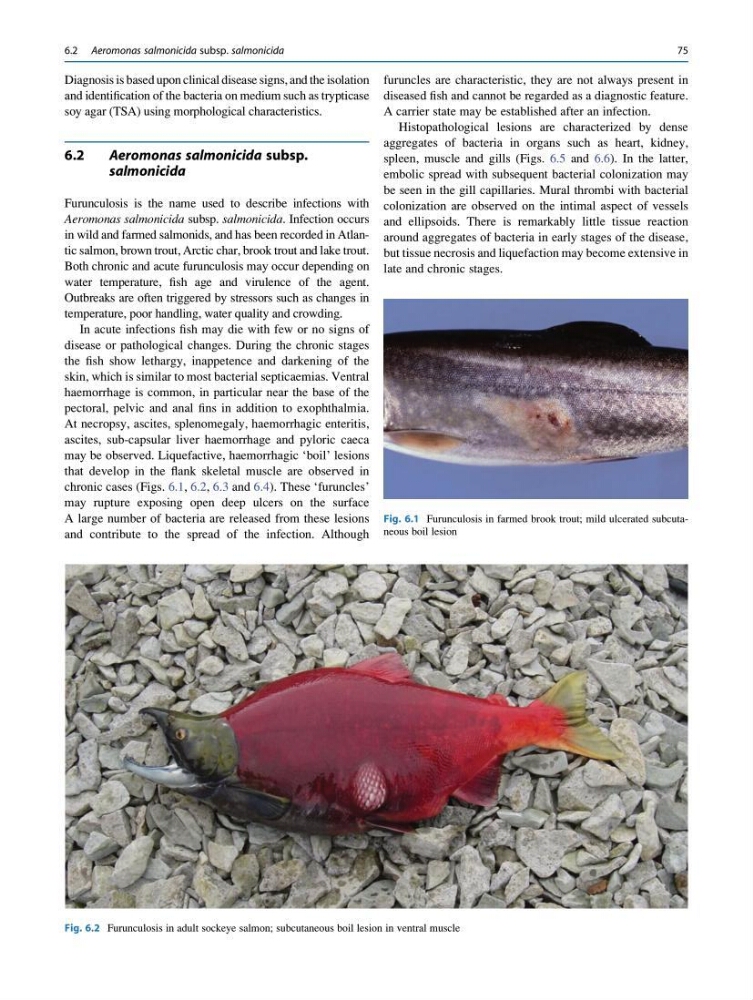
may be observed. Liquefactive, haemorrhagic ‘boil’ lesions
that develop in the flank skeletal muscle are observed in
chronic cases (Figs. 6.1, 6.2, 6.3 and 6.4). These ‘furuncles’
may rupture exposing open deep ulcers on the surface
A large number of bacteria are released from these lesions
and contribute to the spread of the infection. Although
furuncles are characteristic, they are not always present in
diseased fish and cannot be regarded as a diagnostic feature.
A carrier state may be established after an infection.
Histopathological lesions are characterized by dense
aggregates of bacteria in organs such as heart, kidney,
spleen, muscle and gills (Figs. 6.5 and 6.6). In the latter,
embolic spread with subsequent bacterial colonization may
be seen in the gill capillaries. Mural thrombi with bacterial
colonization are observed on the intimal aspect of vessels
and ellipsoids. There is remarkably little tissue reaction
around aggregates of bacteria in early stages of the disease,
but tissue necrosis and liquefaction may become extensive in
late and chronic stages.
Fig. 6.1 Furunculosis in farmed brook trout; mild ulcerated subcutaneous boil lesion
Fig. 6.2 Furunculosis in adult sockeye salmon; subcutaneous boil lesion in ventral muscle
6.2 Aeromonas salmonicida subsp. salmonicida
75
and identification of the bacteria on medium such as trypticase
soy agar (TSA) using morphological characteristics.
6.2
Aeromonas salmonicida subsp.
salmonicida
Furunculosis is the name used to describe infections with
Aeromonas salmonicida subsp. salmonicida. Infection occurs
in wild and farmed salmonids, and has been recorded in Atlantic salmon, brown trout, Arctic char, brook trout and lake trout.
Both chronic and acute furunculosis may occur depending on
water temperature, fish age and virulence of the agent.
Outbreaks are often triggered by stressors such as changes in
temperature, poor handling, water quality and crowding.
In acute infections fish may die with few or no signs of
disease or pathological changes. During the chronic stages
the fish show lethargy, inappetence and darkening of the
skin, which is similar to most bacterial septicaemias. Ventral
haemorrhage is common, in particular near the base of the
pectoral, pelvic and anal fins in addition to exophthalmia.
At necropsy, ascites, splenomegaly, haemorrhagic enteritis,
ascites, sub-capsular liver haemorrhage and pyloric caeca
may be observed. Liquefactive, haemorrhagic ‘boil’ lesions
that develop in the flank skeletal muscle are observed in
chronic cases (Figs. 6.1, 6.2, 6.3 and 6.4). These ‘furuncles’
may rupture exposing open deep ulcers on the surface
A large number of bacteria are released from these lesions
and contribute to the spread of the infection. Although
furuncles are characteristic, they are not always present in
diseased fish and cannot be regarded as a diagnostic feature.
A carrier state may be established after an infection.
Histopathological lesions are characterized by dense
aggregates of bacteria in organs such as heart, kidney,
spleen, muscle and gills (Figs. 6.5 and 6.6). In the latter,
embolic spread with subsequent bacterial colonization may
be seen in the gill capillaries. Mural thrombi with bacterial
colonization are observed on the intimal aspect of vessels
and ellipsoids. There is remarkably little tissue reaction
around aggregates of bacteria in early stages of the disease,
but tissue necrosis and liquefaction may become extensive in
late and chronic stages.
Fig. 6.1 Furunculosis in farmed brook trout; mild ulcerated subcutaneous boil lesion
Fig. 6.2 Furunculosis in adult sockeye salmon; subcutaneous boil lesion in ventral muscle
6.2 Aeromonas salmonicida subsp. salmonicida
75