

sequencing. While the traditional methods of culture remain
relevant, new techniques are contributing to an accurate and
rapid diagnosis of certain agents. Principal and emerging
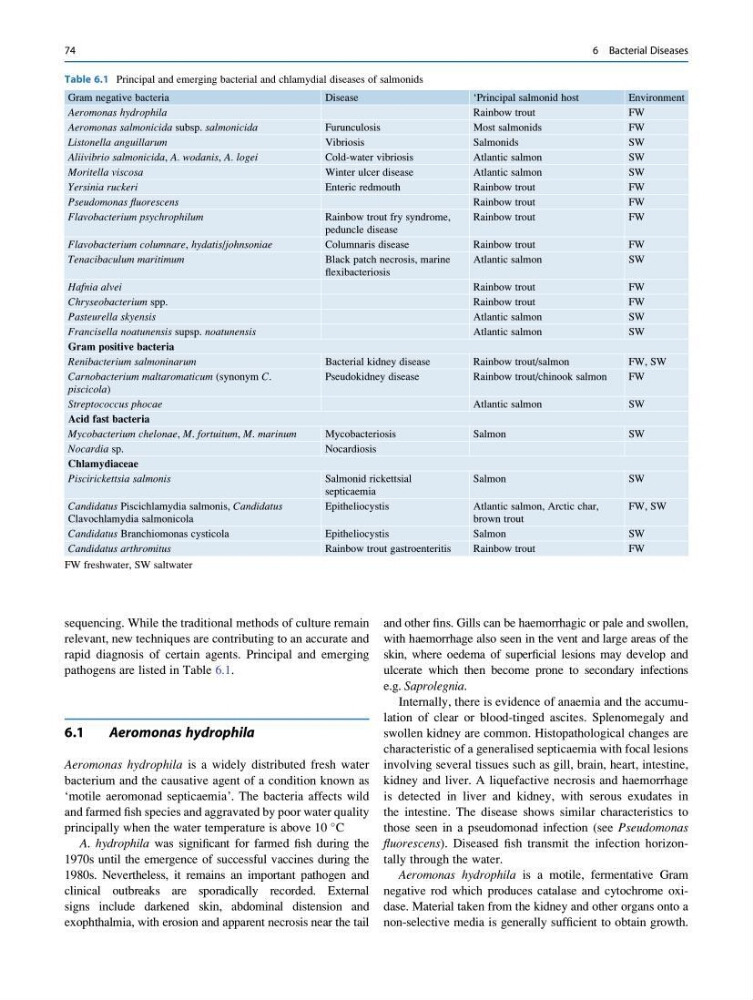
pathogens are listed in Table 6.1.
6.1
Aeromonas hydrophila
Aeromonas hydrophila is a widely distributed fresh water
bacterium and the causative agent of a condition known as
‘motile aeromonad septicaemia’. The bacteria affects wild
and farmed fish species and aggravated by poor water quality
principally when the water temperature is above 10
C
A. hydrophila was significant for farmed fish during the
1970s until the emergence of successful vaccines during the
1980s. Nevertheless, it remains an important pathogen and
clinical outbreaks are sporadically recorded. External
signs include darkened skin, abdominal distension and
exophthalmia, with erosion and apparent necrosis near the tail
and other fins. Gills can be haemorrhagic or pale and swollen,
with haemorrhage also seen in the vent and large areas of the
skin, where oedema of superficial lesions may develop and
ulcerate which then become prone to secondary infections
e.g. Saprolegnia.
Internally, there is evidence of anaemia and the accumulation of clear or blood-tinged ascites. Splenomegaly and
swollen kidney are common. Histopathological changes are
characteristic of a generalised septicaemia with focal lesions
involving several tissues such as gill, brain, heart, intestine,
kidney and liver. A liquefactive necrosis and haemorrhage
is detected in liver and kidney, with serous exudates in
the intestine. The disease shows similar characteristics to
those seen in a pseudomonad infection (see Pseudomonas
fluorescens). Diseased fish transmit the infection horizontally through the water.
Aeromonas hydrophila is a motile, fermentative Gram
negative rod which produces catalase and cytochrome oxidase. Material taken from the kidney and other organs onto a
non-selective media is generally sufficient to obtain growth.
Table 6.1 Principal and emerging bacterial and chlamydial diseases of salmonids
Gram negative bacteria
Disease
‘Principal salmonid host
Environment
Aeromonas hydrophila
Rainbow trout
FW
Aeromonas salmonicida subsp. salmonicida
Furunculosis
Most salmonids
FW
Listonella anguillarum
Vibriosis
Salmonids
SW
Aliivibrio salmonicida, A. wodanis, A. logei
Cold-water vibriosis
Atlantic salmon
SW
Moritella viscosa
Winter ulcer disease
Atlantic salmon
SW
Yersinia ruckeri
Enteric redmouth
Rainbow trout
FW
Pseudomonas fluorescens
Rainbow trout
FW
Flavobacterium psychrophilum
Rainbow trout fry syndrome,
peduncle disease
Rainbow trout
FW
Flavobacterium columnare, hydatis/johnsoniae
Columnaris disease
Rainbow trout
FW
Tenacibaculum maritimum
Black patch necrosis, marine
flexibacteriosis
Atlantic salmon
SW
Hafnia alvei
Rainbow trout
FW
Chryseobacterium spp.
Rainbow trout
FW
Pasteurella skyensis
Atlantic salmon
SW
Francisella noatunensis supsp. noatunensis
Atlantic salmon
SW
Gram positive bacteria
Renibacterium salmoninarum
Bacterial kidney disease
Rainbow trout/salmon
FW, SW
Carnobacterium maltaromaticum (synonym C.
piscicola)
Pseudokidney disease
Rainbow trout/chinook salmon
FW
Streptococcus phocae
Atlantic salmon
SW
Acid fast bacteria
Mycobacterium chelonae, M. fortuitum, M. marinum
Mycobacteriosis
Salmon
SW
Nocardia sp.
Nocardiosis
Chlamydiaceae
Piscirickettsia salmonis
Salmonid rickettsial
septicaemia
Salmon
SW
Candidatus Piscichlamydia salmonis, Candidatus
Clavochlamydia salmonicola
Epitheliocystis
Atlantic salmon, Arctic char,
brown trout
FW, SW
Candidatus Branchiomonas cysticola
Epitheliocystis
Salmon
SW
Candidatus arthromitus
Rainbow trout gastroenteritis
Rainbow trout
FW
FW freshwater, SW saltwater
74
6 Bacterial Diseases
relevant, new techniques are contributing to an accurate and
rapid diagnosis of certain agents. Principal and emerging
pathogens are listed in Table 6.1.
6.1
Aeromonas hydrophila
Aeromonas hydrophila is a widely distributed fresh water
bacterium and the causative agent of a condition known as
‘motile aeromonad septicaemia’. The bacteria affects wild
and farmed fish species and aggravated by poor water quality
principally when the water temperature is above 10
C
A. hydrophila was significant for farmed fish during the
1970s until the emergence of successful vaccines during the
1980s. Nevertheless, it remains an important pathogen and
clinical outbreaks are sporadically recorded. External
signs include darkened skin, abdominal distension and
exophthalmia, with erosion and apparent necrosis near the tail
and other fins. Gills can be haemorrhagic or pale and swollen,
with haemorrhage also seen in the vent and large areas of the
skin, where oedema of superficial lesions may develop and
ulcerate which then become prone to secondary infections
e.g. Saprolegnia.
Internally, there is evidence of anaemia and the accumulation of clear or blood-tinged ascites. Splenomegaly and
swollen kidney are common. Histopathological changes are
characteristic of a generalised septicaemia with focal lesions
involving several tissues such as gill, brain, heart, intestine,
kidney and liver. A liquefactive necrosis and haemorrhage
is detected in liver and kidney, with serous exudates in
the intestine. The disease shows similar characteristics to
those seen in a pseudomonad infection (see Pseudomonas
fluorescens). Diseased fish transmit the infection horizontally through the water.
Aeromonas hydrophila is a motile, fermentative Gram
negative rod which produces catalase and cytochrome oxidase. Material taken from the kidney and other organs onto a
non-selective media is generally sufficient to obtain growth.
Table 6.1 Principal and emerging bacterial and chlamydial diseases of salmonids
Gram negative bacteria
Disease
‘Principal salmonid host
Environment
Aeromonas hydrophila
Rainbow trout
FW
Aeromonas salmonicida subsp. salmonicida
Furunculosis
Most salmonids
FW
Listonella anguillarum
Vibriosis
Salmonids
SW
Aliivibrio salmonicida, A. wodanis, A. logei
Cold-water vibriosis
Atlantic salmon
SW
Moritella viscosa
Winter ulcer disease
Atlantic salmon
SW
Yersinia ruckeri
Enteric redmouth
Rainbow trout
FW
Pseudomonas fluorescens
Rainbow trout
FW
Flavobacterium psychrophilum
Rainbow trout fry syndrome,
peduncle disease
Rainbow trout
FW
Flavobacterium columnare, hydatis/johnsoniae
Columnaris disease
Rainbow trout
FW
Tenacibaculum maritimum
Black patch necrosis, marine
flexibacteriosis
Atlantic salmon
SW
Hafnia alvei
Rainbow trout
FW
Chryseobacterium spp.
Rainbow trout
FW
Pasteurella skyensis
Atlantic salmon
SW
Francisella noatunensis supsp. noatunensis
Atlantic salmon
SW
Gram positive bacteria
Renibacterium salmoninarum
Bacterial kidney disease
Rainbow trout/salmon
FW, SW
Carnobacterium maltaromaticum (synonym C.
piscicola)
Pseudokidney disease
Rainbow trout/chinook salmon
FW
Streptococcus phocae
Atlantic salmon
SW
Acid fast bacteria
Mycobacterium chelonae, M. fortuitum, M. marinum
Mycobacteriosis
Salmon
SW
Nocardia sp.
Nocardiosis
Chlamydiaceae
Piscirickettsia salmonis
Salmonid rickettsial
septicaemia
Salmon
SW
Candidatus Piscichlamydia salmonis, Candidatus
Clavochlamydia salmonicola
Epitheliocystis
Atlantic salmon, Arctic char,
brown trout
FW, SW
Candidatus Branchiomonas cysticola
Epitheliocystis
Salmon
SW
Candidatus arthromitus
Rainbow trout gastroenteritis
Rainbow trout
FW
FW freshwater, SW saltwater
74
6 Bacterial Diseases