

carriers and virus reservoirs. Diagnosis comes from the characteristic histopathological lesions in heart and red muscle,
immunohistochemistry and the presence of PRV demonstrated
by PCR. Pancreas disease (PD) and cardiomyopathy syndrome
(CMS) are important differential diagnoses, but may be
differentiated from HSMI by the type and distribution of
cardiac lesions, pancreatic lesions and pathological changes
in red muscle. There is no treatment or vaccines available.
Prophylactic measures include reduction of stress and
restrictions on the transport of live fish.
5.5
Salmon Leukaemia Virus
Plasmacytoid leukaemia (PL) of farmed Chinook on the
west coast of North America is attributed to salmon leukaemia virus (SLC). Evidence of PL has also been recorded in
freshwater-reared salmon in the United States and in salmon
from net-pens in Chile. Other salmonids such as coho,
sockeye and Atlantic salmon are considered susceptible
under experimental conditions. Affected fish are dark,
lethargic and often show severe bilateral exophthalmia.
Pale gills are a regular finding and affected fish usually
stay near the water surface. Spleen, kidney and retrobulbar
tissue are enlarged and mottled, with petechial haemorrhage
in several organs including the liver, mesenteric fat, pancreas and skeletal muscle. Histologically, infection is
characterised by proliferation and infiltration of
plasmablasts and other lymphoid cells into the visceral
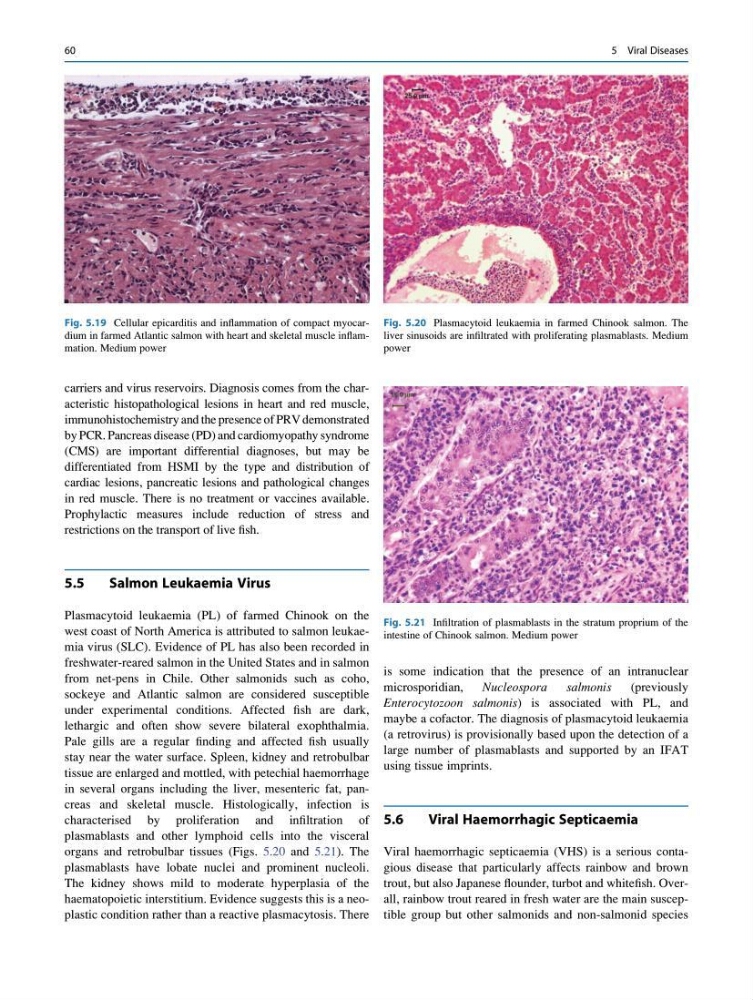
organs and retrobulbar tissues (Figs. 5.20 and 5.21). The
plasmablasts have lobate nuclei and prominent nucleoli.
The kidney shows mild to moderate hyperplasia of the
haematopoietic interstitium. Evidence suggests this is a neoplastic condition rather than a reactive plasmacytosis. There
is some indication that the presence of an intranuclear
microsporidian,
Nucleospora
salmonis
(previously
Enterocytozoon salmonis) is associated with PL, and
maybe a cofactor. The diagnosis of plasmacytoid leukaemia
(a retrovirus) is provisionally based upon the detection of a
large number of plasmablasts and supported by an IFAT
using tissue imprints.
5.6
Viral Haemorrhagic Septicaemia
Viral haemorrhagic septicaemia (VHS) is a serious contagious disease that particularly affects rainbow and brown
trout, but also Japanese flounder, turbot and whitefish. Overall, rainbow trout reared in fresh water are the main susceptible group but other salmonids and non-salmonid species
Fig. 5.19 Cellular epicarditis and inflammation of compact myocardium in farmed Atlantic salmon with heart and skeletal muscle inflammation. Medium power
Fig. 5.20 Plasmacytoid leukaemia in farmed Chinook salmon. The
liver sinusoids are infiltrated with proliferating plasmablasts. Medium
power
Fig. 5.21 Infiltration of plasmablasts in the stratum proprium of the
intestine of Chinook salmon. Medium power
60
5 Viral Diseases
immunohistochemistry and the presence of PRV demonstrated
by PCR. Pancreas disease (PD) and cardiomyopathy syndrome
(CMS) are important differential diagnoses, but may be
differentiated from HSMI by the type and distribution of
cardiac lesions, pancreatic lesions and pathological changes
in red muscle. There is no treatment or vaccines available.
Prophylactic measures include reduction of stress and
restrictions on the transport of live fish.
5.5
Salmon Leukaemia Virus
Plasmacytoid leukaemia (PL) of farmed Chinook on the
west coast of North America is attributed to salmon leukaemia virus (SLC). Evidence of PL has also been recorded in
freshwater-reared salmon in the United States and in salmon
from net-pens in Chile. Other salmonids such as coho,
sockeye and Atlantic salmon are considered susceptible
under experimental conditions. Affected fish are dark,
lethargic and often show severe bilateral exophthalmia.
Pale gills are a regular finding and affected fish usually
stay near the water surface. Spleen, kidney and retrobulbar
tissue are enlarged and mottled, with petechial haemorrhage
in several organs including the liver, mesenteric fat, pancreas and skeletal muscle. Histologically, infection is
characterised by proliferation and infiltration of
plasmablasts and other lymphoid cells into the visceral
organs and retrobulbar tissues (Figs. 5.20 and 5.21). The
plasmablasts have lobate nuclei and prominent nucleoli.
The kidney shows mild to moderate hyperplasia of the
haematopoietic interstitium. Evidence suggests this is a neoplastic condition rather than a reactive plasmacytosis. There
is some indication that the presence of an intranuclear
microsporidian,
Nucleospora
salmonis
(previously
Enterocytozoon salmonis) is associated with PL, and
maybe a cofactor. The diagnosis of plasmacytoid leukaemia
(a retrovirus) is provisionally based upon the detection of a
large number of plasmablasts and supported by an IFAT
using tissue imprints.
5.6
Viral Haemorrhagic Septicaemia
Viral haemorrhagic septicaemia (VHS) is a serious contagious disease that particularly affects rainbow and brown
trout, but also Japanese flounder, turbot and whitefish. Overall, rainbow trout reared in fresh water are the main susceptible group but other salmonids and non-salmonid species
Fig. 5.19 Cellular epicarditis and inflammation of compact myocardium in farmed Atlantic salmon with heart and skeletal muscle inflammation. Medium power
Fig. 5.20 Plasmacytoid leukaemia in farmed Chinook salmon. The
liver sinusoids are infiltrated with proliferating plasmablasts. Medium
power
Fig. 5.21 Infiltration of plasmablasts in the stratum proprium of the
intestine of Chinook salmon. Medium power
60
5 Viral Diseases