

population of sea lampreys in the Great Lakes area where
they have caused considerable damage to the fish population. Lampreys feed on muscular tissue, body fluids and
blood and may eventually emaciate the host.
Histopathological lesions include dermal penetration, muscle necrosis, oedema and haemorrhage. Circular skin ulcers
(e.g. winter ulcers or pseudomonad infections) may pose
differential diagnosis challenges.
10.12 Lesions Associated with Angling
Lesions associated with angling mainly result from physical hook damage to mouth and jaw, as well as scale loss and
epidermal damage associated to handling and netting. In
particular, these lesions may occur in a large proportion of
populations when catch and release is the norm. Fish may
be caught repeatedly in one season and reflected in different or accumulative lesions. Common hook-associated
lesions include tearing, displacement or loss of maxillae,
lesions in the eyes and hooks embedded in the oesophagus
or stomach following deep hooking. Lesions on gill arches
have also been reported. In the process of playing and
landing the fish, damage to skin may result from contact
with gravel, rocks, and landing net or contact with dry
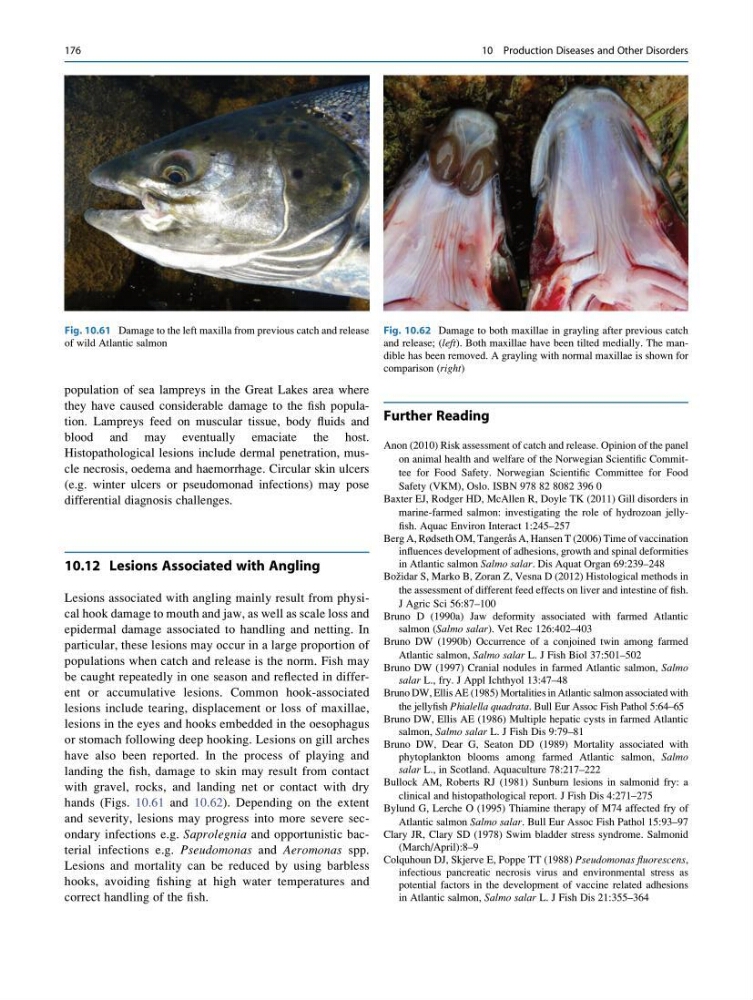
hands (Figs. 10.61 and 10.62). Depending on the extent
and severity, lesions may progress into more severe secondary infections e.g. Saprolegnia and opportunistic bacterial infections e.g. Pseudomonas and Aeromonas spp.
Lesions and mortality can be reduced by using barbless
hooks, avoiding fishing at high water temperatures and
correct handling of the fish.
Further Reading
Anon (2010) Risk assessment of catch and release. Opinion of the panel
on animal health and welfare of the Norwegian Scientific Committee for Food Safety. Norwegian Scientific Committee for Food
Safety (VKM), Oslo. ISBN 978 82 8082 396 0
Baxter EJ, Rodger HD, McAllen R, Doyle TK (2011) Gill disorders in
marine-farmed salmon: investigating the role of hydrozoan jellyfish. Aquac Environ Interact 1:245–257
Berg A, Rødseth OM, Tangera ˚s A, Hansen T (2006) Time of vaccination
influences development of adhesions, growth and spinal deformities
in Atlantic salmon Salmo salar. Dis Aquat Organ 69:239–248
Boz ˇidar S, Marko B, Zoran Z, Vesna D (2012) Histological methods in
the assessment of different feed effects on liver and intestine of fish.
J Agric Sci 56:87–100
Bruno D (1990a) Jaw deformity associated with farmed Atlantic
salmon (Salmo salar). Vet Rec 126:402–403
Bruno DW (1990b) Occurrence of a conjoined twin among farmed
Atlantic salmon, Salmo salar L. J Fish Biol 37:501–502
Bruno DW (1997) Cranial nodules in farmed Atlantic salmon, Salmo
salar L., fry. J Appl Ichthyol 13:47–48
Bruno DW, Ellis AE (1985) Mortalities in Atlantic salmon associated with
the jellyfish Phialella quadrata. Bull Eur Assoc Fish Pathol 5:64–65
Bruno DW, Ellis AE (1986) Multiple hepatic cysts in farmed Atlantic
salmon, Salmo salar L. J Fish Dis 9:79–81
Bruno DW, Dear G, Seaton DD (1989) Mortality associated with
phytoplankton blooms among farmed Atlantic salmon, Salmo
salar L., in Scotland. Aquaculture 78:217–222
Bullock AM, Roberts RJ (1981) Sunburn lesions in salmonid fry: a
clinical and histopathological report. J Fish Dis 4:271–275
Bylund G, Lerche O (1995) Thiamine therapy of M74 affected fry of
Atlantic salmon Salmo salar. Bull Eur Assoc Fish Pathol 15:93–97
Clary JR, Clary SD (1978) Swim bladder stress syndrome. Salmonid
(March/April):8–9
Colquhoun DJ, Skjerve E, Poppe TT (1988) Pseudomonas fluorescens,
infectious pancreatic necrosis virus and environmental stress as
potential factors in the development of vaccine related adhesions
in Atlantic salmon, Salmo salar L. J Fish Dis 21:355–364
Fig. 10.61 Damage to the left maxilla from previous catch and release
of wild Atlantic salmon
Fig. 10.62 Damage to both maxillae in grayling after previous catch
and release; (left). Both maxillae have been tilted medially. The mandible has been removed. A grayling with normal maxillae is shown for
comparison (right)
176
10 Production Diseases and Other Disorders
they have caused considerable damage to the fish population. Lampreys feed on muscular tissue, body fluids and
blood and may eventually emaciate the host.
Histopathological lesions include dermal penetration, muscle necrosis, oedema and haemorrhage. Circular skin ulcers
(e.g. winter ulcers or pseudomonad infections) may pose
differential diagnosis challenges.
10.12 Lesions Associated with Angling
Lesions associated with angling mainly result from physical hook damage to mouth and jaw, as well as scale loss and
epidermal damage associated to handling and netting. In
particular, these lesions may occur in a large proportion of
populations when catch and release is the norm. Fish may
be caught repeatedly in one season and reflected in different or accumulative lesions. Common hook-associated
lesions include tearing, displacement or loss of maxillae,
lesions in the eyes and hooks embedded in the oesophagus
or stomach following deep hooking. Lesions on gill arches
have also been reported. In the process of playing and
landing the fish, damage to skin may result from contact
with gravel, rocks, and landing net or contact with dry
hands (Figs. 10.61 and 10.62). Depending on the extent
and severity, lesions may progress into more severe secondary infections e.g. Saprolegnia and opportunistic bacterial infections e.g. Pseudomonas and Aeromonas spp.
Lesions and mortality can be reduced by using barbless
hooks, avoiding fishing at high water temperatures and
correct handling of the fish.
Further Reading
Anon (2010) Risk assessment of catch and release. Opinion of the panel
on animal health and welfare of the Norwegian Scientific Committee for Food Safety. Norwegian Scientific Committee for Food
Safety (VKM), Oslo. ISBN 978 82 8082 396 0
Baxter EJ, Rodger HD, McAllen R, Doyle TK (2011) Gill disorders in
marine-farmed salmon: investigating the role of hydrozoan jellyfish. Aquac Environ Interact 1:245–257
Berg A, Rødseth OM, Tangera ˚s A, Hansen T (2006) Time of vaccination
influences development of adhesions, growth and spinal deformities
in Atlantic salmon Salmo salar. Dis Aquat Organ 69:239–248
Boz ˇidar S, Marko B, Zoran Z, Vesna D (2012) Histological methods in
the assessment of different feed effects on liver and intestine of fish.
J Agric Sci 56:87–100
Bruno D (1990a) Jaw deformity associated with farmed Atlantic
salmon (Salmo salar). Vet Rec 126:402–403
Bruno DW (1990b) Occurrence of a conjoined twin among farmed
Atlantic salmon, Salmo salar L. J Fish Biol 37:501–502
Bruno DW (1997) Cranial nodules in farmed Atlantic salmon, Salmo
salar L., fry. J Appl Ichthyol 13:47–48
Bruno DW, Ellis AE (1985) Mortalities in Atlantic salmon associated with
the jellyfish Phialella quadrata. Bull Eur Assoc Fish Pathol 5:64–65
Bruno DW, Ellis AE (1986) Multiple hepatic cysts in farmed Atlantic
salmon, Salmo salar L. J Fish Dis 9:79–81
Bruno DW, Dear G, Seaton DD (1989) Mortality associated with
phytoplankton blooms among farmed Atlantic salmon, Salmo
salar L., in Scotland. Aquaculture 78:217–222
Bullock AM, Roberts RJ (1981) Sunburn lesions in salmonid fry: a
clinical and histopathological report. J Fish Dis 4:271–275
Bylund G, Lerche O (1995) Thiamine therapy of M74 affected fry of
Atlantic salmon Salmo salar. Bull Eur Assoc Fish Pathol 15:93–97
Clary JR, Clary SD (1978) Swim bladder stress syndrome. Salmonid
(March/April):8–9
Colquhoun DJ, Skjerve E, Poppe TT (1988) Pseudomonas fluorescens,
infectious pancreatic necrosis virus and environmental stress as
potential factors in the development of vaccine related adhesions
in Atlantic salmon, Salmo salar L. J Fish Dis 21:355–364
Fig. 10.61 Damage to the left maxilla from previous catch and release
of wild Atlantic salmon
Fig. 10.62 Damage to both maxillae in grayling after previous catch
and release; (left). Both maxillae have been tilted medially. The mandible has been removed. A grayling with normal maxillae is shown for
comparison (right)
176
10 Production Diseases and Other Disorders