

conditions and during upstream migration in wild fish, or
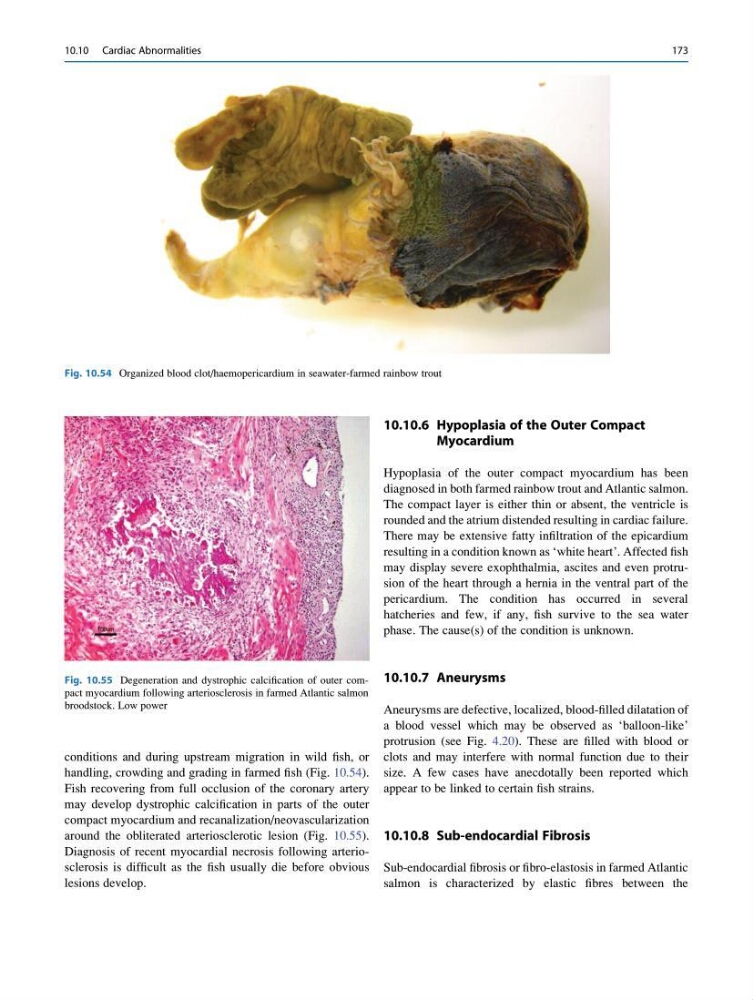
handling, crowding and grading in farmed fish (Fig. 10.54).
Fish recovering from full occlusion of the coronary artery
may develop dystrophic calcification in parts of the outer
compact myocardium and recanalization/neovascularization
around the obliterated arteriosclerotic lesion (Fig. 10.55).
Diagnosis of recent myocardial necrosis following arteriosclerosis is difficult as the fish usually die before obvious
lesions develop.
10.10.6 Hypoplasia of the Outer Compact
Myocardium
Hypoplasia of the outer compact myocardium has been
diagnosed in both farmed rainbow trout and Atlantic salmon.
The compact layer is either thin or absent, the ventricle is
rounded and the atrium distended resulting in cardiac failure.
There may be extensive fatty infiltration of the epicardium
resulting in a condition known as ‘white heart’. Affected fish
may display severe exophthalmia, ascites and even protrusion of the heart through a hernia in the ventral part of the
pericardium. The condition has occurred in several
hatcheries and few, if any, fish survive to the sea water
phase. The cause(s) of the condition is unknown.
10.10.7 Aneurysms
Aneurysms are defective, localized, blood-filled dilatation of
a blood vessel which may be observed as ‘balloon-like’
protrusion (see Fig. 4.20). These are filled with blood or
clots and may interfere with normal function due to their
size. A few cases have anecdotally been reported which
appear to be linked to certain fish strains.
10.10.8 Sub-endocardial Fibrosis
Sub-endocardial fibrosis or fibro-elastosis in farmed Atlantic
salmon is characterized by elastic fibres between the
Fig. 10.54 Organized blood clot/haemopericardium in seawater-farmed rainbow trout
Fig. 10.55 Degeneration and dystrophic calcification of outer compact myocardium following arteriosclerosis in farmed Atlantic salmon
broodstock. Low power
10.10 Cardiac Abnormalities
173
handling, crowding and grading in farmed fish (Fig. 10.54).
Fish recovering from full occlusion of the coronary artery
may develop dystrophic calcification in parts of the outer
compact myocardium and recanalization/neovascularization
around the obliterated arteriosclerotic lesion (Fig. 10.55).
Diagnosis of recent myocardial necrosis following arteriosclerosis is difficult as the fish usually die before obvious
lesions develop.
10.10.6 Hypoplasia of the Outer Compact
Myocardium
Hypoplasia of the outer compact myocardium has been
diagnosed in both farmed rainbow trout and Atlantic salmon.
The compact layer is either thin or absent, the ventricle is
rounded and the atrium distended resulting in cardiac failure.
There may be extensive fatty infiltration of the epicardium
resulting in a condition known as ‘white heart’. Affected fish
may display severe exophthalmia, ascites and even protrusion of the heart through a hernia in the ventral part of the
pericardium. The condition has occurred in several
hatcheries and few, if any, fish survive to the sea water
phase. The cause(s) of the condition is unknown.
10.10.7 Aneurysms
Aneurysms are defective, localized, blood-filled dilatation of
a blood vessel which may be observed as ‘balloon-like’
protrusion (see Fig. 4.20). These are filled with blood or
clots and may interfere with normal function due to their
size. A few cases have anecdotally been reported which
appear to be linked to certain fish strains.
10.10.8 Sub-endocardial Fibrosis
Sub-endocardial fibrosis or fibro-elastosis in farmed Atlantic
salmon is characterized by elastic fibres between the
Fig. 10.54 Organized blood clot/haemopericardium in seawater-farmed rainbow trout
Fig. 10.55 Degeneration and dystrophic calcification of outer compact myocardium following arteriosclerosis in farmed Atlantic salmon
broodstock. Low power
10.10 Cardiac Abnormalities
173