

known among fish farmers that fish with different cardiac
abnormalities suffer far higher mortality than normal fish
during outbreaks of other diseases (e.g. pancreas disease).
This clearly illustrates the compound effect of cardiac
abnormalities for the general fish health. Specific defects in
salmonid hearts are discussed below.
10.10.1 Cardiomegaly
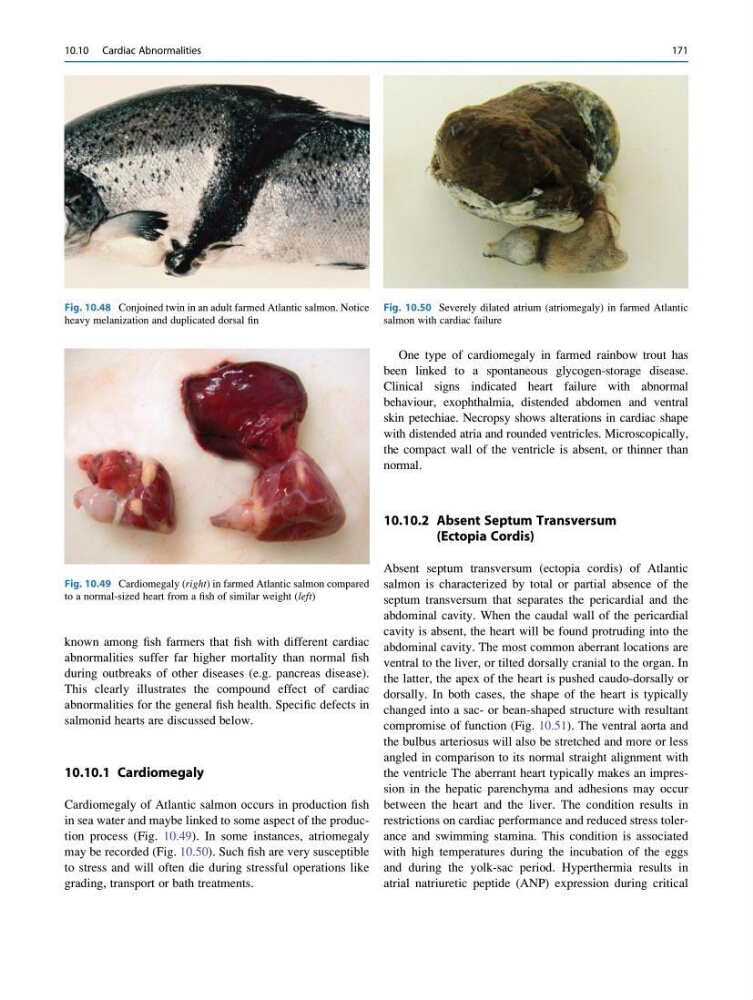
Cardiomegaly of Atlantic salmon occurs in production fish
in sea water and maybe linked to some aspect of the production process (Fig. 10.49). In some instances, atriomegaly
may be recorded (Fig. 10.50). Such fish are very susceptible
to stress and will often die during stressful operations like
grading, transport or bath treatments.
One type of cardiomegaly in farmed rainbow trout has
been linked to a spontaneous glycogen-storage disease.
Clinical signs indicated heart failure with abnormal
behaviour, exophthalmia, distended abdomen and ventral
skin petechiae. Necropsy shows alterations in cardiac shape
with distended atria and rounded ventricles. Microscopically,
the compact wall of the ventricle is absent, or thinner than
normal.
10.10.2 Absent Septum Transversum
(Ectopia Cordis)
Absent septum transversum (ectopia cordis) of Atlantic
salmon is characterized by total or partial absence of the
septum transversum that separates the pericardial and the
abdominal cavity. When the caudal wall of the pericardial
cavity is absent, the heart will be found protruding into the
abdominal cavity. The most common aberrant locations are
ventral to the liver, or tilted dorsally cranial to the organ. In
the latter, the apex of the heart is pushed caudo-dorsally or
dorsally. In both cases, the shape of the heart is typically
changed into a sac- or bean-shaped structure with resultant
compromise of function (Fig. 10.51). The ventral aorta and
the bulbus arteriosus will also be stretched and more or less
angled in comparison to its normal straight alignment with
the ventricle The aberrant heart typically makes an impression in the hepatic parenchyma and adhesions may occur
between the heart and the liver. The condition results in
restrictions on cardiac performance and reduced stress tolerance and swimming stamina. This condition is associated
with high temperatures during the incubation of the eggs
and during the yolk-sac period. Hyperthermia results in
atrial natriuretic peptide (ANP) expression during critical
Fig. 10.48 Conjoined twin in an adult farmed Atlantic salmon. Notice
heavy melanization and duplicated dorsal fin
Fig. 10.49 Cardiomegaly (right) in farmed Atlantic salmon compared
to a normal-sized heart from a fish of similar weight (left)
Fig. 10.50 Severely dilated atrium (atriomegaly) in farmed Atlantic
salmon with cardiac failure
10.10 Cardiac Abnormalities
171
abnormalities suffer far higher mortality than normal fish
during outbreaks of other diseases (e.g. pancreas disease).
This clearly illustrates the compound effect of cardiac
abnormalities for the general fish health. Specific defects in
salmonid hearts are discussed below.
10.10.1 Cardiomegaly
Cardiomegaly of Atlantic salmon occurs in production fish
in sea water and maybe linked to some aspect of the production process (Fig. 10.49). In some instances, atriomegaly
may be recorded (Fig. 10.50). Such fish are very susceptible
to stress and will often die during stressful operations like
grading, transport or bath treatments.
One type of cardiomegaly in farmed rainbow trout has
been linked to a spontaneous glycogen-storage disease.
Clinical signs indicated heart failure with abnormal
behaviour, exophthalmia, distended abdomen and ventral
skin petechiae. Necropsy shows alterations in cardiac shape
with distended atria and rounded ventricles. Microscopically,
the compact wall of the ventricle is absent, or thinner than
normal.
10.10.2 Absent Septum Transversum
(Ectopia Cordis)
Absent septum transversum (ectopia cordis) of Atlantic
salmon is characterized by total or partial absence of the
septum transversum that separates the pericardial and the
abdominal cavity. When the caudal wall of the pericardial
cavity is absent, the heart will be found protruding into the
abdominal cavity. The most common aberrant locations are
ventral to the liver, or tilted dorsally cranial to the organ. In
the latter, the apex of the heart is pushed caudo-dorsally or
dorsally. In both cases, the shape of the heart is typically
changed into a sac- or bean-shaped structure with resultant
compromise of function (Fig. 10.51). The ventral aorta and
the bulbus arteriosus will also be stretched and more or less
angled in comparison to its normal straight alignment with
the ventricle The aberrant heart typically makes an impression in the hepatic parenchyma and adhesions may occur
between the heart and the liver. The condition results in
restrictions on cardiac performance and reduced stress tolerance and swimming stamina. This condition is associated
with high temperatures during the incubation of the eggs
and during the yolk-sac period. Hyperthermia results in
atrial natriuretic peptide (ANP) expression during critical
Fig. 10.48 Conjoined twin in an adult farmed Atlantic salmon. Notice
heavy melanization and duplicated dorsal fin
Fig. 10.49 Cardiomegaly (right) in farmed Atlantic salmon compared
to a normal-sized heart from a fish of similar weight (left)
Fig. 10.50 Severely dilated atrium (atriomegaly) in farmed Atlantic
salmon with cardiac failure
10.10 Cardiac Abnormalities
171