

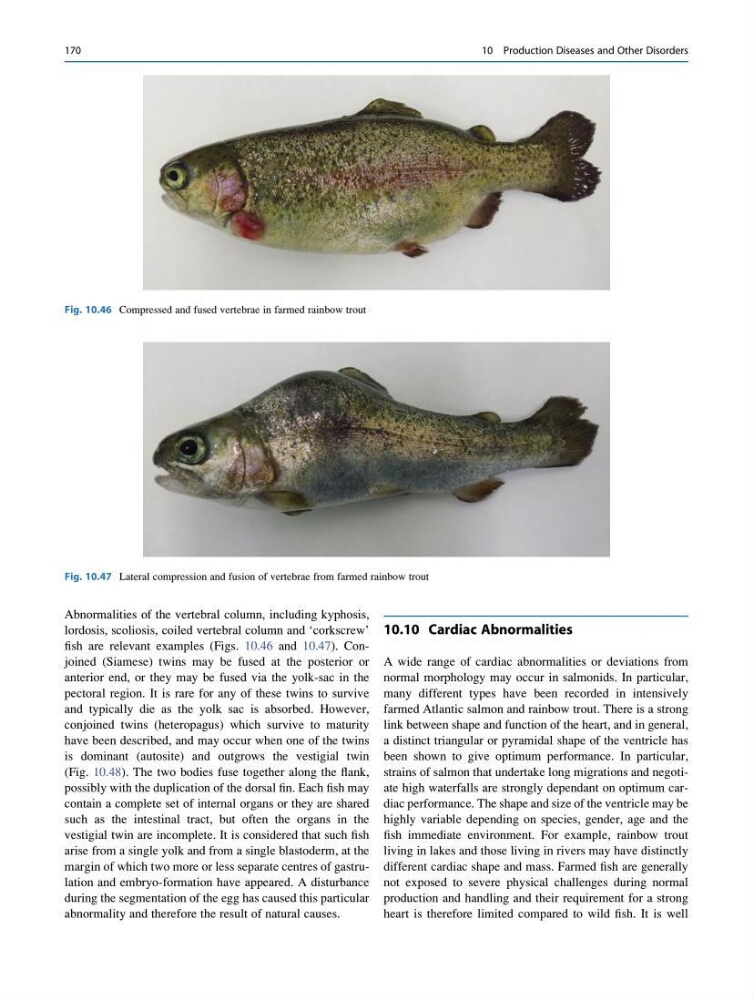
Abnormalities of the vertebral column, including kyphosis,
lordosis, scoliosis, coiled vertebral column and ‘corkscrew’
fish are relevant examples (Figs. 10.46 and 10.47). Conjoined (Siamese) twins may be fused at the posterior or
anterior end, or they may be fused via the yolk-sac in the
pectoral region. It is rare for any of these twins to survive
and typically die as the yolk sac is absorbed. However,
conjoined twins (heteropagus) which survive to maturity
have been described, and may occur when one of the twins
is dominant (autosite) and outgrows the vestigial twin
(Fig. 10.48). The two bodies fuse together along the flank,
possibly with the duplication of the dorsal fin. Each fish may
contain a complete set of internal organs or they are shared
such as the intestinal tract, but often the organs in the
vestigial twin are incomplete. It is considered that such fish
arise from a single yolk and from a single blastoderm, at the
margin of which two more or less separate centres of gastrulation and embryo-formation have appeared. A disturbance
during the segmentation of the egg has caused this particular
abnormality and therefore the result of natural causes.
10.10 Cardiac Abnormalities
A wide range of cardiac abnormalities or deviations from
normal morphology may occur in salmonids. In particular,
many different types have been recorded in intensively
farmed Atlantic salmon and rainbow trout. There is a strong
link between shape and function of the heart, and in general,
a distinct triangular or pyramidal shape of the ventricle has
been shown to give optimum performance. In particular,
strains of salmon that undertake long migrations and negotiate high waterfalls are strongly dependant on optimum cardiac performance. The shape and size of the ventricle may be
highly variable depending on species, gender, age and the
fish immediate environment. For example, rainbow trout
living in lakes and those living in rivers may have distinctly
different cardiac shape and mass. Farmed fish are generally
not exposed to severe physical challenges during normal
production and handling and their requirement for a strong
heart is therefore limited compared to wild fish. It is well
Fig. 10.46 Compressed and fused vertebrae in farmed rainbow trout
Fig. 10.47 Lateral compression and fusion of vertebrae from farmed rainbow trout
170
10 Production Diseases and Other Disorders
lordosis, scoliosis, coiled vertebral column and ‘corkscrew’
fish are relevant examples (Figs. 10.46 and 10.47). Conjoined (Siamese) twins may be fused at the posterior or
anterior end, or they may be fused via the yolk-sac in the
pectoral region. It is rare for any of these twins to survive
and typically die as the yolk sac is absorbed. However,
conjoined twins (heteropagus) which survive to maturity
have been described, and may occur when one of the twins
is dominant (autosite) and outgrows the vestigial twin
(Fig. 10.48). The two bodies fuse together along the flank,
possibly with the duplication of the dorsal fin. Each fish may
contain a complete set of internal organs or they are shared
such as the intestinal tract, but often the organs in the
vestigial twin are incomplete. It is considered that such fish
arise from a single yolk and from a single blastoderm, at the
margin of which two more or less separate centres of gastrulation and embryo-formation have appeared. A disturbance
during the segmentation of the egg has caused this particular
abnormality and therefore the result of natural causes.
10.10 Cardiac Abnormalities
A wide range of cardiac abnormalities or deviations from
normal morphology may occur in salmonids. In particular,
many different types have been recorded in intensively
farmed Atlantic salmon and rainbow trout. There is a strong
link between shape and function of the heart, and in general,
a distinct triangular or pyramidal shape of the ventricle has
been shown to give optimum performance. In particular,
strains of salmon that undertake long migrations and negotiate high waterfalls are strongly dependant on optimum cardiac performance. The shape and size of the ventricle may be
highly variable depending on species, gender, age and the
fish immediate environment. For example, rainbow trout
living in lakes and those living in rivers may have distinctly
different cardiac shape and mass. Farmed fish are generally
not exposed to severe physical challenges during normal
production and handling and their requirement for a strong
heart is therefore limited compared to wild fish. It is well
Fig. 10.46 Compressed and fused vertebrae in farmed rainbow trout
Fig. 10.47 Lateral compression and fusion of vertebrae from farmed rainbow trout
170
10 Production Diseases and Other Disorders