

Another species, Bolinopsis infundibulum has been
reported to be associated with farmed fish mortality during
the autumn in northern Norway. This species is fragile and
ruptures on contact with the cages liberating a jelly-like substance which interferes with oxygen uptake by the fish gills.
Histologically, in general affected gills show sloughed
lamella and necrosis, with oedema and inflammation of the
filaments as emphasised by the presence of granulocytes.
After approximately 48 h gill lesions show large areas of
epithelial sloughing, haemorrhage and lysis of erythrocytes.
Cnidaria vary from a few millimetres to a few metres in
size, and may be solitary (i.e. medusae of Hydrozoa,
Scyphozoa and Cubozoa) or colonial (i.e. hydrozoan
siphonophores) organisms.
10.1.3 Phytoplankton and Algal Blooms
Blooms occur naturally and can adversely affect human
health as well as fish stocks. The blue-green algae,
Cyanobacteria are among the most damaging blooms that
impact on water quality. Impact depends upon the type, size
and frequency of the blooms but reported as seasonal
changes rather than influenced by fish farming. Fish stocks
can suffer directly from toxins or indirectly through damage
to the gill epithelia, resulting in acute necrosis, swelling,
pyknosis and congestion.
10.1.4 Gas Bubble Disease
Gas bubble disease (GBD) is a non-infectious physically
induced process that is caused by uncompensated hyperbaric
pressure of total dissolved gases within the fish vascular
system. GBD can either occur as a natural phenomenon
in lakes and rivers (e.g. heating of water, photosynthesis)
or artificially when supersaturated water is drawn into fish
tanks without adequate aeration (e.g. pumping and heating of
water, hydroelectric plants or leaking pumps). When pressure
compensation is inadequate, a sudden decompression in the
external environment (water) leads to blood dissolved gases
(initially nitrogen) to form emboli in several tissues as it
abruptly comes out of solution when trying to balance with
the decreased external pressure. Highly vascularised tissues
suffer most and severe exophthalmia due to the physical
accumulation of gas bubbles in the choroid gland of the
posterior uvea, is a frequent finding, as well as corneal degeneration and haemorrhage. Macroscopically bubbles may also
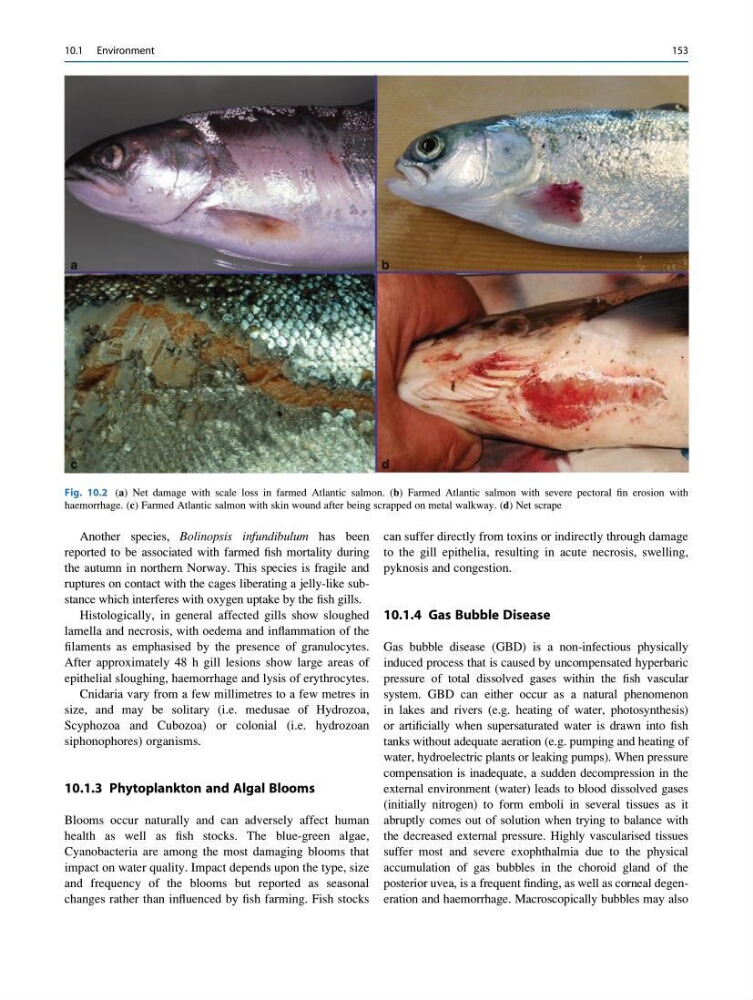
Fig. 10.2 (a) Net damage with scale loss in farmed Atlantic salmon. (b) Farmed Atlantic salmon with severe pectoral fin erosion with
haemorrhage. (c) Farmed Atlantic salmon with skin wound after being scrapped on metal walkway. (d) Net scrape
10.1 Environment
153
reported to be associated with farmed fish mortality during
the autumn in northern Norway. This species is fragile and
ruptures on contact with the cages liberating a jelly-like substance which interferes with oxygen uptake by the fish gills.
Histologically, in general affected gills show sloughed
lamella and necrosis, with oedema and inflammation of the
filaments as emphasised by the presence of granulocytes.
After approximately 48 h gill lesions show large areas of
epithelial sloughing, haemorrhage and lysis of erythrocytes.
Cnidaria vary from a few millimetres to a few metres in
size, and may be solitary (i.e. medusae of Hydrozoa,
Scyphozoa and Cubozoa) or colonial (i.e. hydrozoan
siphonophores) organisms.
10.1.3 Phytoplankton and Algal Blooms
Blooms occur naturally and can adversely affect human
health as well as fish stocks. The blue-green algae,
Cyanobacteria are among the most damaging blooms that
impact on water quality. Impact depends upon the type, size
and frequency of the blooms but reported as seasonal
changes rather than influenced by fish farming. Fish stocks
can suffer directly from toxins or indirectly through damage
to the gill epithelia, resulting in acute necrosis, swelling,
pyknosis and congestion.
10.1.4 Gas Bubble Disease
Gas bubble disease (GBD) is a non-infectious physically
induced process that is caused by uncompensated hyperbaric
pressure of total dissolved gases within the fish vascular
system. GBD can either occur as a natural phenomenon
in lakes and rivers (e.g. heating of water, photosynthesis)
or artificially when supersaturated water is drawn into fish
tanks without adequate aeration (e.g. pumping and heating of
water, hydroelectric plants or leaking pumps). When pressure
compensation is inadequate, a sudden decompression in the
external environment (water) leads to blood dissolved gases
(initially nitrogen) to form emboli in several tissues as it
abruptly comes out of solution when trying to balance with
the decreased external pressure. Highly vascularised tissues
suffer most and severe exophthalmia due to the physical
accumulation of gas bubbles in the choroid gland of the
posterior uvea, is a frequent finding, as well as corneal degeneration and haemorrhage. Macroscopically bubbles may also
Fig. 10.2 (a) Net damage with scale loss in farmed Atlantic salmon. (b) Farmed Atlantic salmon with severe pectoral fin erosion with
haemorrhage. (c) Farmed Atlantic salmon with skin wound after being scrapped on metal walkway. (d) Net scrape
10.1 Environment
153