

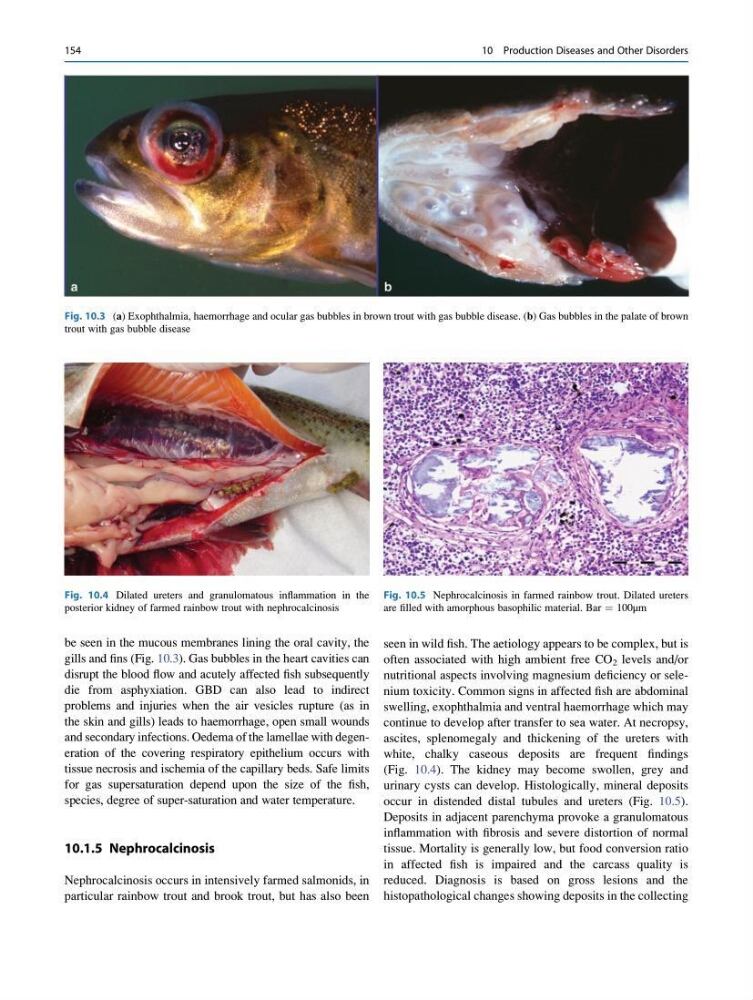
be seen in the mucous membranes lining the oral cavity, the
gills and fins (Fig. 10.3). Gas bubbles in the heart cavities can
disrupt the blood flow and acutely affected fish subsequently
die from asphyxiation. GBD can also lead to indirect
problems and injuries when the air vesicles rupture (as in
the skin and gills) leads to haemorrhage, open small wounds
and secondary infections. Oedema of the lamellae with degeneration of the covering respiratory epithelium occurs with
tissue necrosis and ischemia of the capillary beds. Safe limits
for gas supersaturation depend upon the size of the fish,
species, degree of super-saturation and water temperature.
10.1.5 Nephrocalcinosis
Nephrocalcinosis occurs in intensively farmed salmonids, in
particular rainbow trout and brook trout, but has also been
seen in wild fish. The aetiology appears to be complex, but is
often associated with high ambient free CO 2 levels and/or
nutritional aspects involving magnesium deficiency or selenium toxicity. Common signs in affected fish are abdominal
swelling, exophthalmia and ventral haemorrhage which may
continue to develop after transfer to sea water. At necropsy,
ascites, splenomegaly and thickening of the ureters with
white, chalky caseous deposits are frequent findings
(Fig. 10.4). The kidney may become swollen, grey and
urinary cysts can develop. Histologically, mineral deposits
occur in distended distal tubules and ureters (Fig. 10.5).
Deposits in adjacent parenchyma provoke a granulomatous
inflammation with fibrosis and severe distortion of normal
tissue. Mortality is generally low, but food conversion ratio
in affected fish is impaired and the carcass quality is
reduced. Diagnosis is based on gross lesions and the
histopathological changes showing deposits in the collecting
Fig. 10.3 (a) Exophthalmia, haemorrhage and ocular gas bubbles in brown trout with gas bubble disease. (b) Gas bubbles in the palate of brown
trout with gas bubble disease
Fig. 10.4 Dilated ureters and granulomatous inflammation in the
posterior kidney of farmed rainbow trout with nephrocalcinosis
Fig. 10.5 Nephrocalcinosis in farmed rainbow trout. Dilated ureters
are filled with amorphous basophilic material. Bar ¼ 100μm
154
10 Production Diseases and Other Disorders
gills and fins (Fig. 10.3). Gas bubbles in the heart cavities can
disrupt the blood flow and acutely affected fish subsequently
die from asphyxiation. GBD can also lead to indirect
problems and injuries when the air vesicles rupture (as in
the skin and gills) leads to haemorrhage, open small wounds
and secondary infections. Oedema of the lamellae with degeneration of the covering respiratory epithelium occurs with
tissue necrosis and ischemia of the capillary beds. Safe limits
for gas supersaturation depend upon the size of the fish,
species, degree of super-saturation and water temperature.
10.1.5 Nephrocalcinosis
Nephrocalcinosis occurs in intensively farmed salmonids, in
particular rainbow trout and brook trout, but has also been
seen in wild fish. The aetiology appears to be complex, but is
often associated with high ambient free CO 2 levels and/or
nutritional aspects involving magnesium deficiency or selenium toxicity. Common signs in affected fish are abdominal
swelling, exophthalmia and ventral haemorrhage which may
continue to develop after transfer to sea water. At necropsy,
ascites, splenomegaly and thickening of the ureters with
white, chalky caseous deposits are frequent findings
(Fig. 10.4). The kidney may become swollen, grey and
urinary cysts can develop. Histologically, mineral deposits
occur in distended distal tubules and ureters (Fig. 10.5).
Deposits in adjacent parenchyma provoke a granulomatous
inflammation with fibrosis and severe distortion of normal
tissue. Mortality is generally low, but food conversion ratio
in affected fish is impaired and the carcass quality is
reduced. Diagnosis is based on gross lesions and the
histopathological changes showing deposits in the collecting
Fig. 10.3 (a) Exophthalmia, haemorrhage and ocular gas bubbles in brown trout with gas bubble disease. (b) Gas bubbles in the palate of brown
trout with gas bubble disease
Fig. 10.4 Dilated ureters and granulomatous inflammation in the
posterior kidney of farmed rainbow trout with nephrocalcinosis
Fig. 10.5 Nephrocalcinosis in farmed rainbow trout. Dilated ureters
are filled with amorphous basophilic material. Bar ¼ 100μm
154
10 Production Diseases and Other Disorders