

9.4.8 Stephanostomum tenue
Metacercariae of the trematode Stephanostomum tenue
occur in the heart of sea water-farmed rainbow trout and a
good example of a parasite causing disease in a farmed
species outside its normal range. In this case, the rainbow
trout serves as an accidental host and associated mortality
may be high.
9.5
Monogenea
Parasitic haptorworms represent a large group mainly affecting,
but not exclusively, the gills and skin of many fish species
including salmonids. They attach to the host by their characteristic anchoring structure, the posterior opisthaptor, which bares
hooks, clamps and/or suckers. Monogenea have no true body
cavity and the digestive tract has only one opening; relevant
species are seldom longer than 1 mm. All species are hermaphroditic with both male and female reproductive organs in the
same individual. They have no intermediate hosts and most
species are oviparous, but some, including Gyrodactylus
salaris, is viviparous and the offspring when released, can
attach directly to the host and therefore the number of parasites
on a single fish increases rapidly.
9.5.1 Dactylogyrus sp.
Dactylogyrus, commonly known as gill flukes, occur on the
gills and buccal cavity of affected fish. These flukes are very
common on cyprinids with a reduced occurrence on rainbow
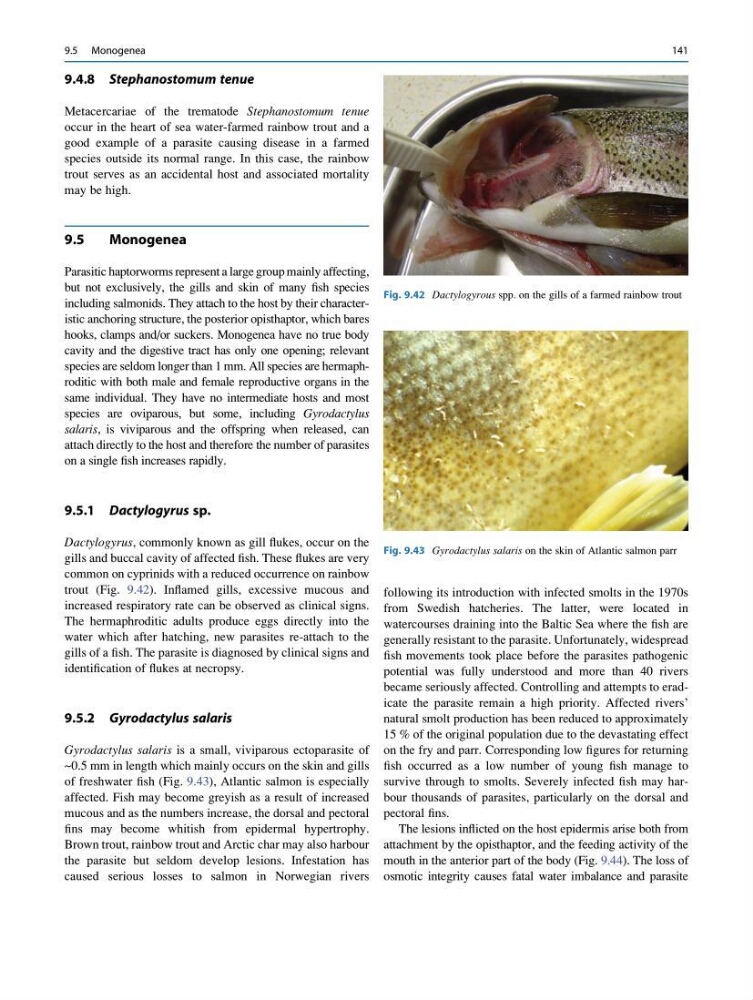
trout (Fig. 9.42). Inflamed gills, excessive mucous and
increased respiratory rate can be observed as clinical signs.
The hermaphroditic adults produce eggs directly into the
water which after hatching, new parasites re-attach to the
gills of a fish. The parasite is diagnosed by clinical signs and
identification of flukes at necropsy.
9.5.2 Gyrodactylus salaris
Gyrodactylus salaris is a small, viviparous ectoparasite of
~0.5 mm in length which mainly occurs on the skin and gills
of freshwater fish (Fig. 9.43), Atlantic salmon is especially
affected. Fish may become greyish as a result of increased
mucous and as the numbers increase, the dorsal and pectoral
fins may become whitish from epidermal hypertrophy.
Brown trout, rainbow trout and Arctic char may also harbour
the parasite but seldom develop lesions. Infestation has
caused serious losses to salmon in Norwegian rivers
following its introduction with infected smolts in the 1970s
from Swedish hatcheries. The latter, were located in
watercourses draining into the Baltic Sea where the fish are
generally resistant to the parasite. Unfortunately, widespread
fish movements took place before the parasites pathogenic
potential was fully understood and more than 40 rivers
became seriously affected. Controlling and attempts to eradicate the parasite remain a high priority. Affected rivers’
natural smolt production has been reduced to approximately
15 % of the original population due to the devastating effect
on the fry and parr. Corresponding low figures for returning
fish occurred as a low number of young fish manage to
survive through to smolts. Severely infected fish may harbour thousands of parasites, particularly on the dorsal and
pectoral fins.
The lesions inflicted on the host epidermis arise both from
attachment by the opisthaptor, and the feeding activity of the
mouth in the anterior part of the body (Fig. 9.44). The loss of
osmotic integrity causes fatal water imbalance and parasite
Fig. 9.42 Dactylogyrous spp. on the gills of a farmed rainbow trout
Fig. 9.43 Gyrodactylus salaris on the skin of Atlantic salmon parr
9.5 Monogenea
141
Metacercariae of the trematode Stephanostomum tenue
occur in the heart of sea water-farmed rainbow trout and a
good example of a parasite causing disease in a farmed
species outside its normal range. In this case, the rainbow
trout serves as an accidental host and associated mortality
may be high.
9.5
Monogenea
Parasitic haptorworms represent a large group mainly affecting,
but not exclusively, the gills and skin of many fish species
including salmonids. They attach to the host by their characteristic anchoring structure, the posterior opisthaptor, which bares
hooks, clamps and/or suckers. Monogenea have no true body
cavity and the digestive tract has only one opening; relevant
species are seldom longer than 1 mm. All species are hermaphroditic with both male and female reproductive organs in the
same individual. They have no intermediate hosts and most
species are oviparous, but some, including Gyrodactylus
salaris, is viviparous and the offspring when released, can
attach directly to the host and therefore the number of parasites
on a single fish increases rapidly.
9.5.1 Dactylogyrus sp.
Dactylogyrus, commonly known as gill flukes, occur on the
gills and buccal cavity of affected fish. These flukes are very
common on cyprinids with a reduced occurrence on rainbow
trout (Fig. 9.42). Inflamed gills, excessive mucous and
increased respiratory rate can be observed as clinical signs.
The hermaphroditic adults produce eggs directly into the
water which after hatching, new parasites re-attach to the
gills of a fish. The parasite is diagnosed by clinical signs and
identification of flukes at necropsy.
9.5.2 Gyrodactylus salaris
Gyrodactylus salaris is a small, viviparous ectoparasite of
~0.5 mm in length which mainly occurs on the skin and gills
of freshwater fish (Fig. 9.43), Atlantic salmon is especially
affected. Fish may become greyish as a result of increased
mucous and as the numbers increase, the dorsal and pectoral
fins may become whitish from epidermal hypertrophy.
Brown trout, rainbow trout and Arctic char may also harbour
the parasite but seldom develop lesions. Infestation has
caused serious losses to salmon in Norwegian rivers
following its introduction with infected smolts in the 1970s
from Swedish hatcheries. The latter, were located in
watercourses draining into the Baltic Sea where the fish are
generally resistant to the parasite. Unfortunately, widespread
fish movements took place before the parasites pathogenic
potential was fully understood and more than 40 rivers
became seriously affected. Controlling and attempts to eradicate the parasite remain a high priority. Affected rivers’
natural smolt production has been reduced to approximately
15 % of the original population due to the devastating effect
on the fry and parr. Corresponding low figures for returning
fish occurred as a low number of young fish manage to
survive through to smolts. Severely infected fish may harbour thousands of parasites, particularly on the dorsal and
pectoral fins.
The lesions inflicted on the host epidermis arise both from
attachment by the opisthaptor, and the feeding activity of the
mouth in the anterior part of the body (Fig. 9.44). The loss of
osmotic integrity causes fatal water imbalance and parasite
Fig. 9.42 Dactylogyrous spp. on the gills of a farmed rainbow trout
Fig. 9.43 Gyrodactylus salaris on the skin of Atlantic salmon parr
9.5 Monogenea
141