

activity on the surface indirectly leads to reduction in mucous
cells through disruption of cell dynamics within the epidermis. Skin ulcers may also be invaded by secondary pathogens
such as Saprolegnia and bacteria, e.g. pseudomonads and
aeromonads.
G. salaris is transmitted horizontally between fish or via
the river-stream substrate, where the parasite can survive for
some days depending on temperature. Infected out-migrant
smolts may transmit the parasite to other rivers in fjord
systems with low surface salinity (less than 20 mg l
À1 ) as
these fish may move back and forth briefly after leaving their
home river. G. salaris does not survive in sea water.
Other gyrodactylids occurring in salmonids include
G. truttae, G. derjavinoides and G. teuchis in Europe, and
G. salmonis in North America. They may all have some
significance when occurring in large numbers. Gyrodactyloides bychowskii may be found on the gills of both
farmed and wild Atlantic salmon in the northwest Atlantic
and may cause lesions when present in large numbers,
including epidermal gill hyperplasia and hypertrophy and a
decline in overall condition of the fish.
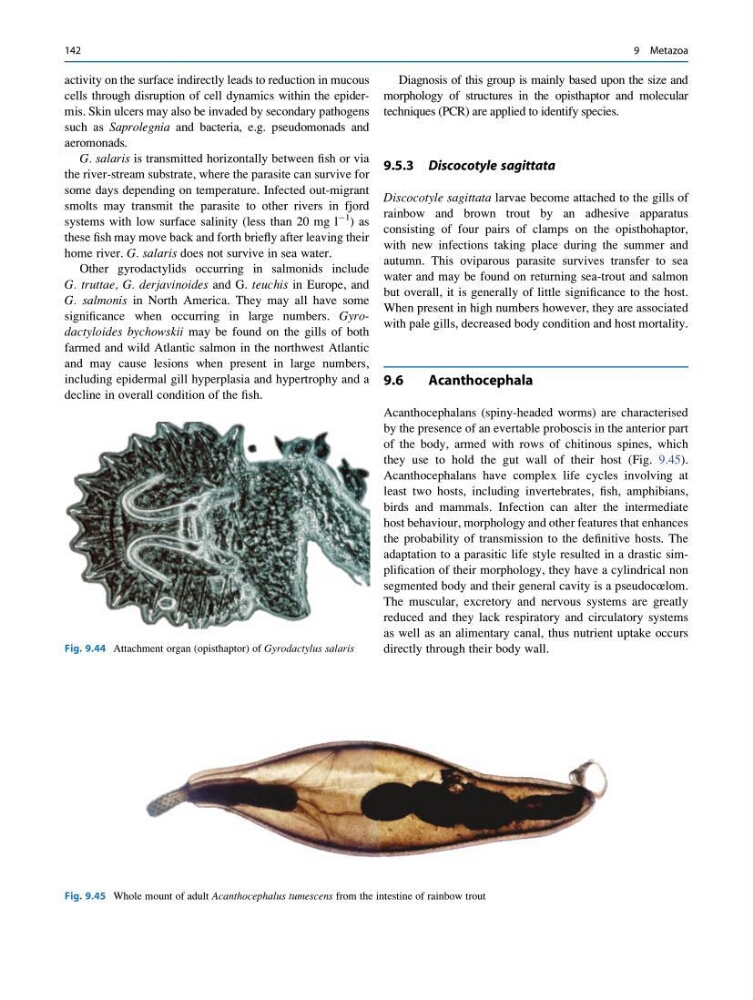
Diagnosis of this group is mainly based upon the size and
morphology of structures in the opisthaptor and molecular
techniques (PCR) are applied to identify species.
9.5.3 Discocotyle sagittata
Discocotyle sagittata larvae become attached to the gills of
rainbow and brown trout by an adhesive apparatus
consisting of four pairs of clamps on the opisthohaptor,
with new infections taking place during the summer and
autumn. This oviparous parasite survives transfer to sea
water and may be found on returning sea-trout and salmon
but overall, it is generally of little significance to the host.
When present in high numbers however, they are associated
with pale gills, decreased body condition and host mortality.
9.6
Acanthocephala
Acanthocephalans (spiny-headed worms) are characterised
by the presence of an evertable proboscis in the anterior part
of the body, armed with rows of chitinous spines, which
they use to hold the gut wall of their host (Fig. 9.45).
Acanthocephalans have complex life cycles involving at
least two hosts, including invertebrates, fish, amphibians,
birds and mammals. Infection can alter the intermediate
host behaviour, morphology and other features that enhances
the probability of transmission to the definitive hosts. The
adaptation to a parasitic life style resulted in a drastic simplification of their morphology, they have a cylindrical non
segmented body and their general cavity is a pseudocœlom.
The muscular, excretory and nervous systems are greatly
reduced and they lack respiratory and circulatory systems
as well as an alimentary canal, thus nutrient uptake occurs
directly through their body wall.
Fig. 9.44 Attachment organ (opisthaptor) of Gyrodactylus salaris
Fig. 9.45 Whole mount of adult Acanthocephalus tumescens from the intestine of rainbow trout
142
9 Metazoa
cells through disruption of cell dynamics within the epidermis. Skin ulcers may also be invaded by secondary pathogens
such as Saprolegnia and bacteria, e.g. pseudomonads and
aeromonads.
G. salaris is transmitted horizontally between fish or via
the river-stream substrate, where the parasite can survive for
some days depending on temperature. Infected out-migrant
smolts may transmit the parasite to other rivers in fjord
systems with low surface salinity (less than 20 mg l
À1 ) as
these fish may move back and forth briefly after leaving their
home river. G. salaris does not survive in sea water.
Other gyrodactylids occurring in salmonids include
G. truttae, G. derjavinoides and G. teuchis in Europe, and
G. salmonis in North America. They may all have some
significance when occurring in large numbers. Gyrodactyloides bychowskii may be found on the gills of both
farmed and wild Atlantic salmon in the northwest Atlantic
and may cause lesions when present in large numbers,
including epidermal gill hyperplasia and hypertrophy and a
decline in overall condition of the fish.
Diagnosis of this group is mainly based upon the size and
morphology of structures in the opisthaptor and molecular
techniques (PCR) are applied to identify species.
9.5.3 Discocotyle sagittata
Discocotyle sagittata larvae become attached to the gills of
rainbow and brown trout by an adhesive apparatus
consisting of four pairs of clamps on the opisthohaptor,
with new infections taking place during the summer and
autumn. This oviparous parasite survives transfer to sea
water and may be found on returning sea-trout and salmon
but overall, it is generally of little significance to the host.
When present in high numbers however, they are associated
with pale gills, decreased body condition and host mortality.
9.6
Acanthocephala
Acanthocephalans (spiny-headed worms) are characterised
by the presence of an evertable proboscis in the anterior part
of the body, armed with rows of chitinous spines, which
they use to hold the gut wall of their host (Fig. 9.45).
Acanthocephalans have complex life cycles involving at
least two hosts, including invertebrates, fish, amphibians,
birds and mammals. Infection can alter the intermediate
host behaviour, morphology and other features that enhances
the probability of transmission to the definitive hosts. The
adaptation to a parasitic life style resulted in a drastic simplification of their morphology, they have a cylindrical non
segmented body and their general cavity is a pseudocœlom.
The muscular, excretory and nervous systems are greatly
reduced and they lack respiratory and circulatory systems
as well as an alimentary canal, thus nutrient uptake occurs
directly through their body wall.
Fig. 9.44 Attachment organ (opisthaptor) of Gyrodactylus salaris
Fig. 9.45 Whole mount of adult Acanthocephalus tumescens from the intestine of rainbow trout
142
9 Metazoa